Florida B.E.S.T. ELA.9.R.1.3
The Standard
Analyze the influence of narrator perspective on a text, explaining how the author creates irony or satire.
Florida B.E.S.T. Standards for English Language Arts
Teacher's field guide
What This Standard Means
What Students Need to Do
- Students identify what the narrator sees, knows, believes, and misses. They compare the narrator’s account with what readers can infer, then explain how that gap creates humor or criticism.
What Mastery Looks Like
- A student selects details that reveal the narrator’s bias, limits, or unreliability. The student explains the gap between the narrator’s view and the reader’s understanding, including its humorous or critical effect.
Common Misconceptions
- Students often treat the narrator as the author. They call any surprise or bad outcome irony and anything funny satire. They may notice a mismatch but not explain how the narrator’s limited or biased view directs criticism.
How to Assess It
- Exit ticket: Read, “Our principal’s brilliant hallway rule made everyone late, but at least the empty classrooms looked orderly,” says a student narrator. Explain how the narrator’s perspective creates irony or satire, and cite two details.
Lesson moves
Ways to Teach It
Give pairs cards labeled narrator says, reader knows, and target of criticism; students sort passage details and justify each match.
Have students rewrite one scene from another character’s viewpoint, then explain in three sentences how the irony or satire changes.
Play Irony Detective with mini passages; teams identify narrator knowledge, reader knowledge, and the satirical target, earning one point per cited clue.
Compare a satirical headline with a straight news headline, then explain how each writer’s voice shapes the reader’s judgment.
Free download
Printable ELA.9.R.1.3 Worksheet
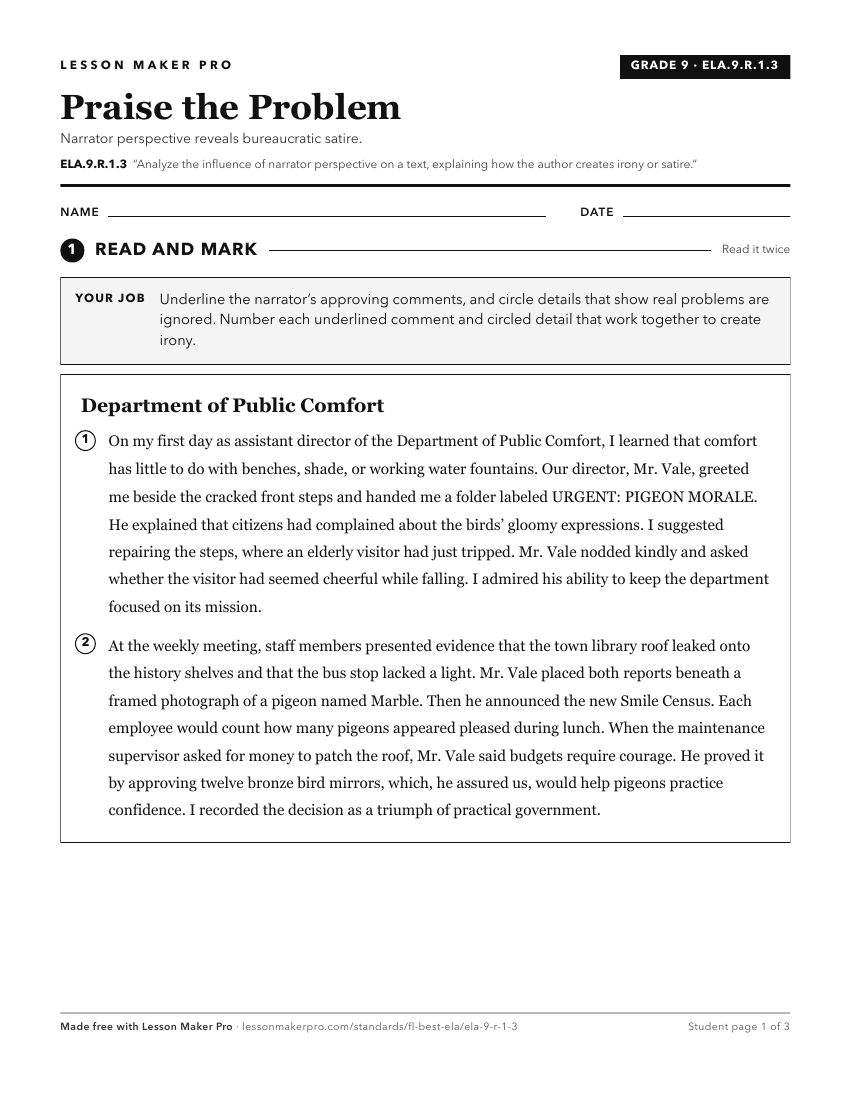
A ready-to-print activity worksheet aligned to ELA.9.R.1.3, with an answer key for the teacher on its own page. No account needed.
PDF, US Letter, prints cleanly in black and white.
Download the worksheetKeep exploring
Related Standards
- ELA.5.R.1.3
Describe how an author develops a character's perspective in a literary text.
- ELA.7.R.1.3
Explain the influence of narrator(s), including unreliable narrator(s), and/or shifts in point of view in a literary text.
- ELA.2.R.1.3
Identify different characters’ perspectives in a literary text.
- ELA.3.R.1.3
Explain different characters' perspectives in a literary text
Turn this exact standard into a lesson
Grade, subject, topic, and the complete standard are prefilled. Create one free, no account needed.
Also for this standard:Make a WorksheetMake a QuizMake a Sub Lesson