Florida B.E.S.T. ELA.1.R.2.4
The Standard
Identify an author's opinion(s) about the topic.
Florida B.E.S.T. Standards for English Language Arts
Teacher's field guide
What This Standard Means
What Students Need to Do
- Students name the topic of a short informational text, then tell what the author thinks or feels about it. They use words or reasons from the text to support their answer.
What Mastery Looks Like
- A student can state the author’s view in a complete sentence. The student can point to a word or reason in the text that supports the answer.
Common Misconceptions
- Students may give their own view instead of the author’s view. They may also mistake a fact, such as “Bees make honey,” for an opinion.
How to Assess It
- Give students this exit ticket: “Our town park is the best place to play because it has shady trees.” Ask, “What does the author think?”
Lesson moves
Ways to Teach It
Give pairs fact and opinion sentence strips about animals, then have them sort the strips and explain each choice.
Read a short text about school lunch, then ask, “What does the author want readers to think about lunch?”
Play Author Says: read one sentence aloud, and students hold up FACT or OPINION cards before naming the author’s view.
Examine two cereal boxes and discuss how words such as “best” or “tasty” show what each company wants buyers to think.
Free download
Printable ELA.1.R.2.4 Worksheet
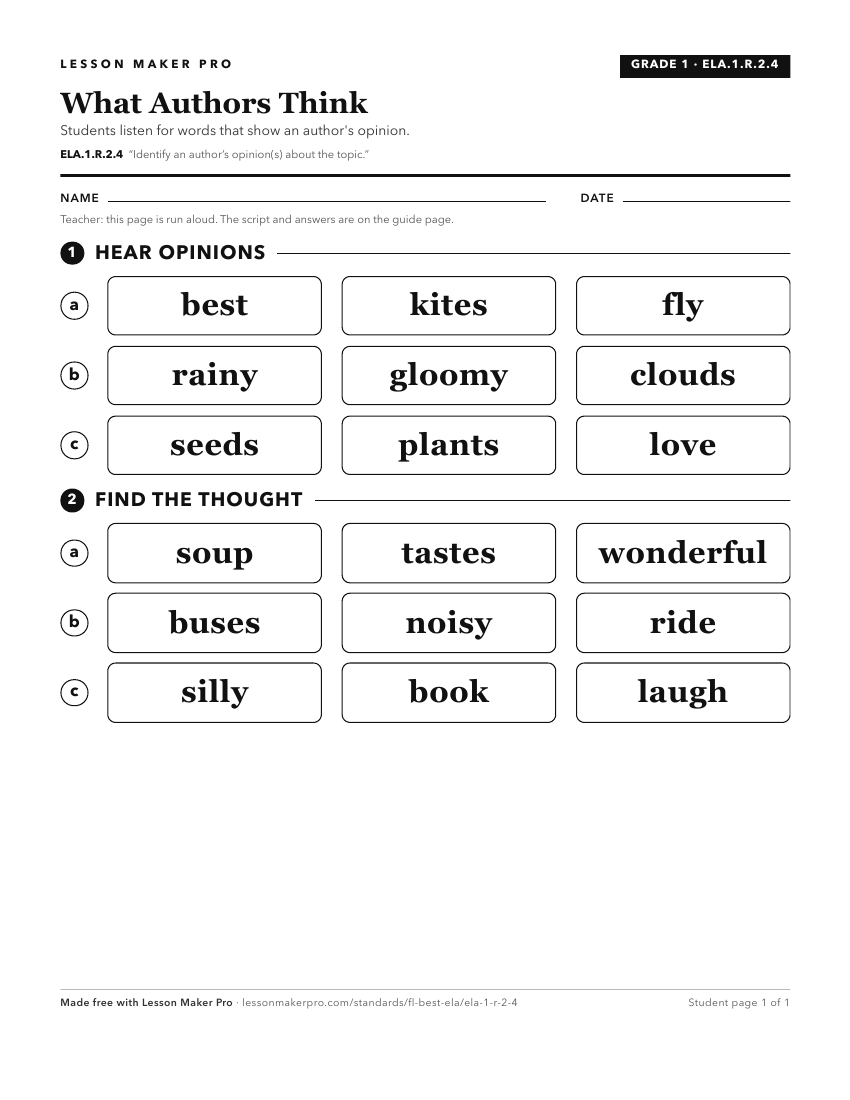
A ready-to-print activity worksheet aligned to ELA.1.R.2.4, with an answer key for the teacher on its own page. No account needed.
PDF, US Letter, prints cleanly in black and white.
Download the worksheetKeep exploring
Related Standards
- ELA.2.R.2.4
Explain an author’s opinion(s) and supporting evidence.
- ELA.4.R.2.3
Explain an author's perspective toward a topic in an informational text.
- ELA.5.R.2.3
Analyze an author's purpose and/or perspective in an informational text.
- ELA.12.R.2.3
Evaluate an author's choices in establishing and achieving purpose(s).
Turn this exact standard into a lesson
Grade, subject, topic, and the complete standard are prefilled. Create one free, no account needed.
Also for this standard:Make a WorksheetMake a QuizMake a Sub Lesson