CCSS.
The Standard
Reason abstractly and quantitatively. Mathematically proficient students make sense of quantities and their relationships in problem situations. They bring two complementary abilities to bear on problems involving quantitative relationships: the ability to decontextualize —to abstract a given situation and represent it symbolically and manipulate the representing symbols as if they have a life of their own, without necessarily attending to their referents—and the ability to contextualize, to pause as needed during the manipulation process in order to probe into the referents for the symbols involved. Quantitative reasoning entails habits of creating a coherent representation of the problem at hand; considering the units involved; attending to the meaning of quantities, not just how to compute them; and knowing and flexibly using different properties of operations and objects.
Common Core State Standards for Mathematics
Teacher's field guide
What This Standard Means
What Students Need to Do
- Students move between a situation and a mathematical representation using numbers, symbols, equations, tables, or diagrams. They explain what quantities mean, track units, and check whether results fit the situation.
What Mastery Looks Like
- Students can turn a situation into an equation or diagram, solve it, and connect the result back to the situation. They name units, explain variables and terms, and reject answers that do not make sense.
Common Misconceptions
- Students may calculate correctly but cannot say what the numbers or symbols represent. They may ignore units or use keywords to choose operations. They may report a remainder, fraction, or negative value that makes no sense in the situation.
How to Assess It
- Exit ticket: Three boxes hold eight pencils each. Ask students to draw a model, write an equation, solve, and label what each number means.
Lesson moves
Ways to Teach It
Give pairs cups and 24 counters; have them model 24 ÷ 6, write an equation, and explain what each number represents.
Have students write a situation for 0.5x + 12, define x, name the units, and explain each term.
Match story cards, diagram cards, and equation cards, then earn a point by explaining how every quantity connects.
Use a grocery receipt to calculate unit prices, label dollars per item, and decide which comparison answers the shopping question.
Free download
Printable CCSS.Math.Practice.MP2 Worksheet
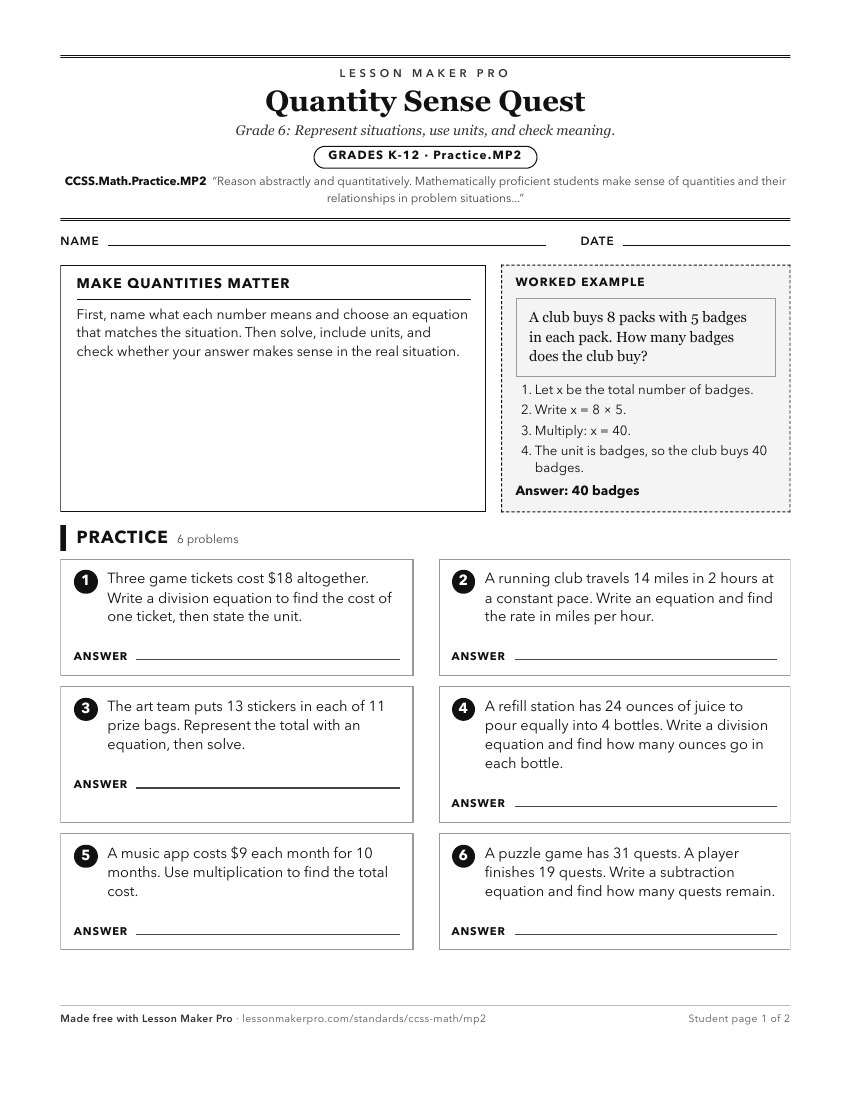
A ready-to-print activity worksheet aligned to CCSS.Math.Practice.MP2, with an answer key for the teacher on its own page. No account needed.
PDF, US Letter, prints cleanly in black and white.
Download the worksheetKeep exploring
Related Standards
- CCSS.Math.Content.7.EE.B.4
Use variables to represent quantities in a real-world or mathematical problem, and construct simple equations and inequalities to solve problems by reasoning ab...
- CCSS.Math.Content.HSN-Q.A
Reason quantitatively and use units to solve problems.
- CCSS.Math.Content.6.EE.C
Represent and analyze quantitative relationships between dependent and independent variables.
- CCSS.Math.Content.8.F.B
Use functions to model relationships between quantities.
Turn this exact standard into a lesson
Grade, subject, topic, and the complete standard are prefilled. Create one free, no account needed.
Also for this standard:Make a WorksheetMake a QuizMake a Sub Lesson