CCSS.
The Standard
Recognize the purposes of and differences among sample surveys, experiments, and observational studies; explain how randomization relates to each.
Common Core State Standards for Mathematics
Teacher's field guide
What This Standard Means
What Students Need to Do
- Students distinguish sample surveys, experiments, and observational studies by how data are collected. They explain that random sampling supports generalizing, while random assignment supports cause-and-effect conclusions.
What Mastery Looks Like
- Given a study description, students correctly name the design and justify their choice. They explain whether results can support generalization, cause and effect, or only an association.
Common Misconceptions
- Students often confuse random sampling with random assignment. They may claim that any study using randomization proves causation, or that an observational study cannot use a random sample.
How to Assess It
- Give this exit ticket: “A school randomly selects 100 students and records their sleep and GPA.” Identify the study type, explain the randomization, and state an allowed conclusion.
Lesson moves
Ways to Teach It
Sort study scenario cards into three labeled hoops, then mark where random sampling or random assignment occurs and what conclusion is allowed.
Discuss whether a survey, experiment, or observational study best answers, “Does later school start time improve attendance?” Defend one choice in writing.
Play Study Design Relay, where teams classify scenario cards, identify the randomization used, and earn a point for naming a valid conclusion.
Analyze a news report about health or education, then identify the study design and check whether the headline overstates the findings.
Free download
Printable HSS-IC.B.3 Worksheet
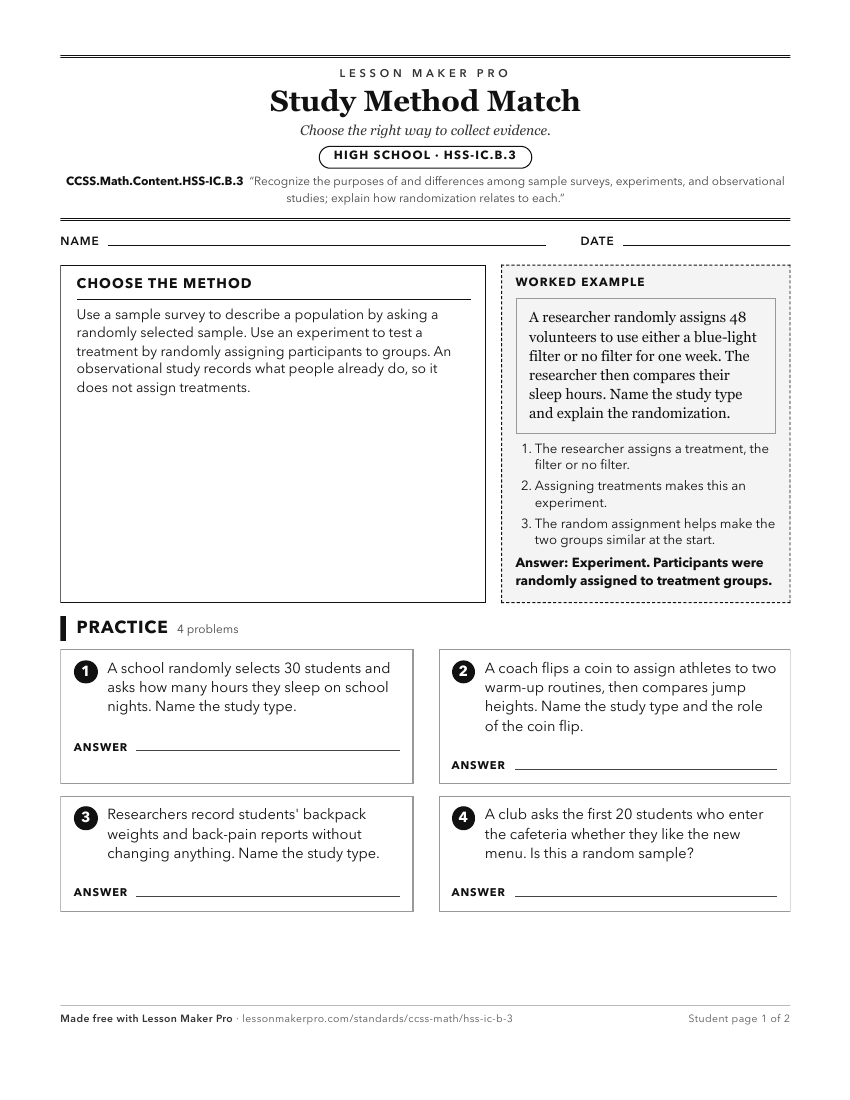
A ready-to-print activity worksheet aligned to CCSS.Math.Content.HSS-IC.B.3, with an answer key for the teacher on its own page. No account needed.
PDF, US Letter, prints cleanly in black and white.
Download the worksheetLearning progression
Where This Standard Sits
Before This Standard
If students are struggling here, check these first.
- CCSS.Math.Content.HSS-IC.A.1
Understanding random samples and population inference supports why surveys generalize, while target adds experiments, observational studies, and randomization roles.
- CCSS.Math.Content.7.SP.A.1
Understanding representative random samples supports explaining random selection in surveys and contrasting it with random assignment in experiments.
- CCSS.Math.Content.HSS-ID.C.9
Knowing correlation is not causation helps students distinguish observational studies from experiments and understand why random assignment supports causal claims.
What This Unlocks
Mastery here sets students up for these next.
- CCSS.Math.Content.HSS-IC.B.6
Knowing study type and randomization helps students judge whether a data report’s conclusions are justified.
- CCSS.Math.Content.HSS-IC.B.5
Understanding experiments and randomization supports comparing treatments and judging whether observed differences are likely due to chance.
Keep exploring
Related Standards
Turn this exact standard into a lesson
Grade, subject, topic, and the complete standard are prefilled. Create one free, no account needed.
Also for this standard:Make a WorksheetMake a QuizMake a Sub Lesson