CCSS.
The Standard
Describe the two-dimensional figures that result from slicing three-dimensional figures, as in plane sections of right rectangular prisms and right rectangular pyramids.
Common Core State Standards for Mathematics · Geometry
Teacher's field guide
What This Standard Means
What Students Need to Do
- Students visualize how a flat cut passes through a rectangular prism or pyramid. They sketch and name the exposed two-dimensional face and explain how the cut’s position and angle determine its shape.
What Mastery Looks Like
- A student can predict and sketch sections from cuts parallel, perpendicular, or angled to a base. They use the faces and edges crossed to justify whether the section is a triangle, rectangle, trapezoid, or another polygon.
Common Misconceptions
- Students may assume every prism section is a rectangle and every pyramid section is a triangle. They may draw the solid’s outer silhouette instead of the cut face. Some think moving or tilting the cutting plane cannot change the shape.
How to Assess It
- Exit ticket: A plane cuts a rectangular prism near one corner, crossing three faces. Sketch and name the section, then explain why it has that shape.
Lesson moves
Ways to Teach It
Build a clay rectangular prism and pyramid, slice each with dental floss at different angles, then trace and name each cut face.
Ask, “Can a slice of a rectangular prism be a triangle?” Students draw evidence and defend their answer using face intersections.
Show section cards and solid cards. Pairs race to match each section to a possible slice, then explain one match.
Study sliced food, such as bread or cheese blocks, and sketch how straight versus angled cuts change the exposed shape.
Free download
Printable 7.G.A.3 Worksheet
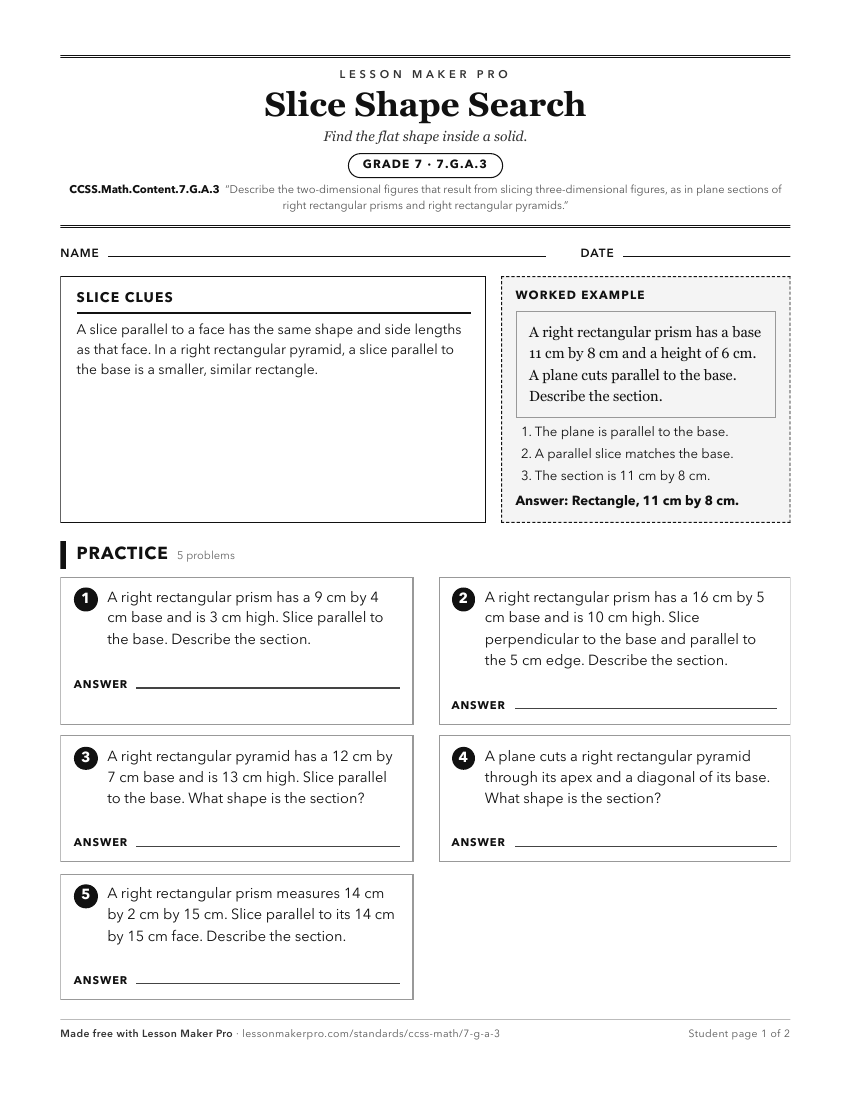
A ready-to-print activity worksheet aligned to CCSS.Math.Content.7.G.A.3, with an answer key for the teacher on its own page. No account needed.
PDF, US Letter, prints cleanly in black and white.
Download the worksheetBefore This Standard
If students are struggling here, check these first.
- CCSS.Math.Content.5.G.B.4
Recognizing and naming plane-section shapes relies on knowing two-dimensional figure properties, though the main new work is spatial slicing.
- CCSS.Math.Content.6.G.A.4
Nets develop visualizing prisms and pyramids as 3D objects with 2D shapes, which supports predicting plane-section shapes.
What This Unlocks
Mastery here sets students up for these next.
Keep exploring
Related Standards
Turn this exact standard into a lesson
Grade, subject, topic, and the complete standard are prefilled. Create one free, no account needed.
Also for this standard:Make a WorksheetMake a QuizMake a Sub Lesson