CCSS.
The Standard
Recognize a statistical question as one that anticipates variability in the data related to the question and accounts for it in the answers.
Common Core State Standards for Mathematics · Statistics and Probability
Teacher's field guide
What This Standard Means
What Students Need to Do
- Students decide whether a question expects data with different values. They identify the group or repeated observations being studied and explain why the answers may vary.
What Mastery Looks Like
- Students correctly classify questions as statistical or nonstatistical. They explain that a statistical question expects multiple data values that may differ.
Common Misconceptions
- Students may think any question involving numbers is statistical. They may also confuse questions with one fixed answer, such as one person’s height, with questions that expect varied data.
How to Assess It
- Give students four questions and ask them to label each statistical or nonstatistical, then explain where variability would appear in one statistical question.
Lesson moves
Ways to Teach It
Give groups question cards to sort into statistical and nonstatistical piles, then have them mark the expected source of variability.
Ask students to rewrite “How many pets do I have?” as a statistical question and explain why the answers could vary.
Play Question Relay, where teams classify projected questions and earn a point only when they justify their choice using expected variability.
Have students design a statistical question about cafeteria wait times, then list the data they would collect across several days.
Free download
Printable 6.SP.A.1 Worksheet
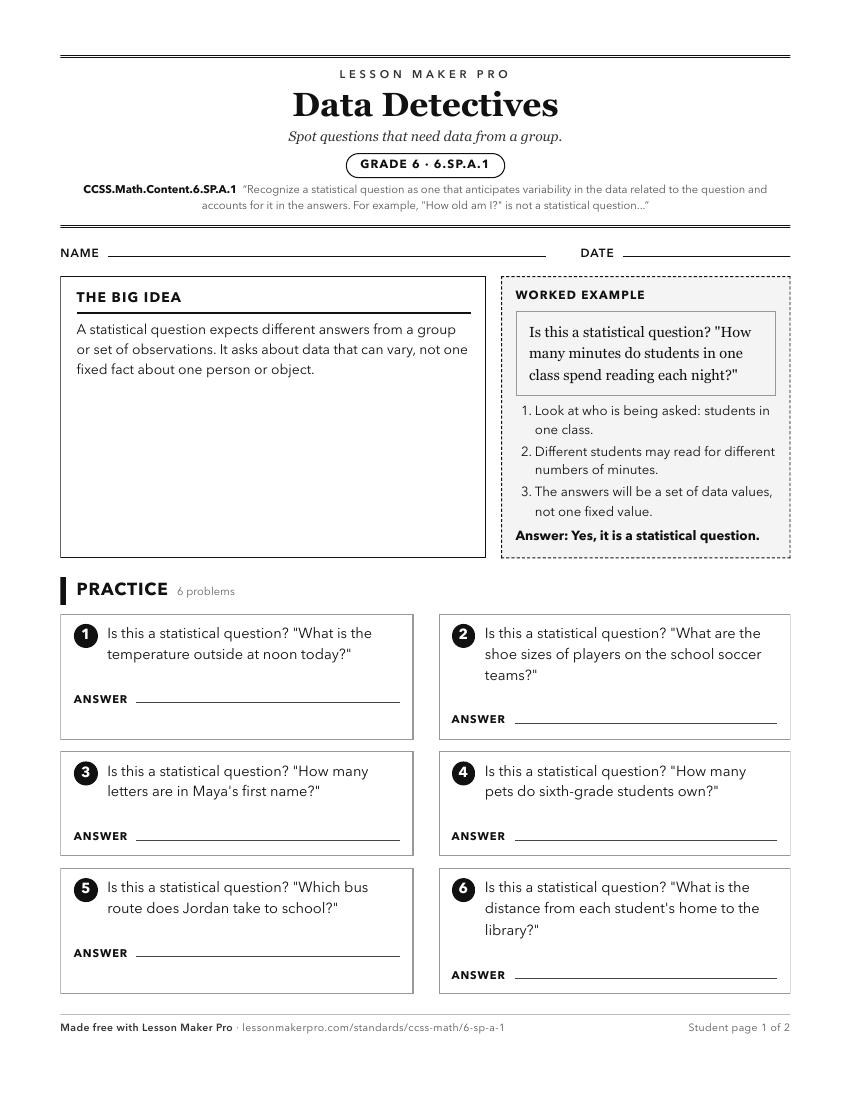
A ready-to-print activity worksheet aligned to CCSS.Math.Content.6.SP.A.1, with an answer key for the teacher on its own page. No account needed.
PDF, US Letter, prints cleanly in black and white.
Download the worksheetLearning progression
Where This Standard Sits
See the whole path on the Statistics & Probability progression map.
Before This Standard
If students are struggling here, check these first.
What This Unlocks
Mastery here sets students up for these next.
- CCSS.Math.Content.7.SP.A.1
Recognizing variability in statistical questions supports understanding why samples vary and why representativeness matters for population inferences.
- CCSS.Math.Content.6.SP.A.2
Recognizing questions that expect variability prepares students to see collected answers as a distribution with center, spread, and shape.
- CCSS.Math.Content.6.SP.B.5b
Recognizing a statistical question helps students identify the varying attribute being measured and describe its measurement context and units.
- CCSS.Math.Content.8.SP.A.4
Recognizing questions with variable data supports understanding why two categorical variables are collected and compared for association.
- CCSS.Math.Content.6.SP.A.3
Recognizing that data vary prepares students to see why data sets need both a typical value and a variation summary.
- CCSS.Math.Content.7.SP.A.2
Anticipating variability in data supports understanding why random samples can differ and why estimates need comparison across samples.
Keep exploring
Related Standards
- CCSS.Math.Content.6.SP.B.5d
Relating the choice of measures of center and variability to the shape of the data distribution and the context in which the data were gathered.
- CCSS.Math.Content.6.SP.B.5c
Giving quantitative measures of center (median and/or mean) and variability (interquartile range and/or mean absolute deviation), as well as describing any over...
- CCSS.Math.Content.6.SP.A
Develop understanding of statistical variability.
Turn this exact standard into a lesson
Grade, subject, topic, and the complete standard are prefilled. Create one free, no account needed.
Also for this standard:Make a WorksheetMake a QuizMake a Sub Lesson