CCSS.
The Standard
Respond thoughtfully to diverse perspectives; synthesize comments, claims, and evidence made on all sides of an issue; resolve contradictions when possible; and determine what additional information or research is required to deepen the investigation or complete the task.
Common Core State Standards for English Language Arts
Teacher's field guide
What This Standard Means
What Students Need to Do
- Students listen closely, identify each speaker’s claim and supporting evidence, and combine ideas from different viewpoints. They address conflicts between claims and name the facts still needed.
What Mastery Looks Like
- Students can accurately summarize several viewpoints and connect claims to evidence. They can reconcile apparent conflicts, explain unresolved disagreements, and name a specific question or source for further research.
Common Misconceptions
- Students may treat responding as simply agreeing or disagreeing. They may list viewpoints without connecting them, ignore conflicting evidence, or request vague “more research” without naming what is missing.
How to Assess It
- Give students a short transcript with three viewpoints. Ask them to identify one agreement, one conflict, a reasonable conclusion, and one specific source needed next.
Lesson moves
Ways to Teach It
Give groups color-coded claim and evidence cards from four speakers, then have them sort agreements, conflicts, and unanswered questions.
After a seminar, ask students to write which viewpoints fit together, where they conflict, and what source could clarify the issue.
Play Evidence Gap, where teams score by identifying an unsupported claim and naming the exact evidence needed to test it.
Use a school phone policy proposal, assign stakeholder statements, and have students draft a recommendation that accounts for each viewpoint.
Free download
Printable SL.11-12.1d Worksheet
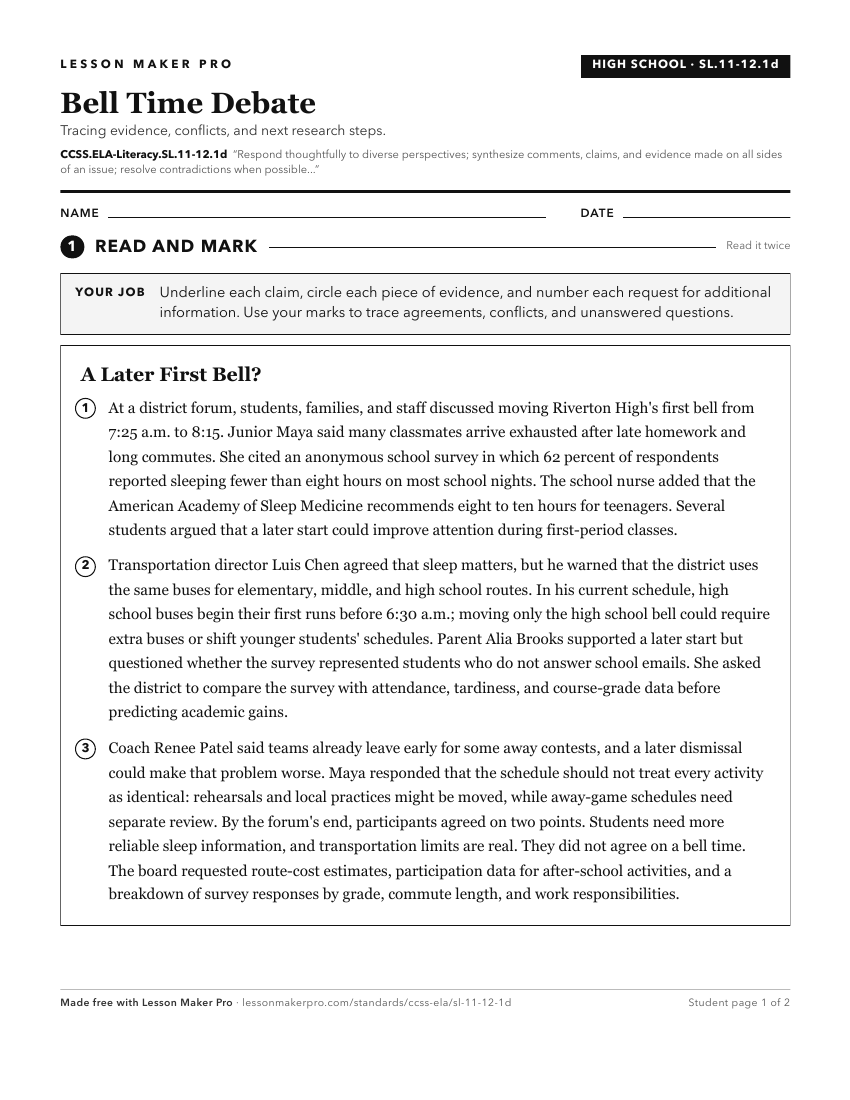
A ready-to-print activity worksheet aligned to CCSS.ELA-Literacy.SL.11-12.1d, with an answer key for the teacher on its own page. No account needed.
PDF, US Letter, prints cleanly in black and white.
Download the worksheetLearning progression
Where This Standard Sits
Before This Standard
If students are struggling here, check these first.
Keep exploring
Related Standards
- CCSS.ELA-Literacy.RH.11-12.9
Integrate information from diverse sources, both primary and secondary, into a coherent understanding of an idea or event, noting discrepancies among sources.
- CCSS.ELA-Literacy.RST.11-12.9
Synthesize information from a range of sources (e.g., texts, experiments, simulations) into a coherent understanding of a process, phenomenon, or concept, resol...
- CCSS.ELA-Literacy.SL.11-12.1c
Propel conversations by posing and responding to questions that probe reasoning and evidence; ensure a hearing for a full range of positions on a topic or issue...
Turn this exact standard into a lesson
Grade, subject, topic, and the complete standard are prefilled. Create one free, no account needed.
Also for this standard:Make a WorksheetMake a QuizMake a Sub Lesson