CCSS.
The Standard
Integrate information from diverse sources, both primary and secondary, into a coherent understanding of an idea or event, noting discrepancies among sources.
Common Core State Standards for English Language Arts · Reading Standards for Literacy in History/Social Studies 6—12
Teacher's field guide
What This Standard Means
What Students Need to Do
- Students compare primary and secondary accounts of the same historical issue or event. They combine supported details into one explanation and point out where sources disagree.
What Mastery Looks Like
- A student selects relevant evidence from several source types, explains how the pieces fit, and cites each source accurately. The student identifies conflicting dates, causes, perspectives, or claims without forcing a false agreement.
Common Misconceptions
- Students may summarize each source separately instead of building one account. They may assume a primary source is automatically more reliable, or ignore differences as minor. Some treat any disagreement as proof that one source is false.
How to Assess It
- Give students three short accounts of the same event. Ask them to explain what most likely happened, use evidence from all three, and identify one discrepancy.
Lesson moves
Ways to Teach It
Set up source stations with a speech, photograph, newspaper report, and textbook excerpt; students sort details into agreements, conflicts, and unique evidence.
Ask students to write: Which source best explains the event, and how does one conflicting detail affect your conclusion?
Play Source Match: teams pair claim cards with evidence cards, then earn a point for identifying a contradiction another team missed.
Compare local news reports and an official statement about one recent event, then build a timeline that labels disputed details.
Free download
Printable RH.11-12.9 Worksheet
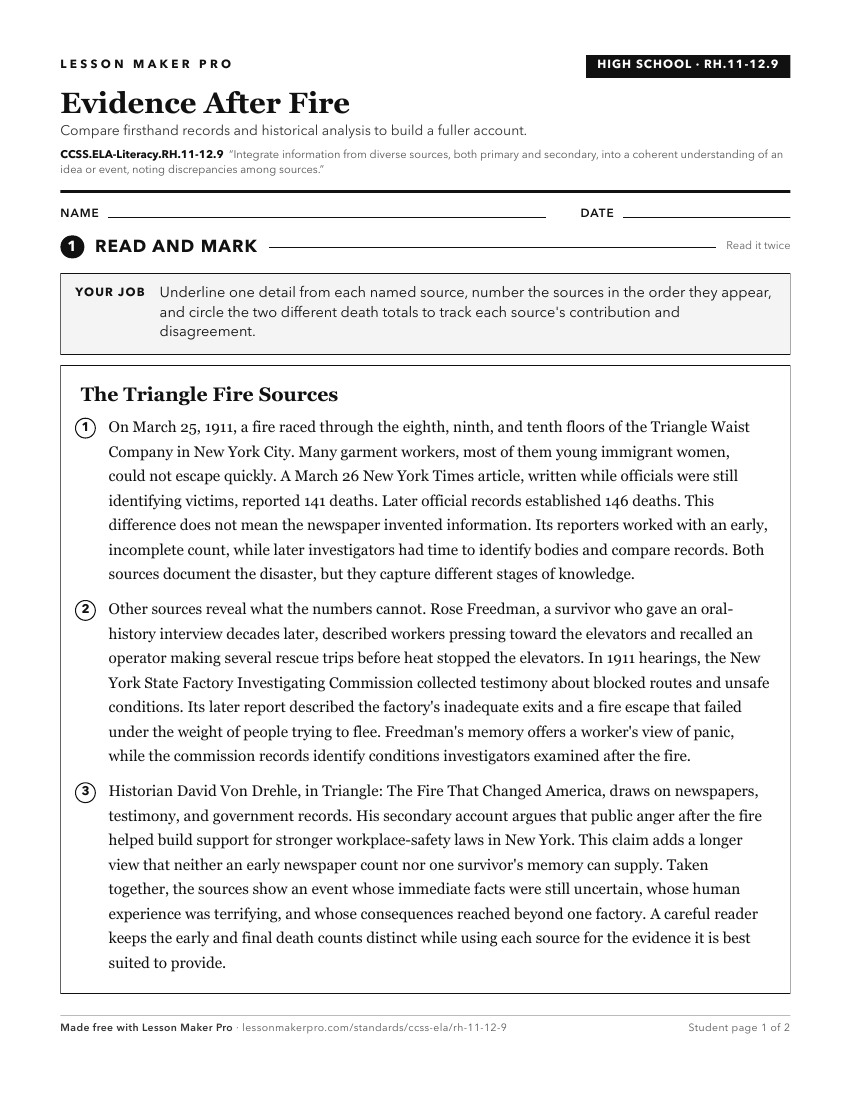
A ready-to-print activity worksheet aligned to CCSS.ELA-Literacy.RH.11-12.9, with an answer key for the teacher on its own page. No account needed.
PDF, US Letter, prints cleanly in black and white.
Download the worksheetLearning progression
Where This Standard Sits
See the whole path on the Reading: History/Social Studies progression map.
Before This Standard
If students are struggling here, check these first.
Keep exploring
Related Standards
- CCSS.ELA-Literacy.RI.6.7
Integrate information presented in different media or formats (e.g., visually, quantitatively) as well as in words to develop a coherent understanding of a topi...
- CCSS.ELA-Literacy.SL.11-12.2
Integrate multiple sources of information presented in diverse formats and media (e.g., visually, quantitatively, orally) in order to make informed decisions an...
- CCSS.ELA-Literacy.SL.9-10.2
Integrate multiple sources of information presented in diverse media or formats (e.g., visually, quantitatively, orally) evaluating the credibility and accuracy...
- CCSS.ELA-Literacy.RH.11-12.7
Integrate and evaluate multiple sources of information presented in diverse formats and media (e.g., visually, quantitatively, as well as in words) in order to ...
Turn this exact standard into a lesson
Grade, subject, topic, and the complete standard are prefilled. Create one free, no account needed.
Also for this standard:Make a WorksheetMake a QuizMake a Sub Lesson