CCSS.
The Standard
Integrate multiple sources of information presented in diverse formats and media (e.g., visually, quantitatively, orally) in order to make informed decisions and solve problems, evaluating the credibility and accuracy of each source and noting any discrepancies among the data.
Common Core State Standards for English Language Arts · Speaking and Listening Standards
Teacher's field guide
What This Standard Means
What Students Need to Do
- Students combine evidence from texts, charts, images, audio, or video to make a decision or solve a problem. They check each source for accuracy and credibility, then explain conflicts among the sources.
What Mastery Looks Like
- Students make a clear decision using evidence from several formats. They explain why particular sources are trustworthy, check whether claims match the data, and address conflicting information.
Common Misconceptions
- Students may treat every source as equally reliable or choose the most polished source. They may list differences without deciding whether the differences affect the conclusion.
How to Assess It
- Give students a graph, interview transcript, and news excerpt about school start times. Ask them to recommend a schedule, use all three sources, identify one conflict, and explain which source is most reliable.
Lesson moves
Ways to Teach It
Place source cards around the room, then have groups sort them by credibility and build one evidence-based recommendation.
Ask students to write which source they would trust most when sources disagree and explain their choice using specific evidence.
Play Source Showdown, where pairs compare two sources and earn points for spotting bias, missing evidence, or unsupported claims.
Have students compare a phone plan advertisement, pricing chart, and customer review before recommending the best plan for a given budget.
Free download
Printable SL.11-12.2 Worksheet
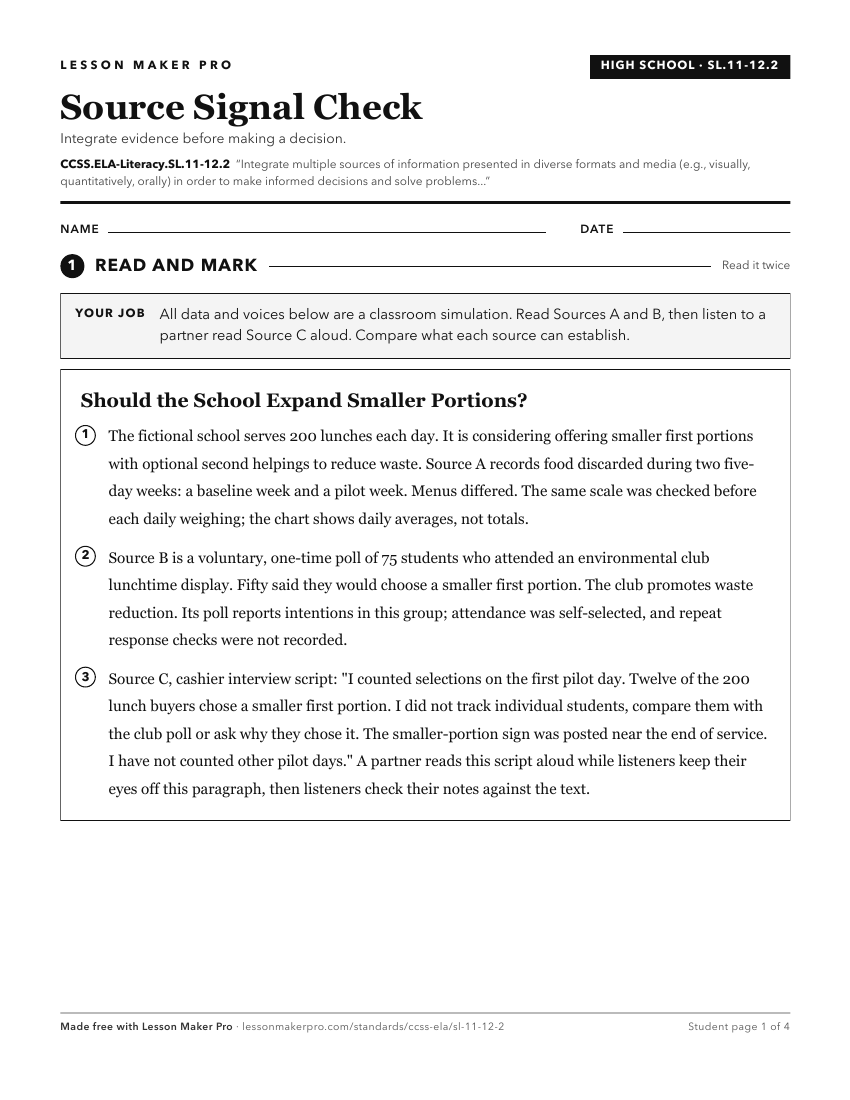
A ready-to-print activity worksheet aligned to CCSS.ELA-Literacy.SL.11-12.2, with an answer key for the teacher on its own page. No account needed.
PDF, US Letter, prints cleanly in black and white.
Download the worksheetLearning progression
Where This Standard Sits
See the whole path on the Speaking & Listening progression map.
Before This Standard
If students are struggling here, check these first.
Keep exploring
Related Standards
- CCSS.ELA-Literacy.RST.11-12.7
Integrate and evaluate multiple sources of information presented in diverse formats and media (e.g., quantitative data, video, multimedia) in order to address a...
- CCSS.ELA-Literacy.RI.11-12.7
Integrate and evaluate multiple sources of information presented in different media or formats (e.g., visually, quantitatively) as well as in words in order to ...
- CCSS.ELA-Literacy.RH.11-12.7
Integrate and evaluate multiple sources of information presented in diverse formats and media (e.g., visually, quantitatively, as well as in words) in order to ...
Turn this exact standard into a lesson
Grade, subject, topic, and the complete standard are prefilled. Create one free, no account needed.
Also for this standard:Make a WorksheetMake a QuizMake a Sub Lesson