CCSS.
The Standard
Synthesize information from a range of sources (e.g., texts, experiments, simulations) into a coherent understanding of a process, phenomenon, or concept, resolving conflicting information when possible.
Common Core State Standards for English Language Arts · Reading Standards for Literacy in Science and Technical Subjects 6—12
Teacher's field guide
What This Standard Means
What Students Need to Do
- Students combine details from articles, lab results, graphs, and simulations to build one clear explanation. They compare disagreements, decide which evidence is better supported, and name conflicts that cannot be settled.
What Mastery Looks Like
- A student can explain a scientific process or concept using accurate evidence from several source types. The explanation connects the evidence, addresses contradictions, and avoids simply listing source summaries.
Common Misconceptions
- Students often summarize each source separately instead of connecting them. They may treat all sources as equally reliable, ignore conflicting results, or force agreement when the evidence remains uncertain.
How to Assess It
- Give students two short passages and a data table about the same phenomenon, including one conflicting result. Ask them to write one paragraph that uses all three sources and explains the conflict.
Lesson moves
Ways to Teach It
Give groups printed evidence cards from an article, experiment, and simulation; students sort them into agreements, conflicts, and unanswered questions.
Ask, “Which source best explains the result, and what makes it more convincing?” Students write a claim using evidence from every source.
Play Source Showdown: teams compare two evidence sets, choose the stronger explanation, and earn a point only after addressing a contradiction.
Compare a weather forecast, radar map, and local temperature log, then explain why predictions changed and which evidence supports the update.
Free download
Printable RST.11-12.9 Worksheet
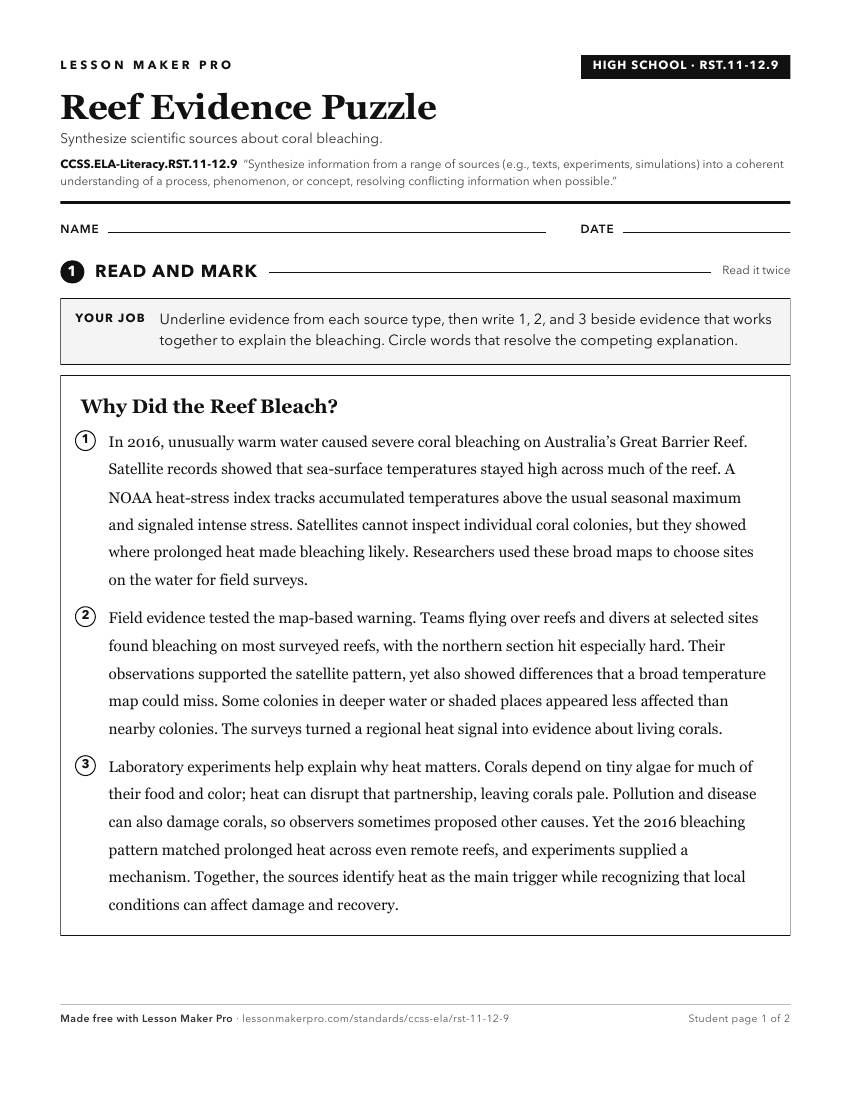
A ready-to-print activity worksheet aligned to CCSS.ELA-Literacy.RST.11-12.9, with an answer key for the teacher on its own page. No account needed.
PDF, US Letter, prints cleanly in black and white.
Download the worksheetLearning progression
Where This Standard Sits
See the whole path on the Reading: Science & Technical Subjects progression map.
Before This Standard
If students are struggling here, check these first.
Keep exploring
Related Standards
- CCSS.ELA-Literacy.RI.6.7
Integrate information presented in different media or formats (e.g., visually, quantitatively) as well as in words to develop a coherent understanding of a topi...
- CCSS.ELA-Literacy.RH.11-12.9
Integrate information from diverse sources, both primary and secondary, into a coherent understanding of an idea or event, noting discrepancies among sources.
- CCSS.ELA-Literacy.SL.11-12.2
Integrate multiple sources of information presented in diverse formats and media (e.g., visually, quantitatively, orally) in order to make informed decisions an...
- CCSS.ELA-Literacy.RH.11-12.7
Integrate and evaluate multiple sources of information presented in diverse formats and media (e.g., visually, quantitatively, as well as in words) in order to ...
Turn this exact standard into a lesson
Grade, subject, topic, and the complete standard are prefilled. Create one free, no account needed.
Also for this standard:Make a WorksheetMake a QuizMake a Sub Lesson