CCSS.
The Standard
Compare and contrast findings presented in a text to those from other sources (including their own experiments), noting when the findings support or contradict previous explanations or accounts.
Common Core State Standards for English Language Arts · Reading Standards for Literacy in Science and Technical Subjects 6—12
Teacher's field guide
What This Standard Means
What Students Need to Do
- Students compare findings in a science or technical text with findings from another source or their own investigation. They identify where results agree, conflict, or cannot be fairly compared.
What Mastery Looks Like
- Students cite specific findings from each source and state whether they support or contradict one another. They also explain how differences in methods, samples, or conditions may affect the comparison.
Common Misconceptions
- Students may treat sources about the same topic as agreeing, even when their findings differ. They may compare conclusions without citing data, or call different results contradictory when methods or conditions are not comparable.
How to Assess It
- Exit ticket: Read a short published conclusion and a class data table. Identify one point of support or contradiction, then cite evidence from both sources.
Lesson moves
Ways to Teach It
Conduct a ramp experiment, then annotate where class results agree or disagree with a textbook statement about motion.
Write a response to this prompt: Which source has stronger support for its finding? Cite one detail from each source.
Sort evidence cards into Supports, Contradicts, or Not Comparable, then defend one placement to a partner.
Compare a nutrition label claim with data from an independent consumer test, noting matching and conflicting findings.
Free download
Printable RST.9-10.9 Worksheet
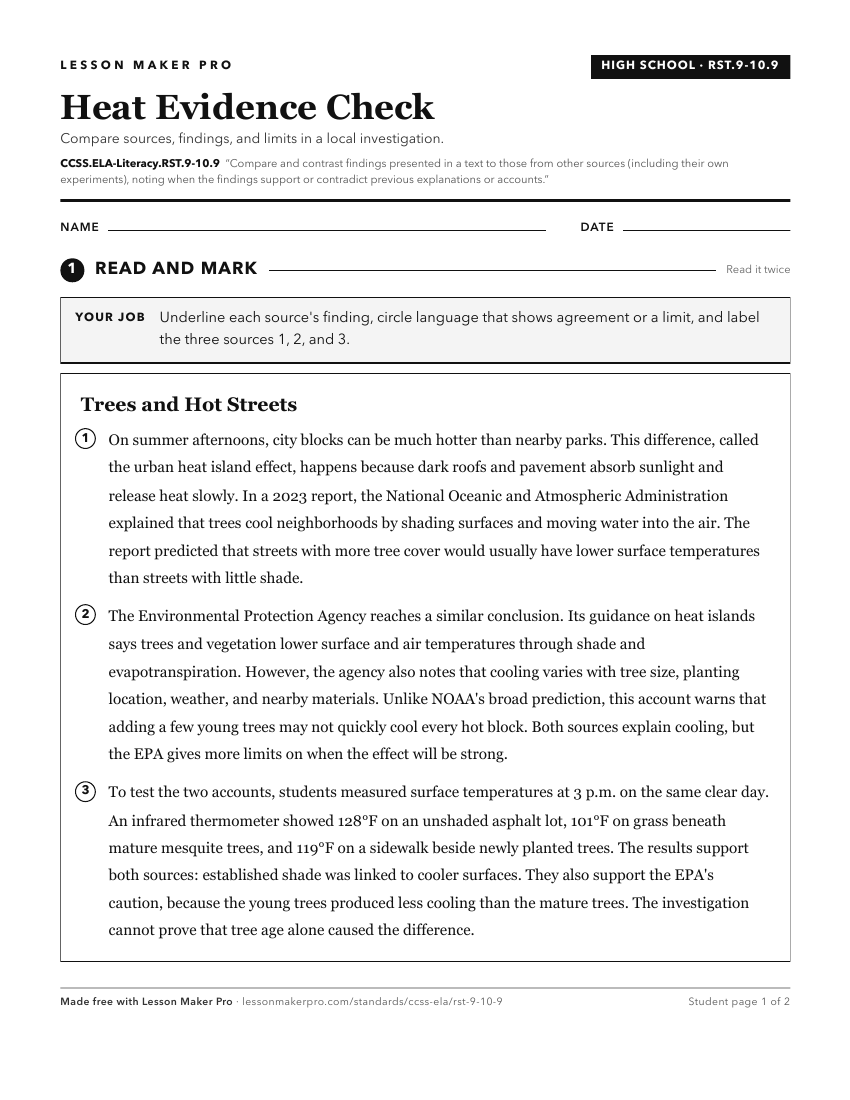
A ready-to-print activity worksheet aligned to CCSS.ELA-Literacy.RST.9-10.9, with an answer key for the teacher on its own page. No account needed.
PDF, US Letter, prints cleanly in black and white.
Download the worksheetLearning progression
Where This Standard Sits
See the whole path on the Reading: Science & Technical Subjects progression map.
What This Unlocks
Mastery here sets students up for these next.
Keep exploring
Related Standards
- CCSS.ELA-Literacy.RST.11-12.8
Evaluate the hypotheses, data, analysis, and conclusions in a science or technical text, verifying the data when possible and corroborating or challenging concl...
- CCSS.ELA-Literacy.RST.6-8.9
Compare and contrast the information gained from experiments, simulations, video, or multimedia sources with that gained from reading a text on the same topic.
- CCSS.ELA-Literacy.RST.11-12.1
Cite specific textual evidence to support analysis of science and technical texts, attending to important distinctions the author makes and to any gaps or incon...
- CCSS.ELA-Literacy.RI.2.9
Compare and contrast the most important points presented by two texts on the same topic.
Turn this exact standard into a lesson
Grade, subject, topic, and the complete standard are prefilled. Create one free, no account needed.
Also for this standard:Make a WorksheetMake a QuizMake a Sub Lesson