CCSS.
The Standard
Cite specific textual evidence to support analysis of science and technical texts, attending to important distinctions the author makes and to any gaps or inconsistencies in the account.
Common Core State Standards for English Language Arts · Reading Standards for Literacy in Science and Technical Subjects 6—12
Teacher's field guide
What This Standard Means
What Students Need to Do
- Students analyze a science or technical text, make a clear claim, and select exact details or data that support it. They also track qualifications, distinctions, missing support, and contradictions in the author’s account.
What Mastery Looks Like
- A student can write a clear analysis and support it with the most relevant sentence, detail, or data point. The student can explain a distinction the author makes and flag a gap or contradiction without misreading a qualification.
Common Misconceptions
- Students may copy a long quotation without explaining how it supports their claim. They may overlook words such as “may,” “often,” or “under certain conditions.” They may also confuse missing evidence with evidence that directly contradicts the author.
How to Assess It
- Give students a short lab report with one unsupported conclusion. Ask them to cite one strong piece of evidence and identify the unsupported conclusion in two sentences.
Lesson moves
Ways to Teach It
Give pairs a printed lab report and three highlighters to mark claims, supporting evidence, and gaps or conflicting details.
Ask students to write: “What distinction does the author make, and which exact words show it?”
Play Evidence Match by having teams pair analysis claims with quotation cards, then reject evidence that is weak or unrelated.
Compare a health infographic with its cited source, then identify one claim that is supported, qualified, or overstated.
Free download
Printable RST.11-12.1 Worksheet
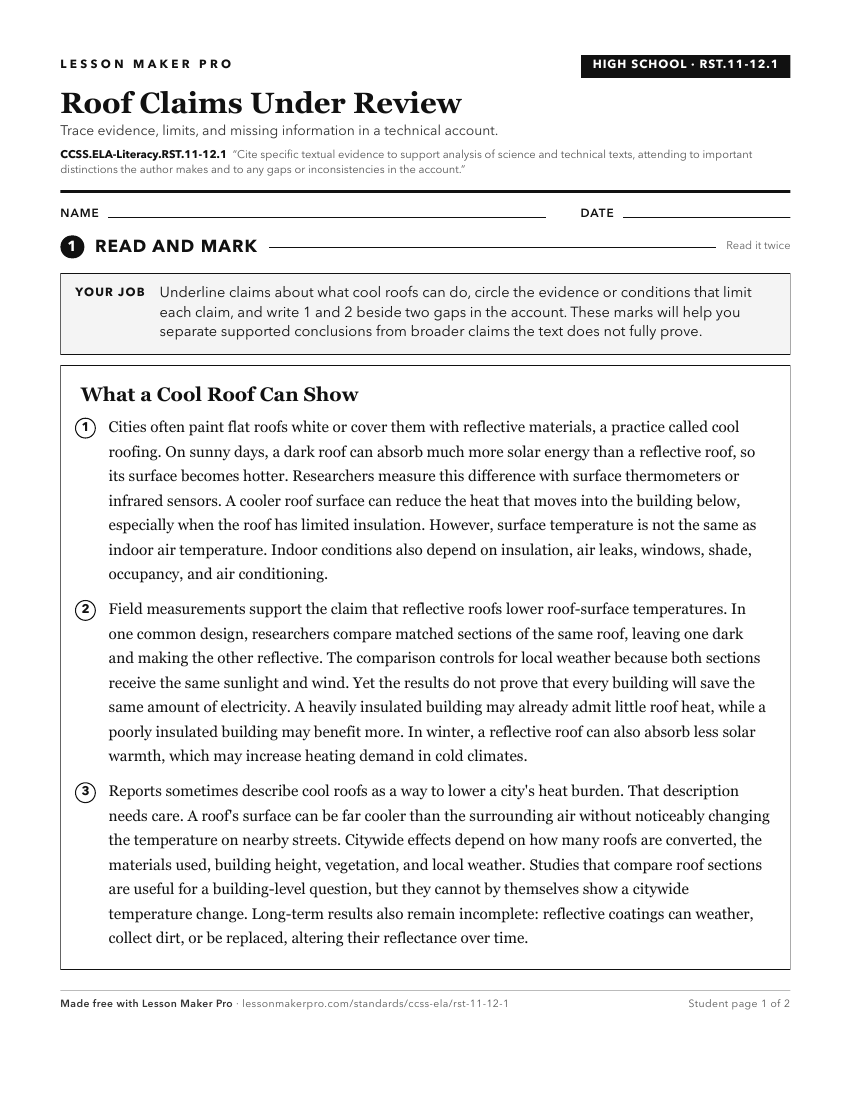
A ready-to-print activity worksheet aligned to CCSS.ELA-Literacy.RST.11-12.1, with an answer key for the teacher on its own page. No account needed.
PDF, US Letter, prints cleanly in black and white.
Download the worksheetLearning progression
Where This Standard Sits
See the whole path on the Reading: Science & Technical Subjects progression map.
Before This Standard
If students are struggling here, check these first.
Keep exploring
Related Standards
- CCSS.ELA-Literacy.RH.9-10.1
Cite specific textual evidence to support analysis of primary and secondary sources, attending to such features as the date and origin of the information.
- CCSS.ELA-Literacy.RI.6.1
Cite textual evidence to support analysis of what the text says explicitly as well as inferences drawn from the text.
- CCSS.ELA-Literacy.RST.6-8.1
Cite specific textual evidence to support analysis of science and technical texts.
Turn this exact standard into a lesson
Grade, subject, topic, and the complete standard are prefilled. Create one free, no account needed.
Also for this standard:Make a WorksheetMake a QuizMake a Sub Lesson