CCSS.
The Standard
Evaluate the hypotheses, data, analysis, and conclusions in a science or technical text, verifying the data when possible and corroborating or challenging conclusions with other sources of information.
Common Core State Standards for English Language Arts · Reading Standards for Literacy in Science and Technical Subjects 6—12
Teacher's field guide
What This Standard Means
What Students Need to Do
- Students separate an author’s proposed explanation, evidence, reasoning, and final claims. They check whether the numbers support the claims and compare the text with other reliable sources.
What Mastery Looks Like
- Students can explain how the evidence connects to the author’s claims and spot gaps in the reasoning. They can check calculations or trends and use a reliable source to support or challenge the conclusion.
Common Misconceptions
- Students may treat an expert’s title or a polished graph as proof. They may confuse correlation with causation, ignore sample size, or accept any source that agrees with the author.
How to Assess It
- Exit ticket: Provide a short report with a data table. Ask students to check one calculation, identify one unsupported claim, and name evidence needed from another source.
Lesson moves
Ways to Teach It
Give pairs a printed research summary, calculators, and highlighters to mark claims, check one calculation, and flag unsupported conclusions.
Write one paragraph answering: Does the evidence justify the author’s conclusion, and what outside source strengthens or weakens it?
Use claim, evidence, and reasoning cards; teams race to build valid sets and explain why leftover cards do not fit.
Compare a news report about a medical study with the original study and a second reliable source, then list differences in their conclusions.
Free download
Printable RST.11-12.8 Worksheet
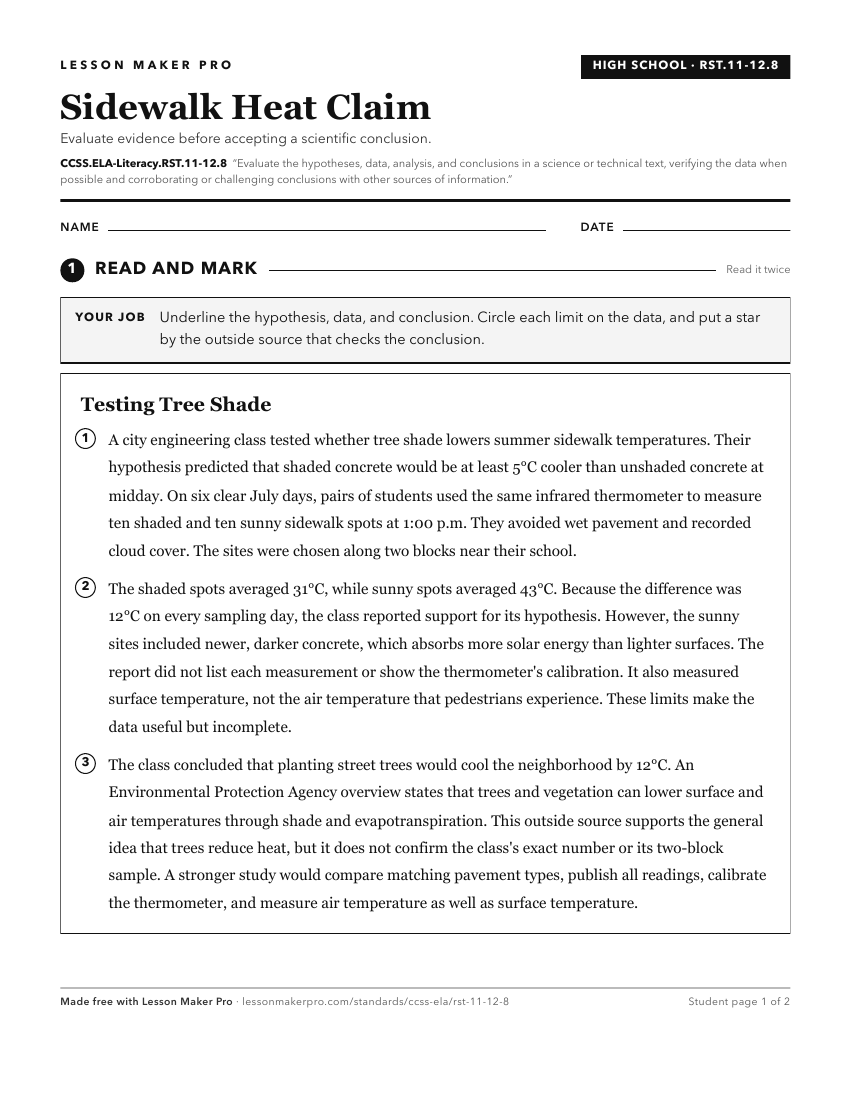
A ready-to-print activity worksheet aligned to CCSS.ELA-Literacy.RST.11-12.8, with an answer key for the teacher on its own page. No account needed.
PDF, US Letter, prints cleanly in black and white.
Download the worksheetLearning progression
Where This Standard Sits
See the whole path on the Reading: Science & Technical Subjects progression map.
Before This Standard
If students are struggling here, check these first.
Keep exploring
Related Standards
- CCSS.ELA-Literacy.RH.11-12.8
Evaluate an author's premises, claims, and evidence by corroborating or challenging them with other information.
- CCSS.ELA-Literacy.RST.11-12.1
Cite specific textual evidence to support analysis of science and technical texts, attending to important distinctions the author makes and to any gaps or incon...
- CCSS.ELA-Literacy.RST.9-10.9
Compare and contrast findings presented in a text to those from other sources (including their own experiments), noting when the findings support or contradict ...
Turn this exact standard into a lesson
Grade, subject, topic, and the complete standard are prefilled. Create one free, no account needed.
Also for this standard:Make a WorksheetMake a QuizMake a Sub Lesson