CCSS.
The Standard
Assess the extent to which the reasoning and evidence in a text support the author's claim or a recommendation for solving a scientific or technical problem.
Common Core State Standards for English Language Arts · Reading Standards for Literacy in Science and Technical Subjects 6—12
Teacher's field guide
What This Standard Means
What Students Need to Do
- Students break a scientific or technical argument into its claim, reasons, and evidence. They judge how well the evidence supports the conclusion or proposed solution and point out missing, weak, or irrelevant support.
What Mastery Looks Like
- Students identify the main claim or proposed solution, trace the author’s reasoning, and judge the quality and relevance of the evidence. They explain whether the evidence fully, partly, or weakly supports the conclusion.
Common Misconceptions
- Students may treat any fact, statistic, or expert quote as strong evidence without checking relevance or reliability. They may identify a claim but skip gaps in reasoning, weak assumptions, or evidence that supports only part of a recommendation.
How to Assess It
- Give students a short technical passage and ask: “Rate the author’s claim as fully, partly, or weakly supported. Cite two details and explain your rating.”
Lesson moves
Ways to Teach It
Give groups claim, evidence, and reasoning cards from a science article, then have them arrange and label strong, weak, or irrelevant links.
Ask students to write: “Which piece of evidence best supports the recommendation, and what missing evidence would make it stronger?”
Run an evidence ranking game where teams score four details for relevance, reliability, and sufficiency, then defend their highest score.
Compare two online recommendations about reducing household energy use, then judge which one uses stronger data and clearer reasoning.
Free download
Printable RST.9-10.8 Worksheet
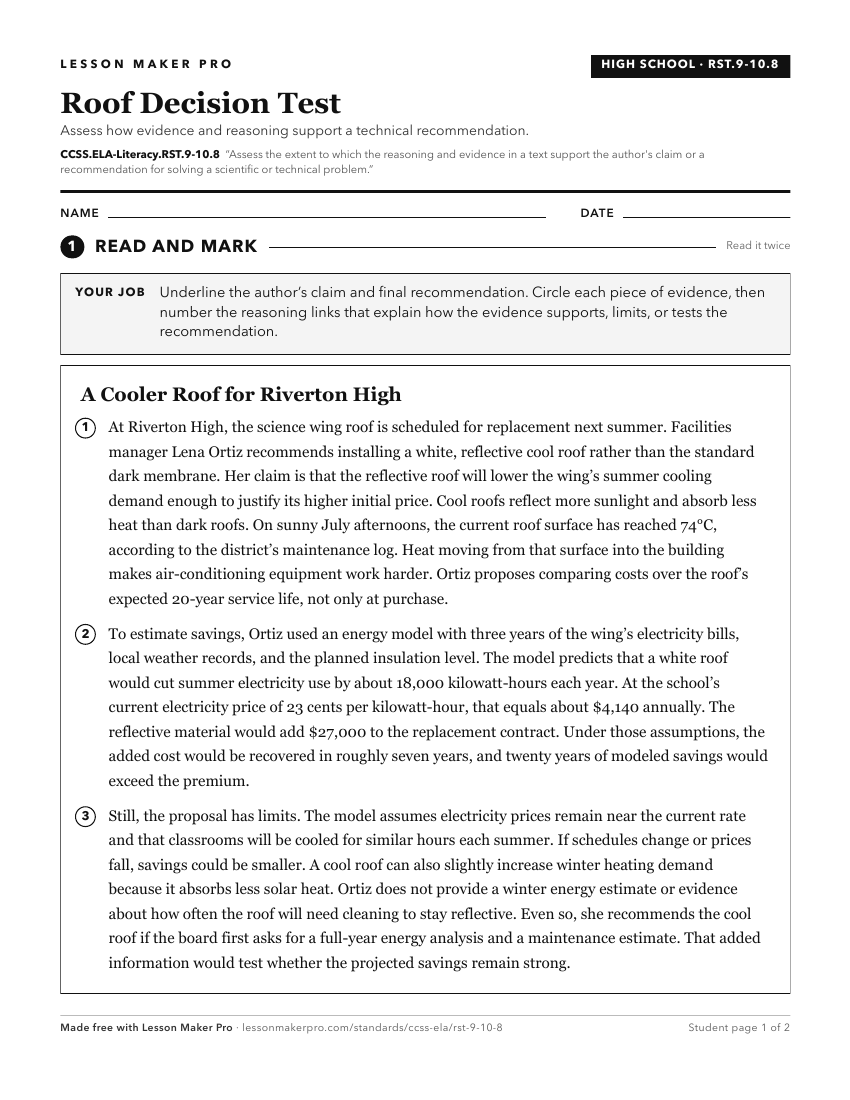
A ready-to-print activity worksheet aligned to CCSS.ELA-Literacy.RST.9-10.8, with an answer key for the teacher on its own page. No account needed.
PDF, US Letter, prints cleanly in black and white.
Download the worksheetLearning progression
Where This Standard Sits
See the whole path on the Reading: Science & Technical Subjects progression map.
What This Unlocks
Mastery here sets students up for these next.
Keep exploring
Related Standards
- CCSS.ELA-Literacy.RH.9-10.8
Assess the extent to which the reasoning and evidence in a text support the author's claims.
- CCSS.ELA-Literacy.RST.11-12.1
Cite specific textual evidence to support analysis of science and technical texts, attending to important distinctions the author makes and to any gaps or incon...
- CCSS.ELA-Literacy.RST.6-8.1
Cite specific textual evidence to support analysis of science and technical texts.
Turn this exact standard into a lesson
Grade, subject, topic, and the complete standard are prefilled. Create one free, no account needed.
Also for this standard:Make a WorksheetMake a QuizMake a Sub Lesson