CCSS.
The Standard
Assess the extent to which the reasoning and evidence in a text support the author's claims.
Common Core State Standards for English Language Arts · Reading Standards for Literacy in History/Social Studies 6—12
Teacher's field guide
What This Standard Means
What Students Need to Do
- Students identify an author’s claims, reasons, and supporting evidence in a history or social studies text. They judge whether the evidence is relevant, reliable, and sufficient to support each claim.
What Mastery Looks Like
- Students can label claims, reasons, and evidence in a historical argument. They can judge a claim as well supported, partly supported, or unsupported and cite details that explain their rating.
Common Misconceptions
- Students may treat any fact or quotation as strong evidence, even when it does not address the claim. They may also assume that more evidence means better support or that a primary source is automatically reliable.
How to Assess It
- Use an exit ticket with one claim and three evidence statements. Ask students to rank the evidence from strongest to weakest and justify the top choice.
Lesson moves
Ways to Teach It
Give groups claim and evidence cards from a historical argument, then have them sort each piece as strong, weak, or irrelevant support.
Ask students to write: Which claim is best supported, and what specific evidence makes it stronger than the others?
Run an evidence ranking game where teams score quotations for relevance, reliability, and sufficiency, then defend their scores.
Compare a news post about a current policy with its linked source, checking whether the source actually supports the post’s claim.
Free download
Printable RH.9-10.8 Worksheet
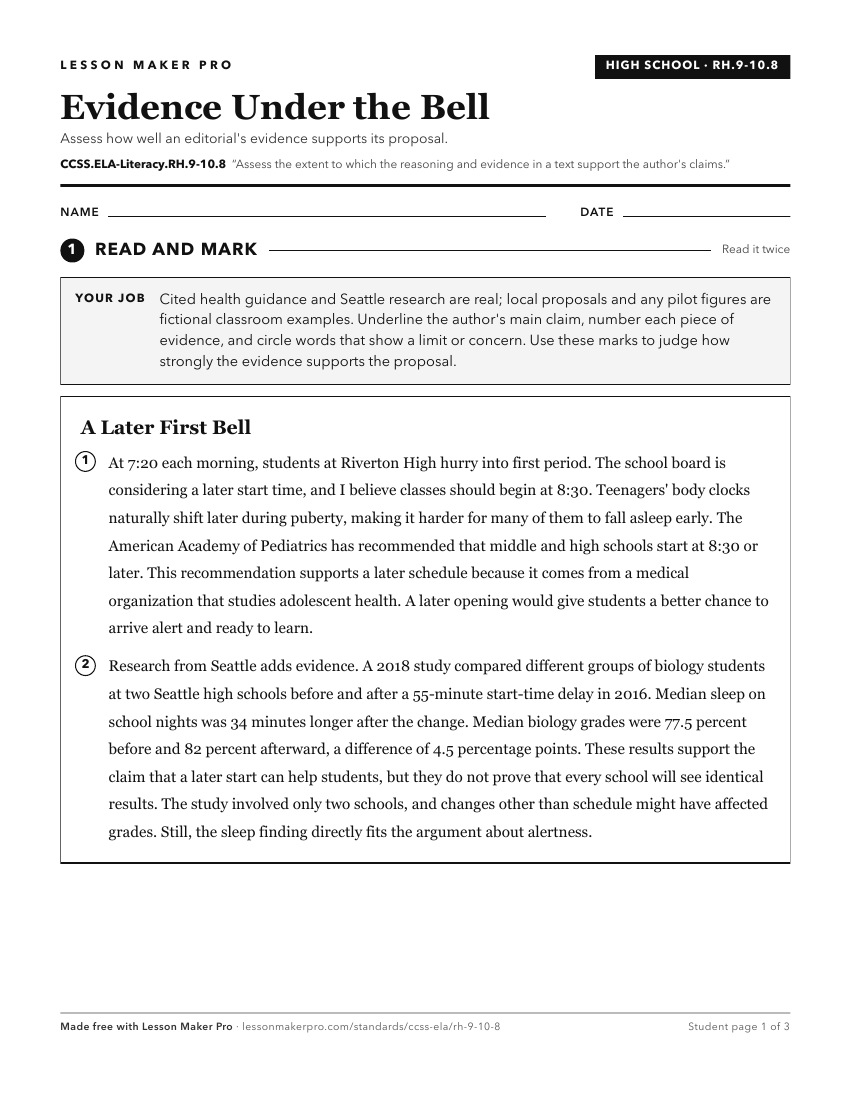
A ready-to-print activity worksheet aligned to CCSS.ELA-Literacy.RH.9-10.8, with an answer key for the teacher on its own page. No account needed.
PDF, US Letter, prints cleanly in black and white.
Download the worksheetLearning progression
Where This Standard Sits
See the whole path on the Reading: History/Social Studies progression map.
What This Unlocks
Mastery here sets students up for these next.
Keep exploring
Related Standards
- CCSS.ELA-Literacy.RST.9-10.8
Assess the extent to which the reasoning and evidence in a text support the author's claim or a recommendation for solving a scientific or technical problem.
- CCSS.ELA-Literacy.RI.5.8
Explain how an author uses reasons and evidence to support particular points in a text, identifying which reasons and evidence support which point(s).
- CCSS.ELA-Literacy.RI.7.8
Trace and evaluate the argument and specific claims in a text, assessing whether the reasoning is sound and the evidence is relevant and sufficient to support t...
- CCSS.ELA-Literacy.RI.4.8
Explain how an author uses reasons and evidence to support particular points in a text.
Turn this exact standard into a lesson
Grade, subject, topic, and the complete standard are prefilled. Create one free, no account needed.
Also for this standard:Make a WorksheetMake a QuizMake a Sub Lesson