CCSS.
The Standard
Trace and evaluate the argument and specific claims in a text, assessing whether the reasoning is sound and the evidence is relevant and sufficient to support the claims.
Common Core State Standards for English Language Arts · Reading Standards for Informational Text
Teacher's field guide
What This Standard Means
What Students Need to Do
- Students identify an author’s main argument and the smaller claims used to build it. They follow the reasons and evidence, then judge whether the support fits, makes sense, and is enough.
What Mastery Looks Like
- Students can mark the main argument, supporting claims, reasons, and evidence in an informational text. They can point out weak logic, irrelevant details, and claims that need more support.
Common Misconceptions
- Students may treat every fact or quotation as strong evidence. They may also confuse a claim with a reason, or decide an argument is sound simply because they agree with it.
How to Assess It
- Use this exit ticket with a class text: “State the main claim, identify two pieces of evidence, and explain whether they are relevant and sufficient.”
Lesson moves
Ways to Teach It
Print claims, reasons, and evidence on separate cards, then have groups match them and place unsupported claims in a separate pile.
Ask students to write: “Which claim is best supported, and what specific evidence makes it stronger than the others?”
Play Evidence Jury, where teams rate evidence as relevant, irrelevant, sufficient, or insufficient and defend each rating with one sentence.
Compare two advertisements for the same product, then identify each claim and judge whether customer quotes, statistics, or images provide enough support.
Free download
Printable RI.7.8 Worksheet
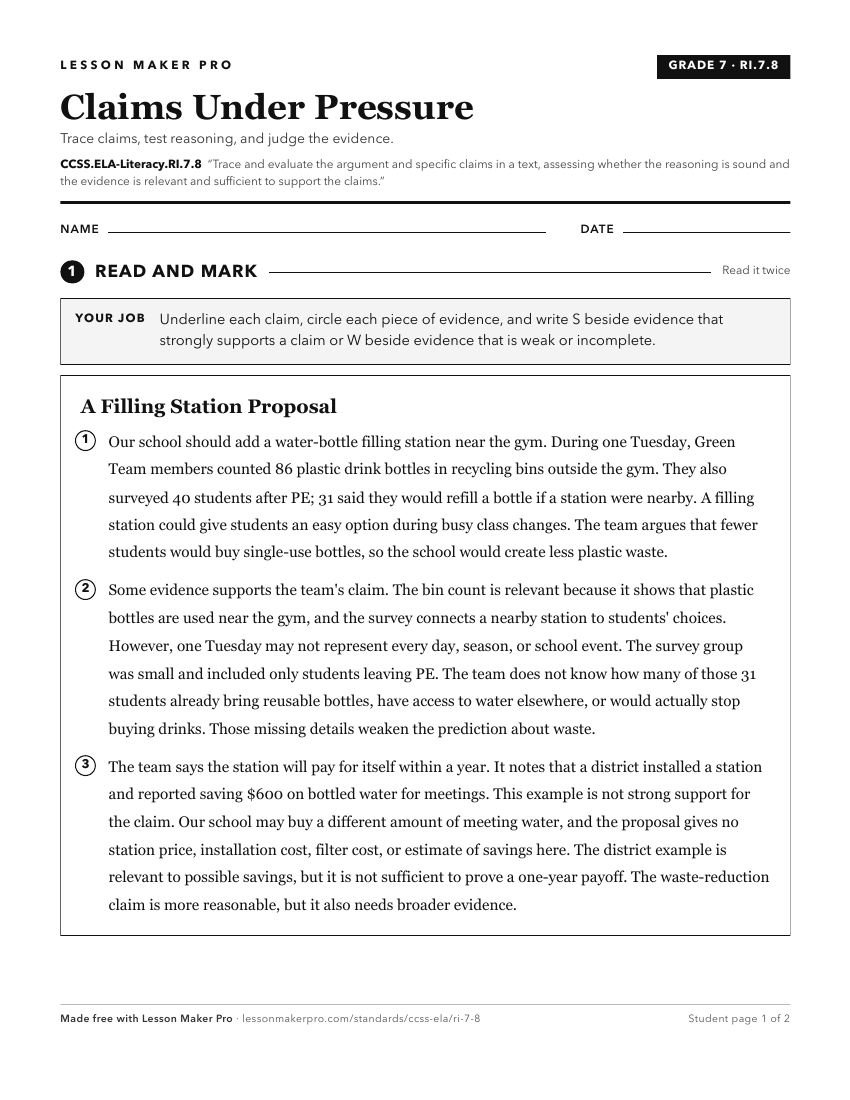
A ready-to-print activity worksheet aligned to CCSS.ELA-Literacy.RI.7.8, with an answer key for the teacher on its own page. No account needed.
PDF, US Letter, prints cleanly in black and white.
Download the worksheetLearning progression
Where This Standard Sits
See the whole path on the Reading: Informational Text progression map.
Before This Standard
If students are struggling here, check these first.
What This Unlocks
Mastery here sets students up for these next.
Keep exploring
Related Standards
- CCSS.ELA-Literacy.RI.9-10.8
Delineate and evaluate the argument and specific claims in a text, assessing whether the reasoning is valid and the evidence is relevant and sufficient; identif...
- CCSS.ELA-Literacy.CCRA.R.8
Delineate and evaluate the argument and specific claims in a text, including the validity of the reasoning as well as the relevance and sufficiency of the evide...
Turn this exact standard into a lesson
Grade, subject, topic, and the complete standard are prefilled. Create one free, no account needed.
Also for this standard:Make a WorksheetMake a QuizMake a Sub Lesson