CCSS.
The Standard
Trace and evaluate the argument and specific claims in a text, distinguishing claims that are supported by reasons and evidence from claims that are not.
Common Core State Standards for English Language Arts · Reading Standards for Informational Text
Teacher's field guide
What This Standard Means
What Students Need to Do
- Students find the writer’s main position and break it into smaller statements the writer wants readers to accept. They connect each statement to the reasons and facts offered, then judge whether that support is relevant and sufficient.
What Mastery Looks Like
- A student can mark the writer’s main position, separate claims, and link each claim to the details meant to support it. The student can explain when support is relevant, sufficient, missing, or unrelated.
Common Misconceptions
- Students may treat any fact, example, or statistic as strong support, even when it does not connect to the writer’s point. They may confuse the topic with the writer’s position. They may also judge a claim by whether they agree with it rather than by the support provided.
How to Assess It
- Exit ticket: Read a short paragraph, identify one claim, cite its supporting detail, and explain whether that detail gives strong or weak support.
Lesson moves
Ways to Teach It
Print a short editorial, cut its claims and evidence into strips, and have pairs match each strip before labeling strong or weak support.
Discuss which claim in a school lunch article is best supported, then require each student to point to two details.
Play Evidence Detective by giving teams claim cards and detail cards, with points for correct matches and clear explanations.
Examine a product advertisement and list its claims, then check whether each claim has facts, examples, expert comments, or no support.
Free download
Printable RI.6.8 Worksheet
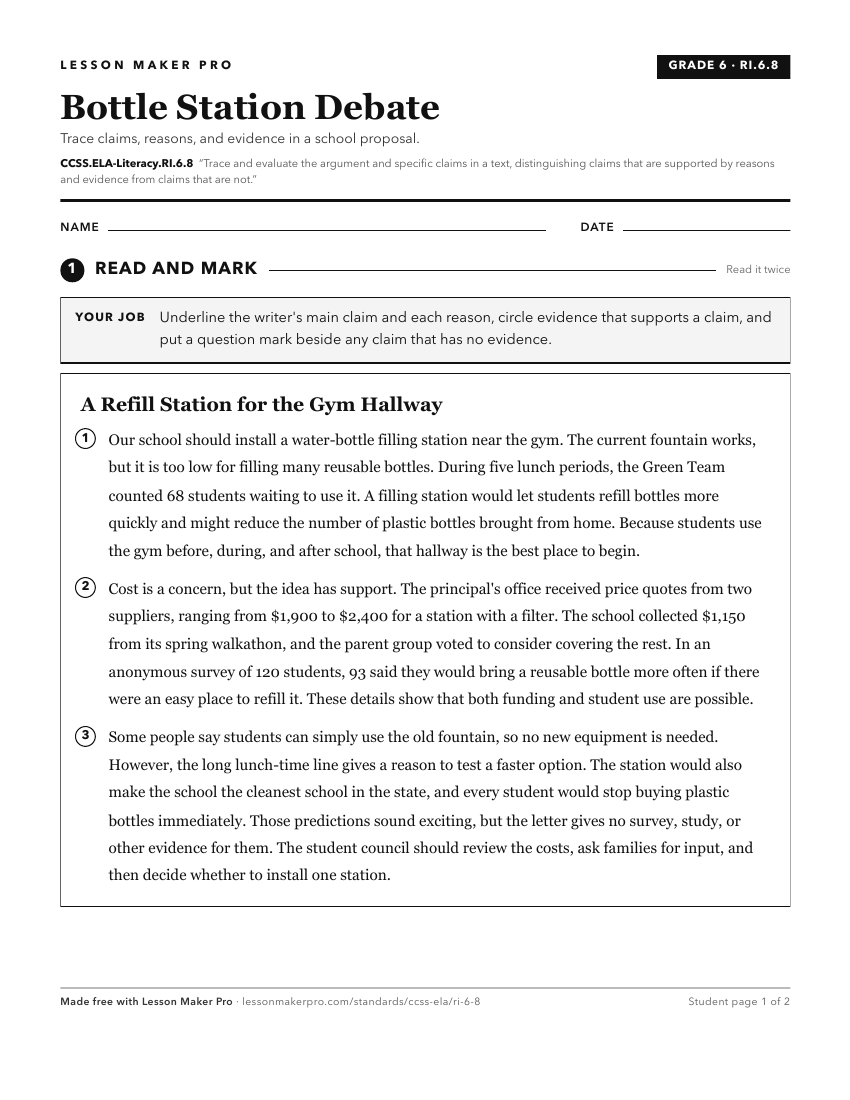
A ready-to-print activity worksheet aligned to CCSS.ELA-Literacy.RI.6.8, with an answer key for the teacher on its own page. No account needed.
PDF, US Letter, prints cleanly in black and white.
Download the worksheetLearning progression
Where This Standard Sits
See the whole path on the Reading: Informational Text progression map.
Before This Standard
If students are struggling here, check these first.
What This Unlocks
Mastery here sets students up for these next.
Keep exploring
Related Standards
- CCSS.ELA-Literacy.RI.9-10.8
Delineate and evaluate the argument and specific claims in a text, assessing whether the reasoning is valid and the evidence is relevant and sufficient; identif...
- CCSS.ELA-Literacy.CCRA.R.8
Delineate and evaluate the argument and specific claims in a text, including the validity of the reasoning as well as the relevance and sufficiency of the evide...
- CCSS.ELA-Literacy.RI.8.8
Delineate and evaluate the argument and specific claims in a text, assessing whether the reasoning is sound and the evidence is relevant and sufficient; recogni...
Turn this exact standard into a lesson
Grade, subject, topic, and the complete standard are prefilled. Create one free, no account needed.
Also for this standard:Make a WorksheetMake a QuizMake a Sub Lesson