CCSS.
The Standard
Evaluate an author's premises, claims, and evidence by corroborating or challenging them with other information.
Common Core State Standards for English Language Arts · Reading Standards for Literacy in History/Social Studies 6—12
Teacher's field guide
What This Standard Means
What Students Need to Do
- Students break an argument into its assumptions, claims, and supporting evidence. They check each part against other reliable sources and decide whether those sources strengthen or weaken the argument.
What Mastery Looks Like
- Students can separate an author's assumptions, main claims, and supporting details. They compare those parts with credible sources, then explain whether the argument holds up and why.
Common Misconceptions
- Students may treat every statement as a claim or assume cited evidence is automatically reliable. They may also call sources contradictory when the sources address different questions or time periods.
How to Assess It
- Give students a short historical argument and a second source. Ask them to name one claim and explain in two sentences how the second source supports or weakens it.
Lesson moves
Ways to Teach It
Give pairs a claim, evidence cards, and two source excerpts, then have them sort each card as support, contradiction, or unrelated.
Ask students to write: Which assumption does the author expect readers to accept, and what source could test that assumption?
Run a corroboration relay where teams match claims to source excerpts, then earn points by explaining each match accurately.
Compare two news reports about the same public policy and identify where their evidence agrees, conflicts, or leaves questions unanswered.
Free download
Printable RH.11-12.8 Worksheet
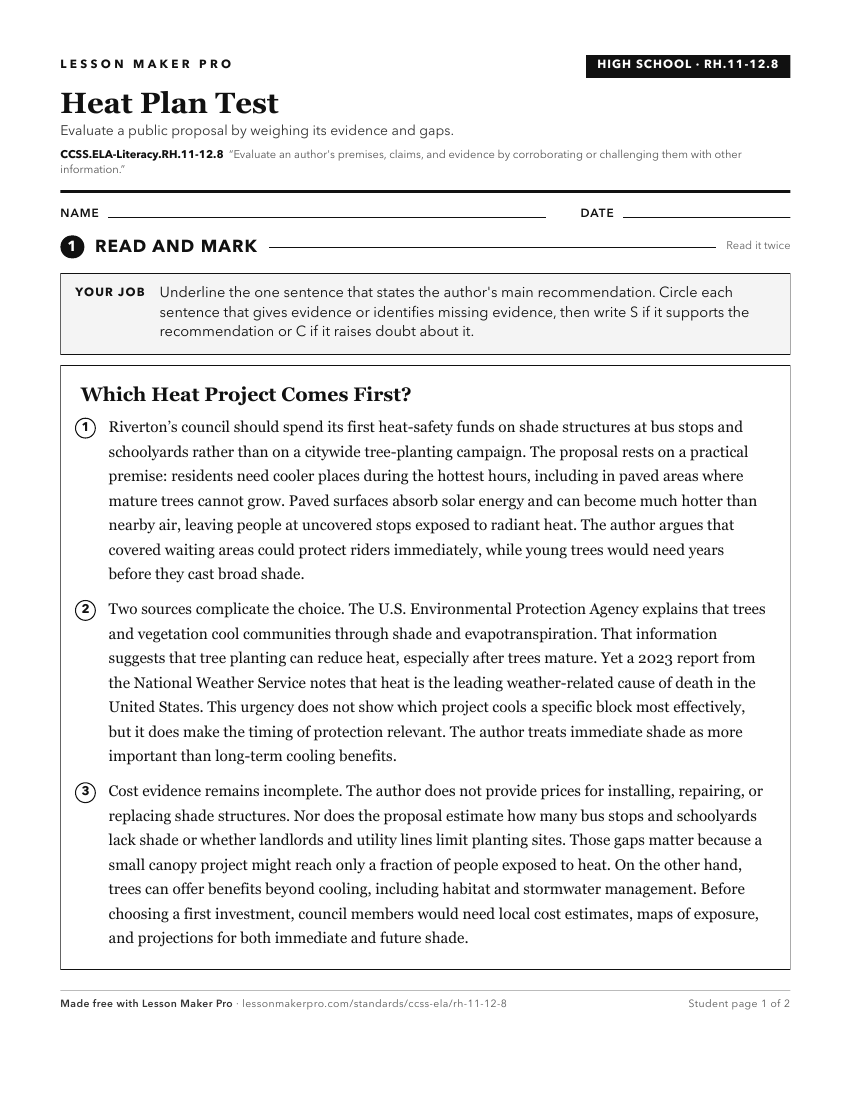
A ready-to-print activity worksheet aligned to CCSS.ELA-Literacy.RH.11-12.8, with an answer key for the teacher on its own page. No account needed.
PDF, US Letter, prints cleanly in black and white.
Download the worksheetLearning progression
Where This Standard Sits
See the whole path on the Reading: History/Social Studies progression map.
Before This Standard
If students are struggling here, check these first.
Keep exploring
Related Standards
- CCSS.ELA-Literacy.RH.11-12.6
Evaluate authors' differing points of view on the same historical event or issue by assessing the authors' claims, reasoning, and evidence.
- CCSS.ELA-Literacy.RST.11-12.8
Evaluate the hypotheses, data, analysis, and conclusions in a science or technical text, verifying the data when possible and corroborating or challenging concl...
- CCSS.ELA-Literacy.RI.8.6
Determine an author's point of view or purpose in a text and analyze how the author acknowledges and responds to conflicting evidence or viewpoints.
Turn this exact standard into a lesson
Grade, subject, topic, and the complete standard are prefilled. Create one free, no account needed.
Also for this standard:Make a WorksheetMake a QuizMake a Sub Lesson