CCSS.
The Standard
Evaluate authors' differing points of view on the same historical event or issue by assessing the authors' claims, reasoning, and evidence.
Common Core State Standards for English Language Arts · Reading Standards for Literacy in History/Social Studies 6—12
Teacher's field guide
What This Standard Means
What Students Need to Do
- Students compare accounts of the same event or issue and identify each author’s position. They examine claims, reasoning, and evidence to decide which account is better supported.
What Mastery Looks Like
- Students can state where two authors agree and disagree. They can trace each author’s claim through the reasoning and evidence, then make a supported judgment about which account is more convincing.
Common Misconceptions
- Students may treat any difference in perspective as proof that one source is unreliable. They may summarize each account without judging its support, or assume more evidence always means better evidence.
How to Assess It
- Give students short excerpts from two accounts of the decision to use the atomic bomb. Ask them to identify each claim, cite supporting evidence, and explain which account is better supported and why.
Lesson moves
Ways to Teach It
Give pairs color-coded cards from two accounts; students sort each sentence as claim, reasoning, or evidence, then compare the completed sets.
Ask: Which author makes the stronger case, and what specific evidence or reasoning creates that advantage?
Run a Source Showdown: teams earn points for matching quotations to authors and explaining how each quotation supports a claim.
Compare two museum websites describing the same event, then discuss how audience and institutional purpose shape each account.
Free download
Printable RH.11-12.6 Worksheet
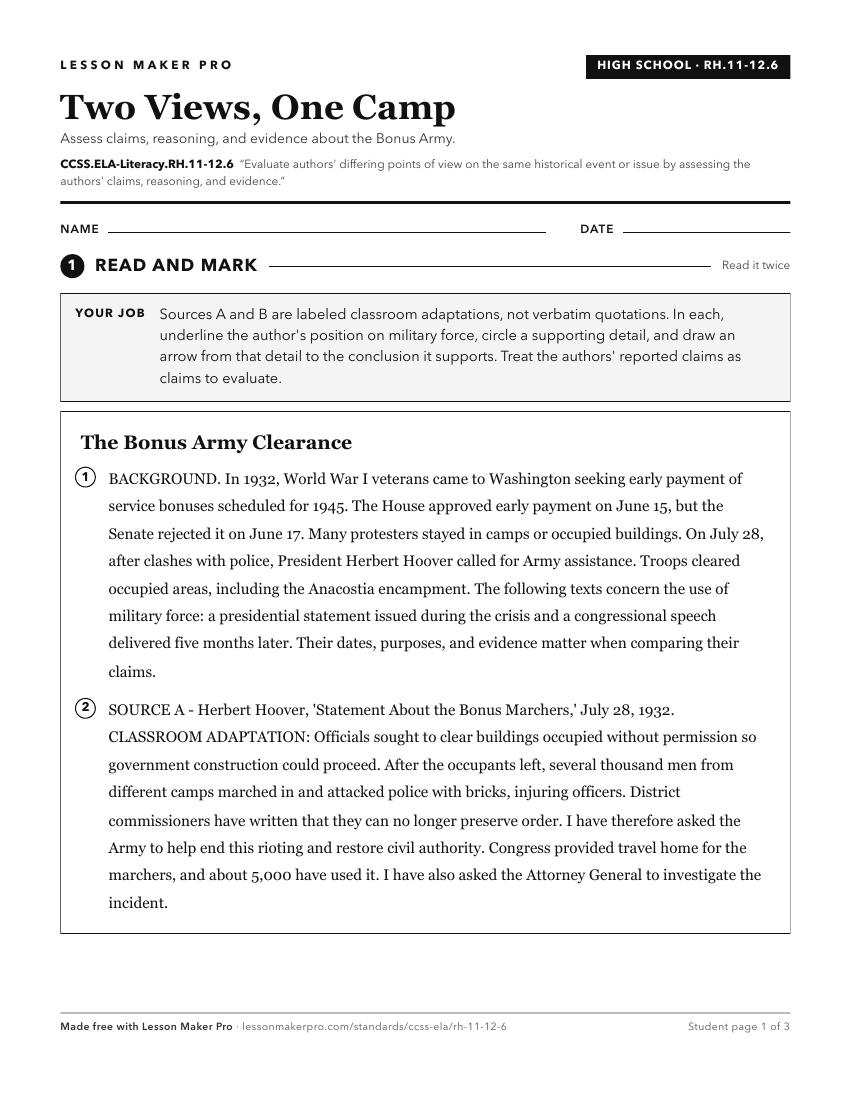
A ready-to-print activity worksheet aligned to CCSS.ELA-Literacy.RH.11-12.6, with an answer key for the teacher on its own page. No account needed.
PDF, US Letter, prints cleanly in black and white.
Download the worksheetLearning progression
Where This Standard Sits
See the whole path on the Reading: History/Social Studies progression map.
Before This Standard
If students are struggling here, check these first.
Keep exploring
Related Standards
- CCSS.ELA-Literacy.RH.11-12.8
Evaluate an author's premises, claims, and evidence by corroborating or challenging them with other information.
- CCSS.ELA-Literacy.RI.7.9
Analyze how two or more authors writing about the same topic shape their presentations of key information by emphasizing different evidence or advancing differe...
- CCSS.ELA-Literacy.RI.8.6
Determine an author's point of view or purpose in a text and analyze how the author acknowledges and responds to conflicting evidence or viewpoints.
Turn this exact standard into a lesson
Grade, subject, topic, and the complete standard are prefilled. Create one free, no account needed.
Also for this standard:Make a WorksheetMake a QuizMake a Sub Lesson