CCSS.
The Standard
Analyze a particular point of view or cultural experience reflected in a work of literature from outside the United States, drawing on a wide reading of world literature.
Common Core State Standards for English Language Arts · Reading Standards for Literature
Teacher's field guide
What This Standard Means
What Students Need to Do
- Students explain how a narrator or character views events and how cultural context shapes that view. They support their analysis with text details and connections to other works from around the world.
What Mastery Looks Like
- A student can explain how word choice, assumptions, customs, and conflicts reveal a specific perspective. The student uses precise evidence and makes relevant connections to other world literature without stereotyping a culture.
Common Misconceptions
- Students may confuse the author with the narrator or assume every character shares the same cultural values. They may summarize customs without explaining how those customs shape perspective. They may also treat one text as proof about an entire culture.
How to Assess It
- Give students a short passage from a translated story and ask, "How does one cultural value shape the narrator's view of the conflict? Cite two details."
Lesson moves
Ways to Teach It
Give pairs colored sticky notes to mark details showing the narrator's perspective and details revealing cultural context in a short translated story.
Discuss the prompt, "Whose values shape the conflict, and how would the scene change if another character narrated it?"
Play Evidence Sort, where teams match claim cards about perspective with supporting quotations from several world literature excerpts.
Pair a migration story with a first person interview from the same region, then note similarities and differences in perspective.
Free download
Printable RL.9-10.6 Worksheet
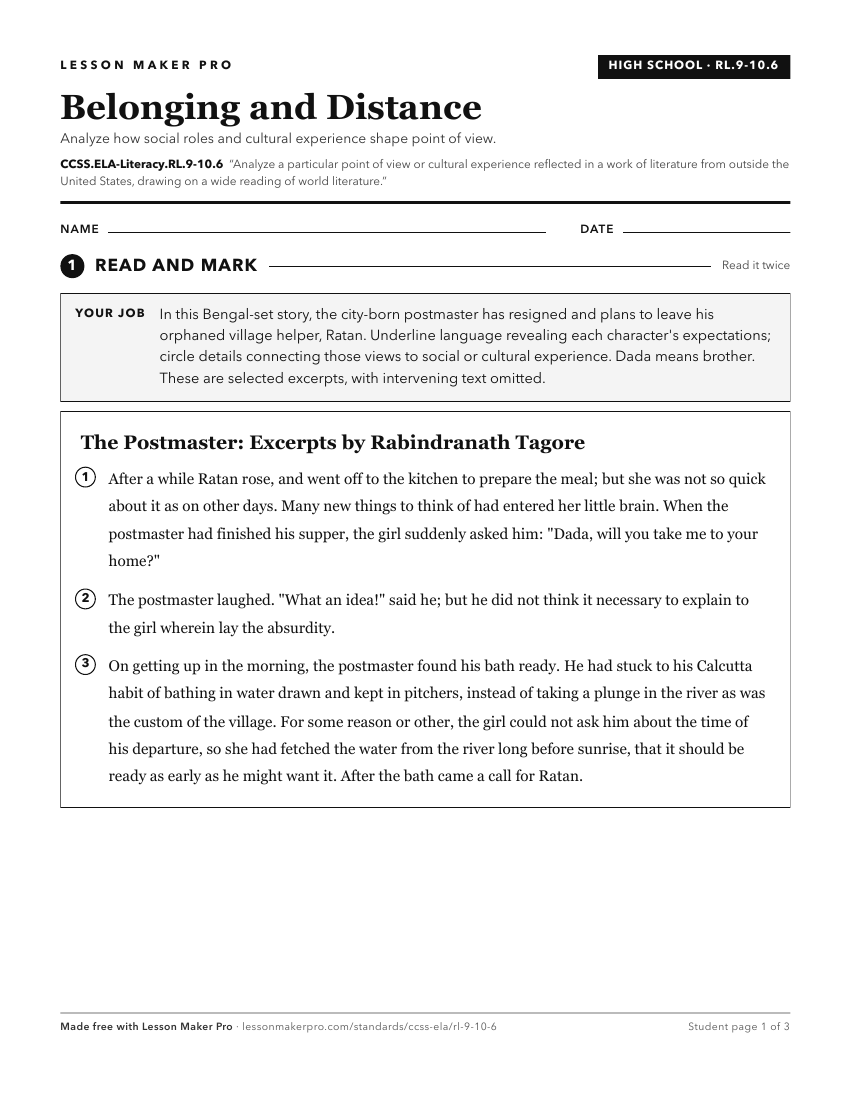
A ready-to-print activity worksheet aligned to CCSS.ELA-Literacy.RL.9-10.6, with an answer key for the teacher on its own page. No account needed.
PDF, US Letter, prints cleanly in black and white.
Download the worksheetLearning progression
Where This Standard Sits
See the whole path on the Reading: Literature progression map.
Before This Standard
If students are struggling here, check these first.
What This Unlocks
Mastery here sets students up for these next.
Keep exploring
Related Standards
- CCSS.ELA-Literacy.RL.11-12.9
Demonstrate knowledge of eighteenth-, nineteenth- and early-twentieth-century foundational works of American literature, including how two or more texts from th...
- CCSS.ELA-Literacy.RL.11-12.7
Analyze multiple interpretations of a story, drama, or poem (e.g., recorded or live production of a play or recorded novel or poetry), evaluating how each versi...
- CCSS.ELA-Literacy.W.8.9a
Apply grade 8 Reading standards to literature (e.g., "Analyze how a modern work of fiction draws on themes, patterns of events, or character types from myths, t...
- CCSS.ELA-Literacy.W.11-12.9a
Apply grades 11—12 Reading standards to literature (e.g., "Demonstrate knowledge of eighteenth-, nineteenth- and early-twentieth-century foundational works of A...
Turn this exact standard into a lesson
Grade, subject, topic, and the complete standard are prefilled. Create one free, no account needed.
Also for this standard:Make a WorksheetMake a QuizMake a Sub Lesson