CCSS.
The Standard
Analyze a case in which grasping point of view requires distinguishing what is directly stated in a text from what is really meant (e.g., satire, sarcasm, irony, or understatement).
Common Core State Standards for English Language Arts · Reading Standards for Literature
Teacher's field guide
What This Standard Means
What Students Need to Do
- Students identify what a narrator or character says and infer the intended meaning. They use tone, context, contradictions, and word choice to explain sarcasm, irony, satire, or understatement.
What Mastery Looks Like
- Given a difficult passage, students can state the literal message and the implied message. They can name the device and support their interpretation with two precise details.
Common Misconceptions
- Students often treat every statement as sincere or label any joke as sarcasm. They may confuse an unexpected event with verbal irony. Some infer intention from opinion alone instead of citing context, tone, or contradiction.
How to Assess It
- Exit ticket: After the set falls during a school play, a character says, "Well, that could not have gone better." Explain both meanings, then cite one clue.
Lesson moves
Ways to Teach It
Give pairs printed passage strips to color-code literal statements, intended meanings, and clues that reveal the difference.
After reading a satirical paragraph, write: What does the speaker claim, what does the speaker mean, and which words expose the gap?
Play Meaning Match: students pair literal statement cards with intended meaning cards, then defend each match using a context clue.
Compare a satirical news headline with a factual headline on the same issue, then identify clues showing the satirical writer's real criticism.
Free download
Printable RL.11-12.6 Worksheet
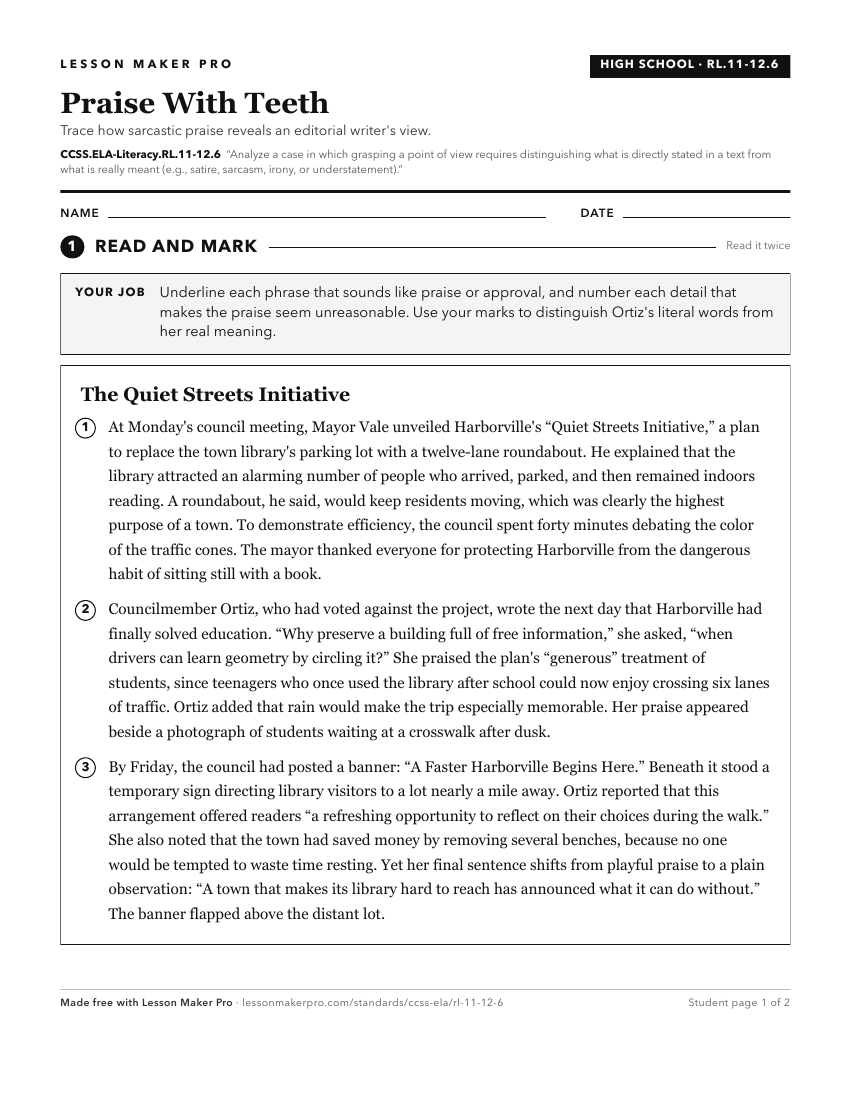
A ready-to-print activity worksheet aligned to CCSS.ELA-Literacy.RL.11-12.6, with an answer key for the teacher on its own page. No account needed.
PDF, US Letter, prints cleanly in black and white.
Download the worksheetLearning progression
Where This Standard Sits
See the whole path on the Reading: Literature progression map.
Before This Standard
If students are struggling here, check these first.
Keep exploring
Related Standards
- CCSS.ELA-Literacy.RL.8.6
Analyze how differences in the points of view of the characters and the audience or reader (e.g., created through the use of dramatic irony) create such effects...
- CCSS.ELA-Literacy.RI.7.6
Determine an author's point of view or purpose in a text and analyze how the author distinguishes his or her position from that of others.
- CCSS.ELA-Literacy.RH.6-8.6
Identify aspects of a text that reveal an author's point of view or purpose (e.g., loaded language, inclusion or avoidance of particular facts).
- CCSS.ELA-Literacy.RI.8.9
Analyze a case in which two or more texts provide conflicting information on the same topic and identify where the texts disagree on matters of fact or interpre...
Turn this exact standard into a lesson
Grade, subject, topic, and the complete standard are prefilled. Create one free, no account needed.
Also for this standard:Make a WorksheetMake a QuizMake a Sub Lesson