CCSS.
The Standard
Determine an author's point of view or purpose in a text and analyze how the author distinguishes his or her position from that of others.
Common Core State Standards for English Language Arts · Reading Standards for Informational Text
Teacher's field guide
What This Standard Means
What Students Need to Do
- Students identify what a writer believes and what the writer wants readers to think or do. They explain how word choice, evidence, and responses to other views set that position apart.
What Mastery Looks Like
- A student states the writer's position and purpose using accurate evidence. The student identifies another view and explains how the writer contrasts, challenges, or partly accepts it.
Common Misconceptions
- Students may confuse the topic with the writer's purpose. They may treat every quoted opinion as the writer's own view. Some list competing positions but do not explain how wording or evidence separates them.
How to Assess It
- Give students a 200-word editorial containing one counterclaim. Ask them to name the writer's position, underline the counterclaim, and explain one contrast in two sentences.
Lesson moves
Ways to Teach It
Color-code a printed editorial: blue for the writer's claims, yellow for other views, and green for responses to those views.
Discuss: Which words make the writer's position sound stronger than the opposing position, and what effect do those choices have?
Play a quote sort where teams place sentence cards under writer's view, opposing view, or response, then justify each choice.
Compare two opinion pieces about school phone rules, then write how each writer presents and responds to the other side.
Free download
Printable RI.7.6 Worksheet
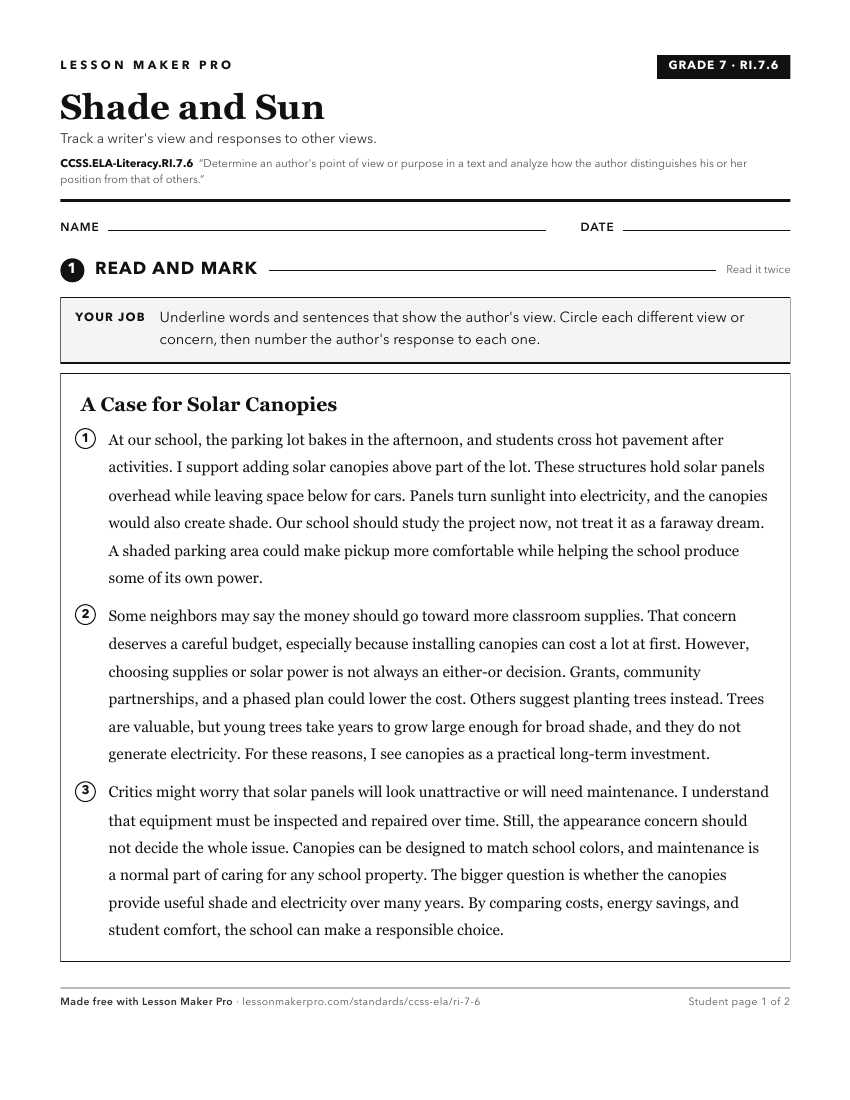
A ready-to-print activity worksheet aligned to CCSS.ELA-Literacy.RI.7.6, with an answer key for the teacher on its own page. No account needed.
PDF, US Letter, prints cleanly in black and white.
Download the worksheetLearning progression
Where This Standard Sits
See the whole path on the Reading: Informational Text progression map.
Before This Standard
If students are struggling here, check these first.
What This Unlocks
Mastery here sets students up for these next.
Keep exploring
Related Standards
- CCSS.ELA-Literacy.RI.11-12.6
Determine an author's point of view or purpose in a text in which the rhetoric is particularly effective, analyzing how style and content contribute to the powe...
- CCSS.ELA-Literacy.RI.9-10.6
Determine an author's point of view or purpose in a text and analyze how an author uses rhetoric to advance that point of view or purpose.
Turn this exact standard into a lesson
Grade, subject, topic, and the complete standard are prefilled. Create one free, no account needed.
Also for this standard:Make a WorksheetMake a QuizMake a Sub Lesson