CCSS.
The Standard
Determine an author's point of view or purpose in a text and explain how it is conveyed in the text.
Common Core State Standards for English Language Arts · Reading Standards for Informational Text
Teacher's field guide
What This Standard Means
What Students Need to Do
- Students identify what a writer thinks or wants readers to understand, believe, or do. They use word choice, selected details, examples, and tone to support their conclusion.
What Mastery Looks Like
- Students clearly state the writer’s attitude or goal. They cite relevant words, details, and examples, then explain how those choices shape the reader’s response.
Common Misconceptions
- Students often confuse the topic with the writer’s purpose. They may label any informational text as neutral or name a viewpoint without citing words that reveal it.
How to Assess It
- Give students a short editorial and ask: “What does the writer want readers to think or do? Quote two phrases and explain how each supports your answer.”
Lesson moves
Ways to Teach It
Give pairs sentence strips from two accounts of one event, then have them sort and mark words showing positive, negative, or neutral views.
Ask students to write: “What does the writer want readers to believe, and which three choices reveal that goal?”
Play Evidence Match by having teams pair purpose cards with quotations from a shared article and defend each match.
Compare a product webpage with an independent review, then identify each writer’s goal and the wording used to influence readers.
Free download
Printable RI.6.6 Worksheet
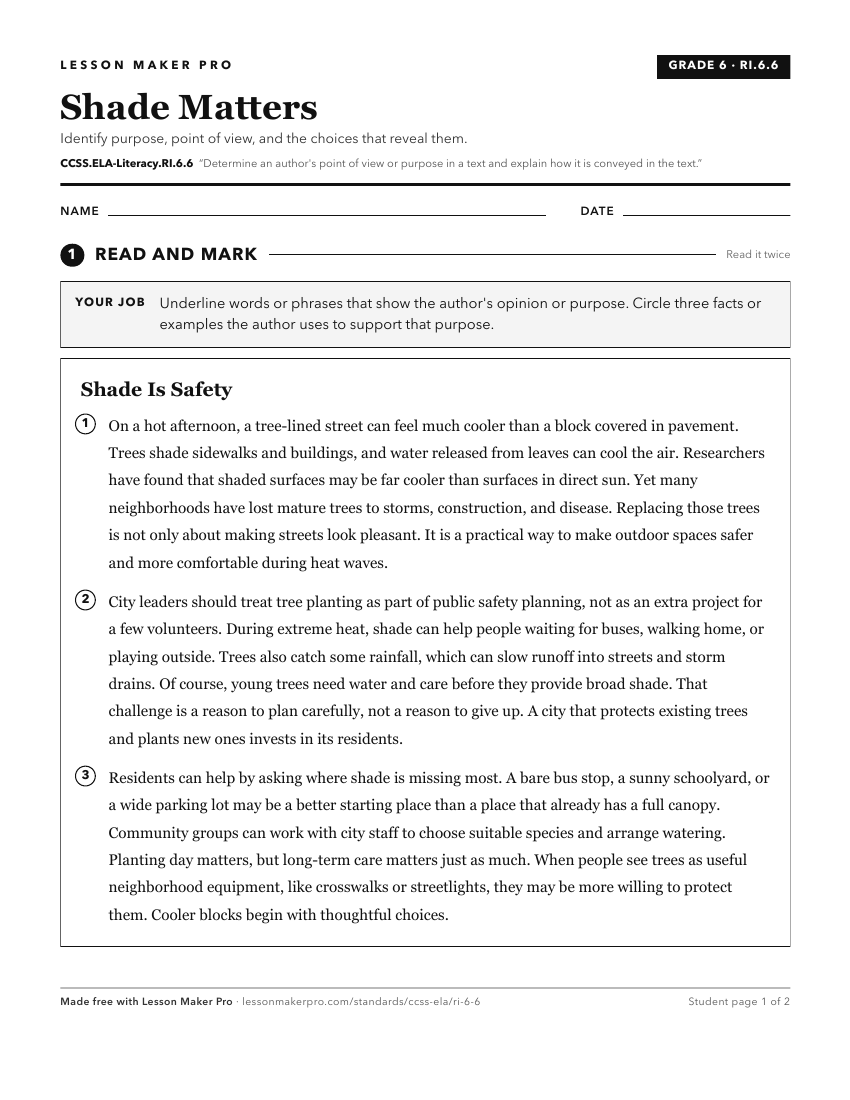
A ready-to-print activity worksheet aligned to CCSS.ELA-Literacy.RI.6.6, with an answer key for the teacher on its own page. No account needed.
PDF, US Letter, prints cleanly in black and white.
Download the worksheetLearning progression
Where This Standard Sits
See the whole path on the Reading: Informational Text progression map.
Before This Standard
If students are struggling here, check these first.
What This Unlocks
Mastery here sets students up for these next.
Keep exploring
Related Standards
- CCSS.ELA-Literacy.RI.11-12.6
Determine an author's point of view or purpose in a text in which the rhetoric is particularly effective, analyzing how style and content contribute to the powe...
- CCSS.ELA-Literacy.RI.9-10.6
Determine an author's point of view or purpose in a text and analyze how an author uses rhetoric to advance that point of view or purpose.
- CCSS.ELA-Literacy.RI.8.6
Determine an author's point of view or purpose in a text and analyze how the author acknowledges and responds to conflicting evidence or viewpoints.
Turn this exact standard into a lesson
Grade, subject, topic, and the complete standard are prefilled. Create one free, no account needed.
Also for this standard:Make a WorksheetMake a QuizMake a Sub Lesson