CCSS.
The Standard
Describe the connection between a series of historical events, scientific ideas or concepts, or steps in technical procedures in a text.
Common Core State Standards for English Language Arts · Reading Standards for Informational Text
Teacher's field guide
What This Standard Means
What Students Need to Do
- Students track events, ideas, or directions across an informational text. They explain whether details are linked by time order, cause and effect, or a step-by-step sequence.
What Mastery Looks Like
- Students correctly explain time order, cause and effect, or how one step leads to another. They use details from the text and words such as because, so, before, after, or next.
Common Misconceptions
- Students may list details without explaining how they are related. They may confuse what happened first with what caused something else, or treat every connection as cause and effect.
How to Assess It
- Use this exit ticket: “Rain soaked the hill. The soil became loose, so it slid downhill and covered the road.” Ask, “How are the events connected?”
Lesson moves
Ways to Teach It
Give pairs mixed-up cards showing a seed growing; students order them and add arrows labeled before, after, because, or result.
Read a short volcano passage, then ask how one event causes the next; students discuss and write an answer using text details.
Play Connection Match: students pair event or step cards, then explain each match using because, so, before, or after.
Have students map the steps for washing hands and explain why changing the order could affect the result.
Free download
Printable RI.2.3 Worksheet
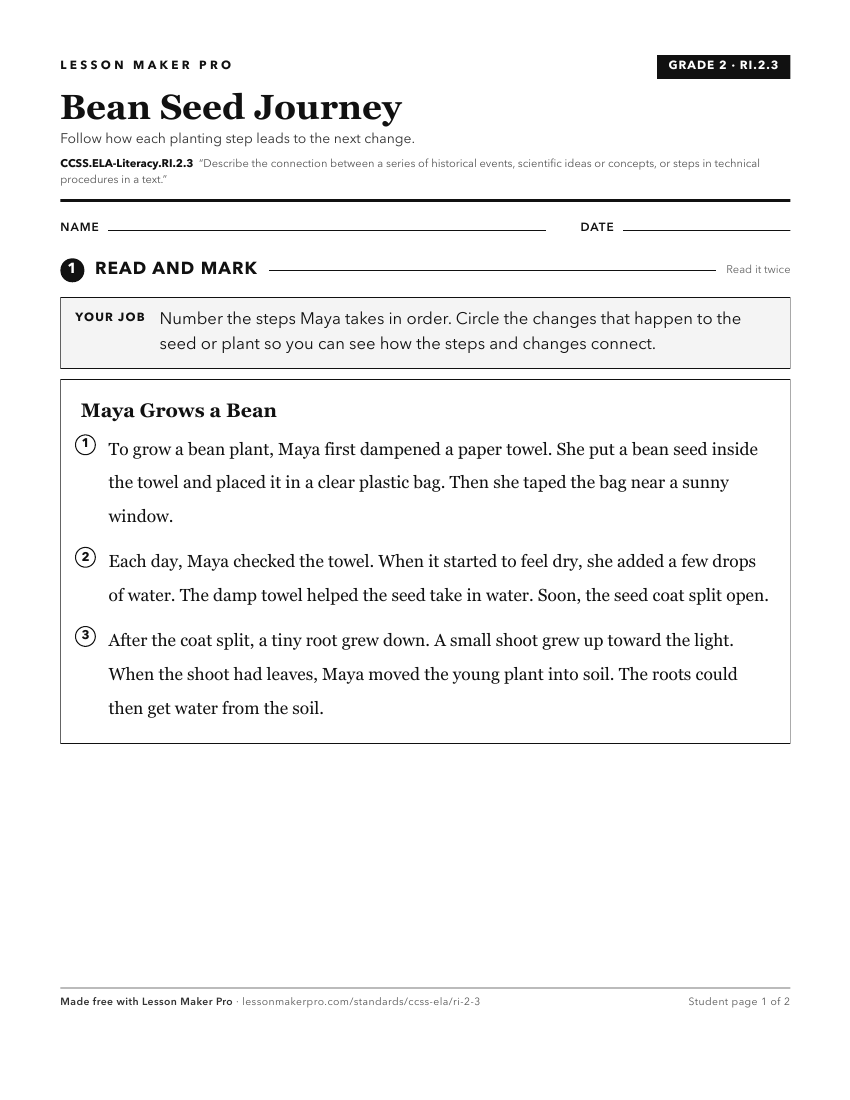
A ready-to-print activity worksheet aligned to CCSS.ELA-Literacy.RI.2.3, with an answer key for the teacher on its own page. No account needed.
PDF, US Letter, prints cleanly in black and white.
Download the worksheetLearning progression
Where This Standard Sits
See the whole path on the Reading: Informational Text progression map.
Before This Standard
If students are struggling here, check these first.
What This Unlocks
Mastery here sets students up for these next.
Keep exploring
Related Standards
- CCSS.ELA-Literacy.RI.5.3
Explain the relationships or interactions between two or more individuals, events, ideas, or concepts in a historical, scientific, or technical text based on sp...
- CCSS.ELA-Literacy.RI.K.3
With prompting and support, describe the connection between two individuals, events, ideas, or pieces of information in a text.
Turn this exact standard into a lesson
Grade, subject, topic, and the complete standard are prefilled. Create one free, no account needed.
Also for this standard:Make a WorksheetMake a QuizMake a Sub Lesson