CCSS.
The Standard
Describe the connection between two individuals, events, ideas, or pieces of information in a text.
Common Core State Standards for English Language Arts · Reading Standards for Informational Text
Teacher's field guide
What This Standard Means
What Students Need to Do
- Students find two related people, events, or facts in an informational text. They explain the link using clues such as because, before, after, or both.
What Mastery Looks Like
- Students can select two related details from a short text and name each one accurately. They explain the link in a complete sentence and point to supporting words or pictures.
Common Misconceptions
- Students may retell each detail separately without stating the link. They may use outside knowledge, confuse sequence with cause, or choose unrelated details.
How to Assess It
- Exit ticket: Choose two facts from the class text. Complete: “___ and ___ are connected because ___.”
Lesson moves
Ways to Teach It
Give pairs two event cards from a short article; students arrange them, connect them with yarn, and explain the link.
Read a page about animal families, then ask, “How are the parent and baby connected in what they do?”
Play Connection Match: students pair fact cards from the same text and earn a point by stating an accurate link.
Use a school lunch schedule and menu to explain how the day of the week connects to the meal served.
Free download
Printable RI.1.3 Worksheet
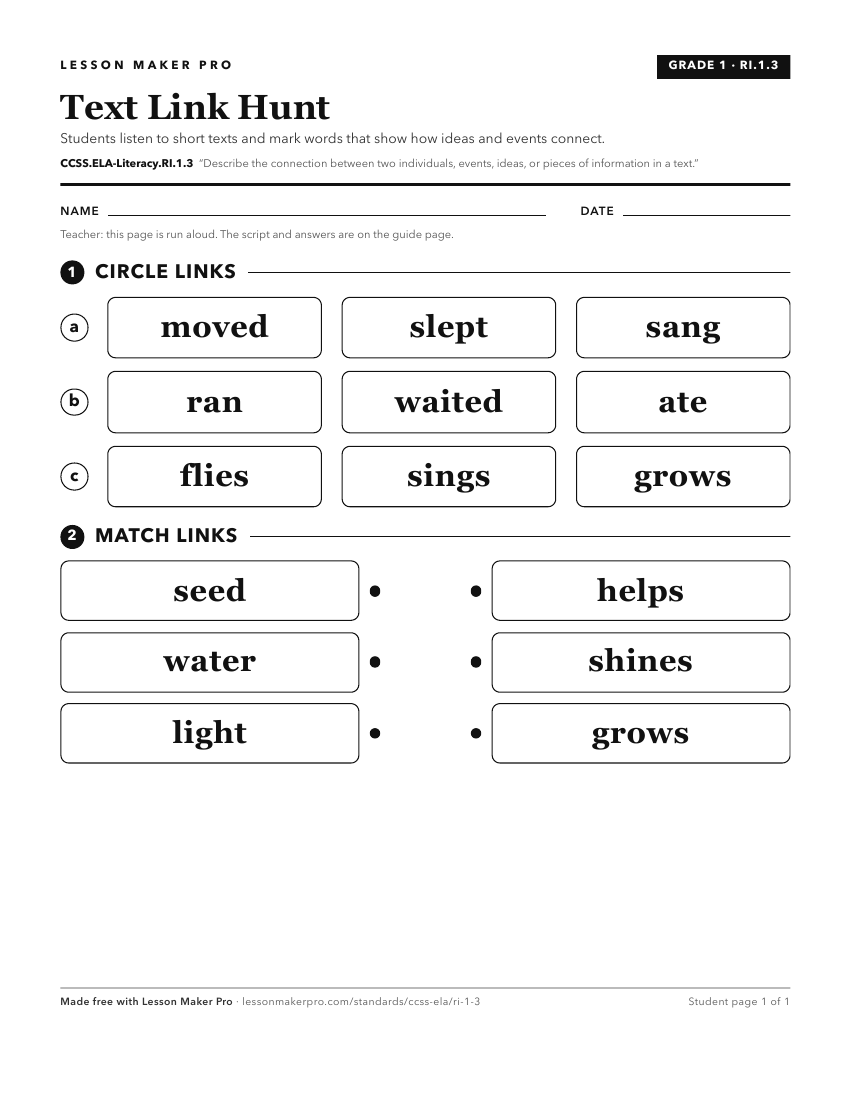
A ready-to-print activity worksheet aligned to CCSS.ELA-Literacy.RI.1.3, with an answer key for the teacher on its own page. No account needed.
PDF, US Letter, prints cleanly in black and white.
Download the worksheetLearning progression
Where This Standard Sits
See the whole path on the Reading: Informational Text progression map.
Before This Standard
If students are struggling here, check these first.
What This Unlocks
Mastery here sets students up for these next.
Keep exploring
Related Standards
- CCSS.ELA-Literacy.RI.5.3
Explain the relationships or interactions between two or more individuals, events, ideas, or concepts in a historical, scientific, or technical text based on sp...
- CCSS.ELA-Literacy.RI.8.3
Analyze how a text makes connections among and distinctions between individuals, ideas, or events (e.g., through comparisons, analogies, or categories).
Turn this exact standard into a lesson
Grade, subject, topic, and the complete standard are prefilled. Create one free, no account needed.
Also for this standard:Make a WorksheetMake a QuizMake a Sub Lesson