CCSS.
The Standard
Print many upper- and lowercase letters.
Common Core State Standards for English Language Arts
Teacher's field guide
What This Standard Means
What Students Need to Do
- Students form recognizable capital and small letters by hand. They use clear strokes, direction, size, and orientation so another person can read their writing.
What Mastery Looks Like
- A student writes a broad range of capital and small letters without tracing. The letters are recognizable, face the correct direction, and show a clear difference between cases.
Common Misconceptions
- Students may reverse letters such as b, d, p, and q. They may make both cases look alike or use capitals much larger than the writing space. Some can name a letter but cannot write it without a model.
How to Assess It
- Dictate A, B, D, M, R, and G. Ask students to write each capital and its small form without using an alphabet chart.
Lesson moves
Ways to Teach It
Have students trace letter pairs in a salt tray, then write the same pairs with pencil on lined paper.
Show one capital and three small letters, then ask students to circle its match and explain the clues they used.
Students draw a letter card, write both forms on a whiteboard, and earn a point when a partner can name them.
Students find letters on classroom labels, then record each capital letter beside its matching small letter.
Free download
Printable L.K.1a Worksheet
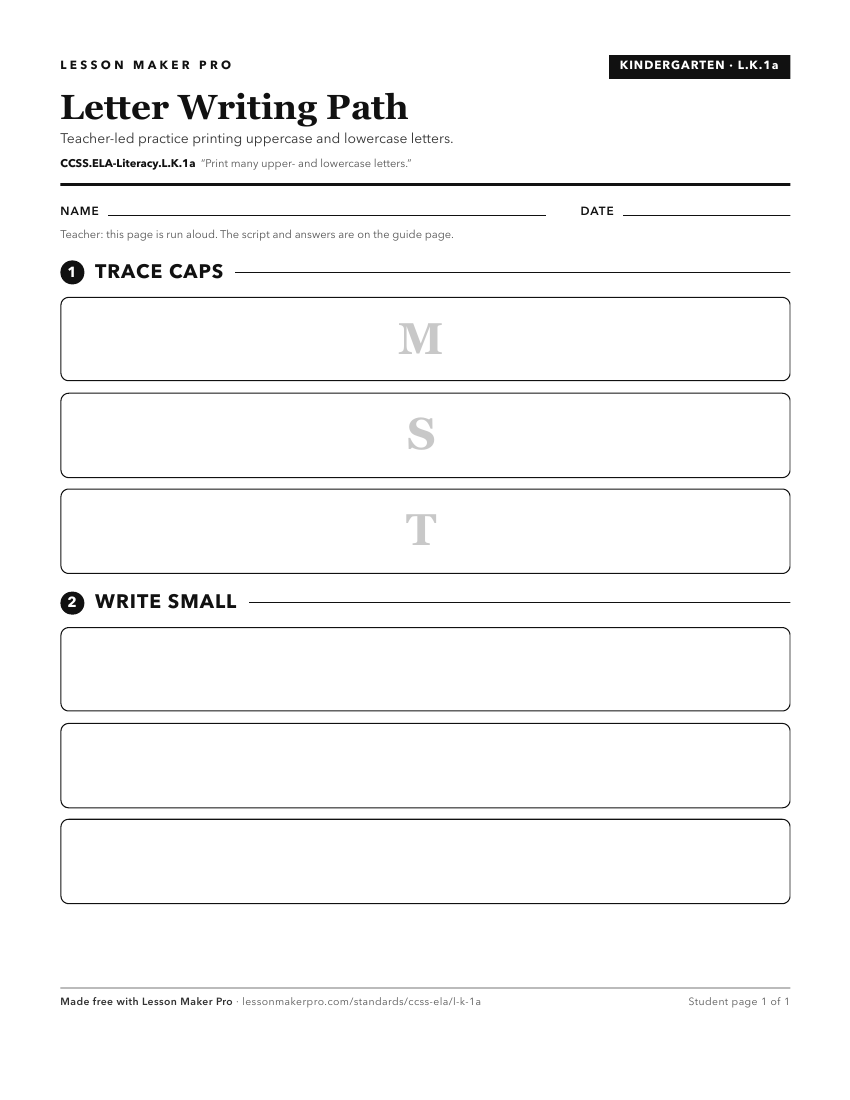
A ready-to-print activity worksheet aligned to CCSS.ELA-Literacy.L.K.1a, with an answer key for the teacher on its own page. No account needed.
PDF, US Letter, prints cleanly in black and white.
Download the worksheetLearning progression
Where This Standard Sits
What This Unlocks
Mastery here sets students up for these next.
Keep exploring
Related Standards
Turn this exact standard into a lesson
Grade, subject, topic, and the complete standard are prefilled. Create one free, no account needed.
Also for this standard:Make a WorksheetMake a QuizMake a Sub Lesson