CCSS.
The Standard
Use a semicolon (and perhaps a conjunctive adverb) to link two or more closely related independent clauses.
Common Core State Standards for English Language Arts
Teacher's field guide
What This Standard Means
What Students Need to Do
- Students join complete, closely connected thoughts with a semicolon. They may add transitions such as however, therefore, or meanwhile and punctuate them correctly.
What Mastery Looks Like
- Students can identify two complete thoughts that are closely connected and join them correctly. They can place a conjunctive adverb and its comma correctly without creating a run-on sentence.
Common Misconceptions
- Students may place a semicolon before a fragment or use it between unrelated ideas. They may use only a comma between complete thoughts or forget the comma after a conjunctive adverb.
How to Assess It
- Exit ticket: Combine “The rehearsal ended late. We still finished the set.” using a semicolon and the word “however.”
Lesson moves
Ways to Teach It
Give pairs sentence strips, semicolon cards, and conjunctive adverb cards, then have students build and read correct combinations.
Ask students to write two connected claims about school rules, join them with a semicolon, and explain why the ideas belong together.
Play Semicolon Sort: teams classify examples as correct, fragment, run-on, or unrelated, then repair each incorrect sentence.
Have students revise a short email or announcement by joining two related sentences where a semicolon would improve flow.
Free download
Printable L.9-10.2a Worksheet
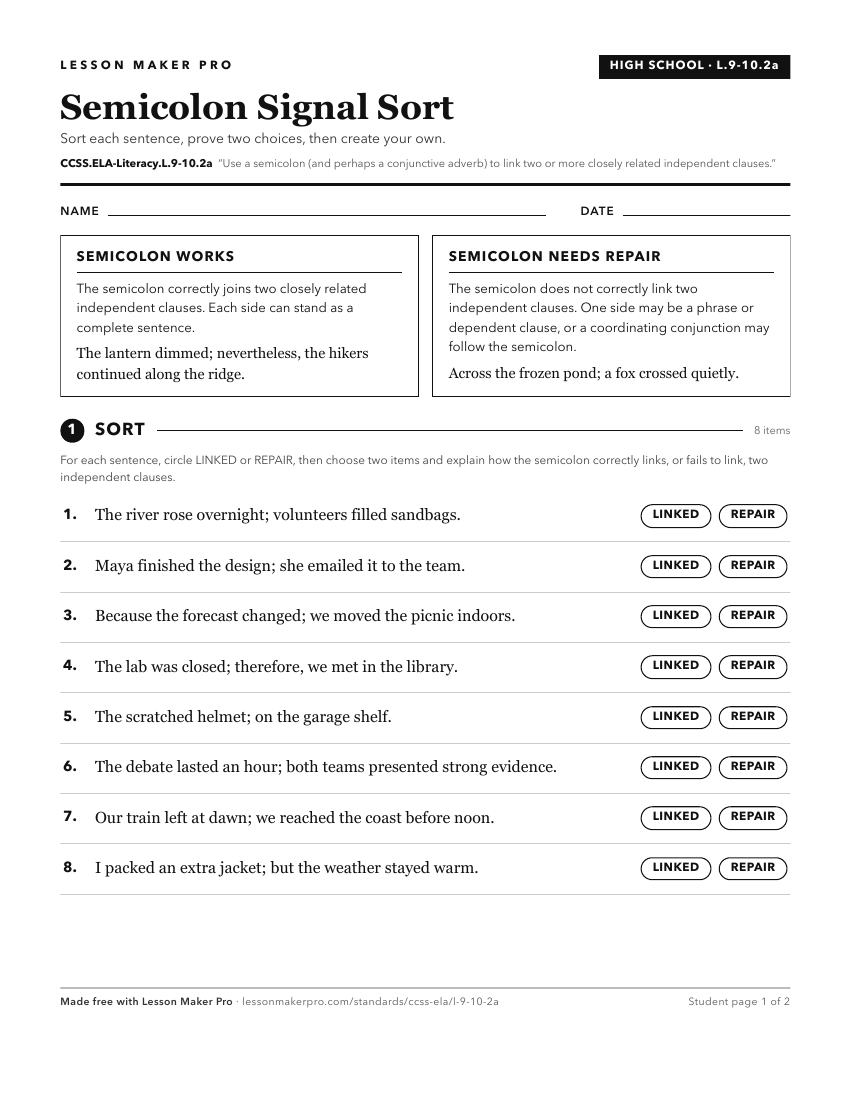
A ready-to-print activity worksheet aligned to CCSS.ELA-Literacy.L.9-10.2a, with an answer key for the teacher on its own page. No account needed.
PDF, US Letter, prints cleanly in black and white.
Download the worksheetLearning progression
Where This Standard Sits
Before This Standard
If students are struggling here, check these first.
Keep exploring
Related Standards
- CCSS.ELA-Literacy.L.4.2c
Use a comma before a coordinating conjunction in a compound sentence.
- CCSS.ELA-Literacy.W.3.2c
Use linking words and phrases (e.g., also, another, and, more, but) to connect ideas within categories of information.
- CCSS.ELA-Literacy.L.1.1g
Use frequently occurring conjunctions (e.g., and, but, or, so, because).
- CCSS.ELA-Literacy.L.3.1h
Use coordinating and subordinating conjunctions.
Turn this exact standard into a lesson
Grade, subject, topic, and the complete standard are prefilled. Create one free, no account needed.
Also for this standard:Make a WorksheetMake a QuizMake a Sub Lesson