CCSS.
The Standard
Use punctuation (comma, ellipsis, dash) to indicate a pause or break.
Common Core State Standards for English Language Arts
Teacher's field guide
What This Standard Means
What Students Need to Do
- Students use commas, ellipses, and dashes to show different kinds of pauses or breaks. They choose a mark based on meaning, pacing, and tone.
What Mastery Looks Like
- Students select punctuation that matches the intended pause, hesitation, interruption, or shift. They can explain how changing the mark changes pacing, emphasis, or tone.
Common Misconceptions
- Students often place a comma anywhere they hear a pause. They may confuse a dash with a hyphen or use ellipses with the wrong number of periods.
How to Assess It
- Give students this prompt: “Rewrite ‘I opened the door and saw my brother’ three times, using a comma, ellipsis, and dash. Label the effect of each choice.”
Lesson moves
Ways to Teach It
Give sentence strips and punctuation cards labeled comma, ellipsis, and dash; students place each card, then read the sentence aloud.
Rewrite “I opened the box and found my missing key” three ways, then explain how each punctuation choice changes pacing or emphasis.
Read mini dialogues aloud; teams hold up comma, ellipsis, or dash cards to match hesitation, a slight pause, or an abrupt interruption.
Examine punctuation in a comic, text exchange, or advertisement, then revise one line to create a different pause or break.
Free download
Printable L.8.2a Worksheet
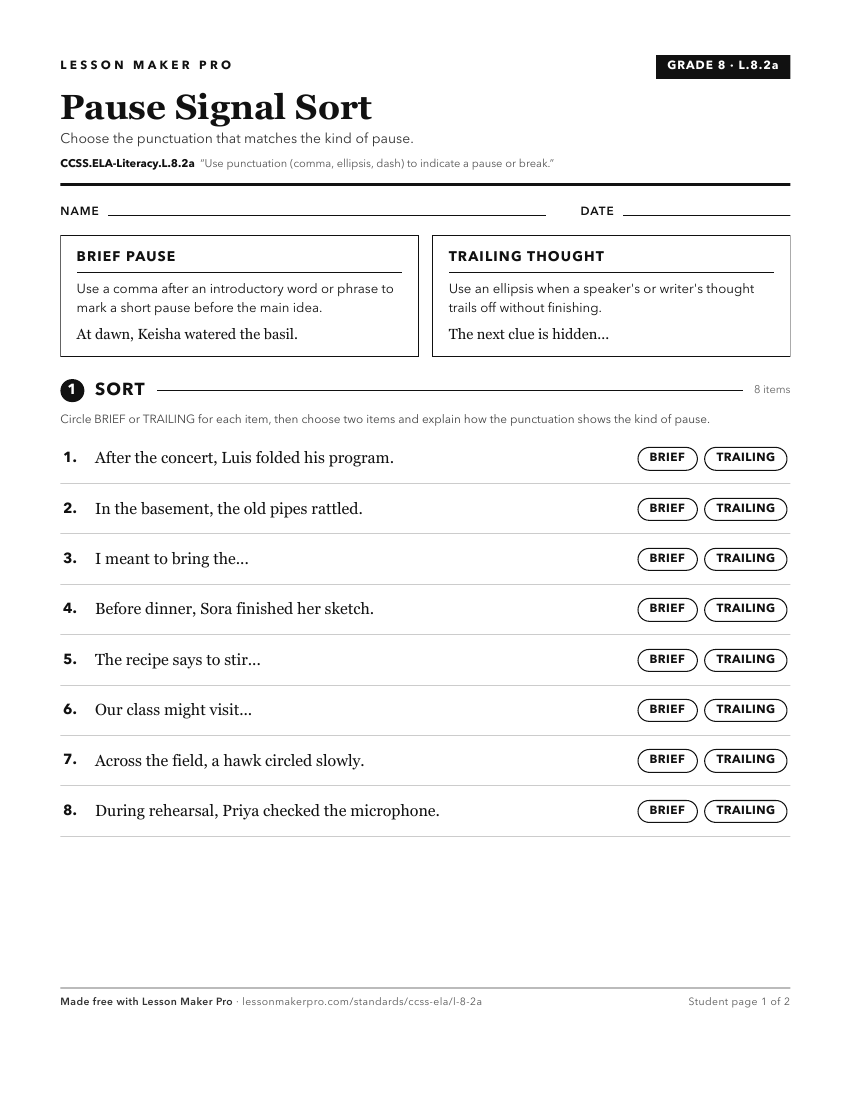
A ready-to-print activity worksheet aligned to CCSS.ELA-Literacy.L.8.2a, with an answer key for the teacher on its own page. No account needed.
PDF, US Letter, prints cleanly in black and white.
Download the worksheetLearning progression
Where This Standard Sits
Before This Standard
If students are struggling here, check these first.
What This Unlocks
Mastery here sets students up for these next.
Keep exploring
Related Standards
- CCSS.ELA-Literacy.L.4.3b
Choose punctuation for effect.
- CCSS.ELA-Literacy.L.5.2a
Use punctuation to separate items in a series.
- CCSS.ELA-Literacy.L.6.2a
Use punctuation (commas, parentheses, dashes) to set off nonrestrictive/parenthetical elements.
- CCSS.ELA-Literacy.L.8.2b
Use an ellipsis to indicate an omission.
Turn this exact standard into a lesson
Grade, subject, topic, and the complete standard are prefilled. Create one free, no account needed.
Also for this standard:Make a WorksheetMake a QuizMake a Sub Lesson