CCSS.
The Standard
Use a comma before a coordinating conjunction in a compound sentence.
Common Core State Standards for English Language Arts
Teacher's field guide
What This Standard Means
What Students Need to Do
- Students identify two complete thoughts joined by and, but, or, so, for, nor, or yet. They place a comma after the first complete thought and before the joining word.
What Mastery Looks Like
- Students can combine two related complete sentences and punctuate the result correctly. They can explain why no comma belongs in a sentence with one subject and two verbs.
Common Misconceptions
- Students often put a comma before every and or but. They may skip the comma because the sentence sounds smooth, or add one based only on a pause. They also confuse two complete thoughts with one subject doing two actions.
How to Assess It
- Exit ticket: Combine “Maya finished her book” and “she returned it to the library” using so, then underline both complete thoughts.
Lesson moves
Ways to Teach It
Give pairs sentence strips with complete thoughts, joining-word cards, and comma cards to build and punctuate compound sentences.
Ask, “Why does Jordan washed the dishes and dried them not need a comma?” Students explain using subjects and complete thoughts.
Play Comma or No Comma: display sentences, and students hold up response cards, then underline each complete thought.
Have students edit three comma choices in a mock class newsletter, then justify each correction in the margin.
Free download
Printable L.4.2c Worksheet
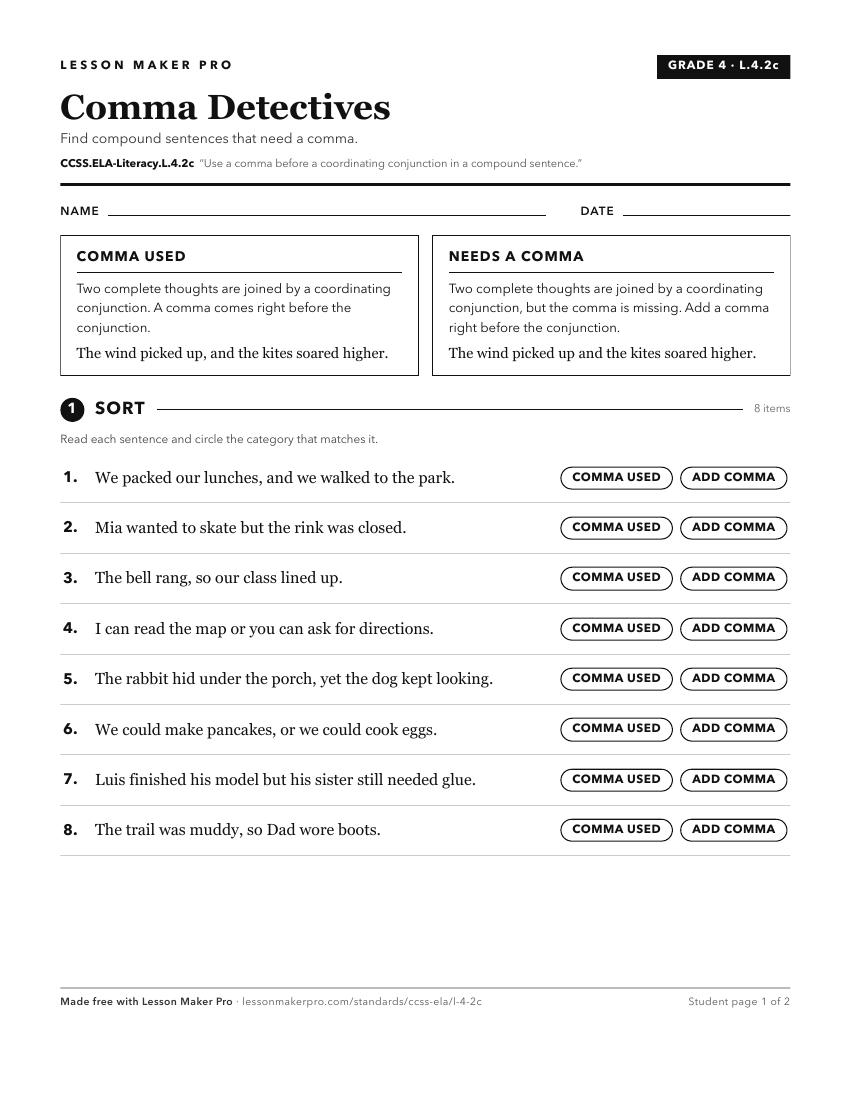
A ready-to-print activity worksheet aligned to CCSS.ELA-Literacy.L.4.2c, with an answer key for the teacher on its own page. No account needed.
PDF, US Letter, prints cleanly in black and white.
Download the worksheetLearning progression
Where This Standard Sits
Before This Standard
If students are struggling here, check these first.
What This Unlocks
Mastery here sets students up for these next.
Keep exploring
Related Standards
- CCSS.ELA-Literacy.L.7.2a
Use a comma to separate coordinate adjectives (e.g., It was a fascinating, enjoyable movie but not He wore an old[,] green shirt).
- CCSS.ELA-Literacy.L.9-10.2a
Use a semicolon (and perhaps a conjunctive adverb) to link two or more closely related independent clauses.
- CCSS.ELA-Literacy.L.5.2b
Use a comma to separate an introductory element from the rest of the sentence.
- CCSS.ELA-Literacy.L.3.1h
Use coordinating and subordinating conjunctions.
Turn this exact standard into a lesson
Grade, subject, topic, and the complete standard are prefilled. Create one free, no account needed.
Also for this standard:Make a WorksheetMake a QuizMake a Sub Lesson