CCSS.
The Standard
Use linking words and phrases (e.g., also, another, and, more, but) to connect ideas within categories of information.
Common Core State Standards for English Language Arts
Teacher's field guide
What This Standard Means
What Students Need to Do
- Students choose words that show addition or contrast between related facts. They place these words in sentences and paragraphs so information flows clearly within a section.
What Mastery Looks Like
- A student can choose a connector that clearly shows how one fact relates to the next. The student uses several connectors correctly without making the paragraph sound repetitive.
Common Misconceptions
- Students may treat connectors as interchangeable or begin every sentence with the same one. They may join unrelated facts or use time-order words when no sequence exists.
How to Assess It
- Ask students to write three sentences about frogs using “also” to add a related fact and “but” to show a difference.
Lesson moves
Ways to Teach It
Give pairs fact strips about one animal, then have them arrange and join the facts with connector word cards.
Ask students to explain how changing “also” to “but” changes the relationship between two facts.
Play Connector Match by having students pair sentence cards with the connector that best completes each pair.
Have students write a short museum label that connects three facts about one object or animal.
Free download
Printable W.3.2c Worksheet
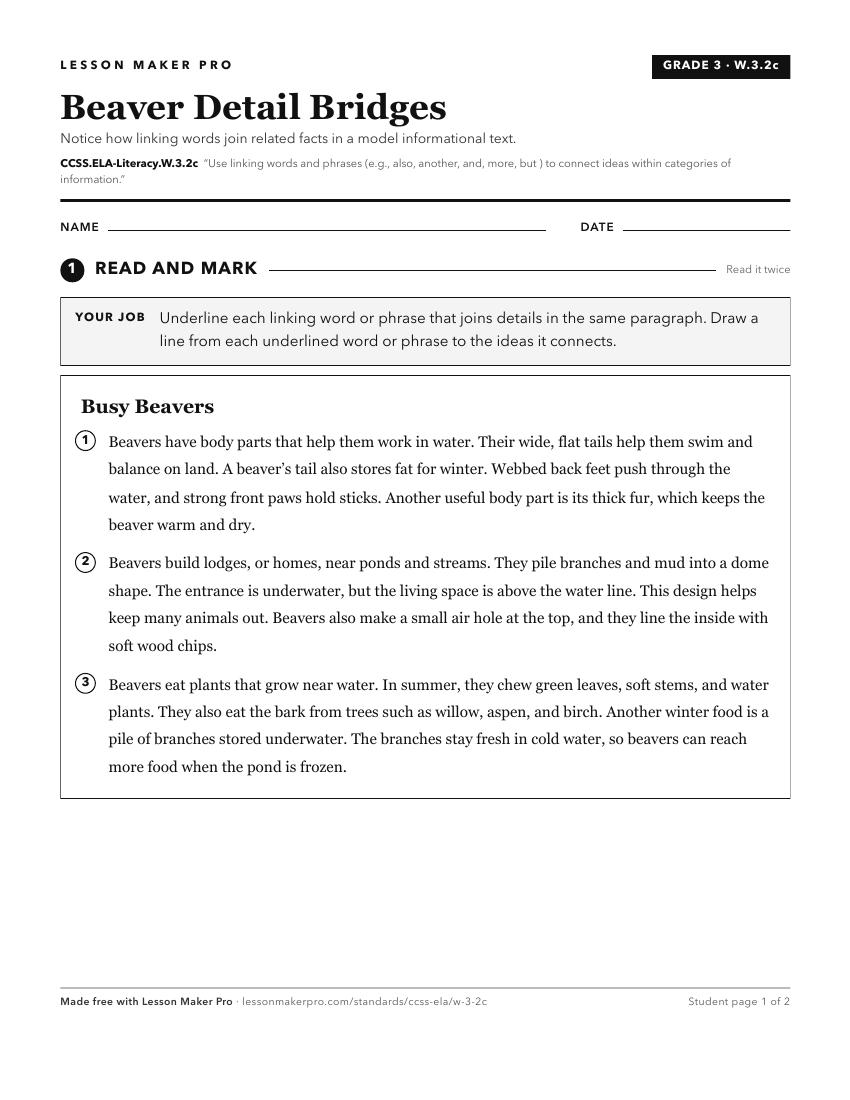
A ready-to-print activity worksheet aligned to CCSS.ELA-Literacy.W.3.2c, with an answer key for the teacher on its own page. No account needed.
PDF, US Letter, prints cleanly in black and white.
Download the worksheetLearning progression
Where This Standard Sits
What This Unlocks
Mastery here sets students up for these next.
Keep exploring
Related Standards
- CCSS.ELA-Literacy.W.4.1c
Link opinion and reasons using words and phrases (e.g., for instance, in order to, in addition).
- CCSS.ELA-Literacy.W.5.2c
Link ideas within and across categories of information using words, phrases, and clauses (e.g., in contrast, especially).
- CCSS.ELA-Literacy.W.3.1c
Use linking words and phrases (e.g., because, therefore, since, for example) to connect opinion and reasons.
Turn this exact standard into a lesson
Grade, subject, topic, and the complete standard are prefilled. Create one free, no account needed.
Also for this standard:Make a WorksheetMake a QuizMake a Sub Lesson