CCSS.
The Standard
Use linking words and phrases (e.g., because, therefore, since, for example) to connect opinion and reasons.
Common Core State Standards for English Language Arts
Teacher's field guide
What This Standard Means
What Students Need to Do
- Students connect an opinion to each supporting reason with words that make the relationship clear. They select connectors that show a cause, result, or example.
What Mastery Looks Like
- Students write a clear opinion and connect each reason to it smoothly. They choose words that correctly show a cause, result, or example.
Common Misconceptions
- Students may list reasons without showing how they support the opinion. They may choose a connector that does not fit, or write an incomplete sentence such as, “I agree because.”
How to Assess It
- Exit ticket: Write an opinion about school uniforms, give two reasons, and use two different linking words. Underline the linking words.
Lesson moves
Ways to Teach It
Give pairs opinion, reason, and linking word strips to arrange into two logical sentences, then read each sentence aloud.
Ask, “Should homework be optional?” Students state a reason, then rewrite their response using because or therefore.
Play Linking Word Match by drawing opinion and reason cards, choosing a fitting connector, and reading the completed sentence for a point.
Examine a school lunch review, circle its connectors, then add one sentence linking the writer’s opinion to a specific example.
Free download
Printable W.3.1c Worksheet
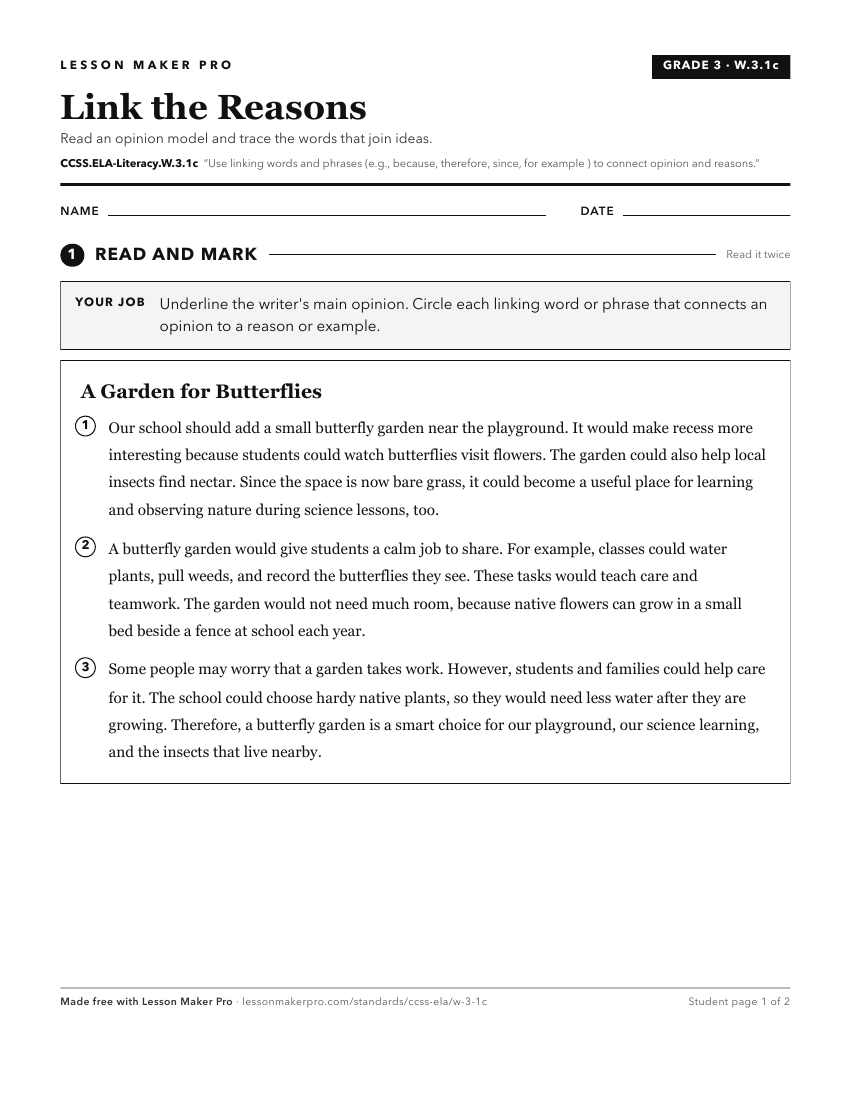
A ready-to-print activity worksheet aligned to CCSS.ELA-Literacy.W.3.1c, with an answer key for the teacher on its own page. No account needed.
PDF, US Letter, prints cleanly in black and white.
Download the worksheetLearning progression
Where This Standard Sits
What This Unlocks
Mastery here sets students up for these next.
Keep exploring
Related Standards
- CCSS.ELA-Literacy.WHST.9-10.1c
Use words, phrases, and clauses to link the major sections of the text, create cohesion, and clarify the relationships between claim(s) and reasons, between rea...
- CCSS.ELA-Literacy.W.9-10.1c
Use words, phrases, and clauses to link the major sections of the text, create cohesion, and clarify the relationships between claim(s) and reasons, between rea...
- CCSS.ELA-Literacy.W.5.1c
Link opinion and reasons using words, phrases, and clauses (e.g., consequently, specifically).
Turn this exact standard into a lesson
Grade, subject, topic, and the complete standard are prefilled. Create one free, no account needed.
Also for this standard:Make a WorksheetMake a QuizMake a Sub Lesson