CCSS.
The Standard
Demonstrate understanding of figurative language, word relationships, and nuances in word meanings.
Common Core State Standards for English Language Arts · Language Standards
Teacher's field guide
What This Standard Means
What Students Need to Do
- Students explain nonliteral phrases and familiar allusions in context. They use analogies and other word relationships to infer meaning, then compare the tone of near-synonyms.
What Mastery Looks Like
- Students explain a figure of speech or allusion using clues from the passage. They complete analogies and choose among similar words based on the tone a writer wants.
Common Misconceptions
- Students may read figurative phrases literally or miss allusions they do not recognize. They may treat synonyms as interchangeable and overlook how context changes a word’s tone.
How to Assess It
- Use a three-part exit ticket: explain “Leo met his Waterloo,” complete “whisper is to speak as nibble is to ___,” and compare “confident” with “arrogant.”
Lesson moves
Ways to Teach It
Give pairs phrase cards to sort as literal, figurative, or allusion, then have them explain each choice using a context sentence.
Ask students to explain how replacing “slender” with “skinny” changes the tone of a character description.
Play an analogy relay where teams complete word pairs and state the relationship, such as part to whole or cause to effect.
Collect headlines and advertisements, then identify loaded words and rewrite each example with a more neutral word.
Free download
Printable L.7.5 Worksheet
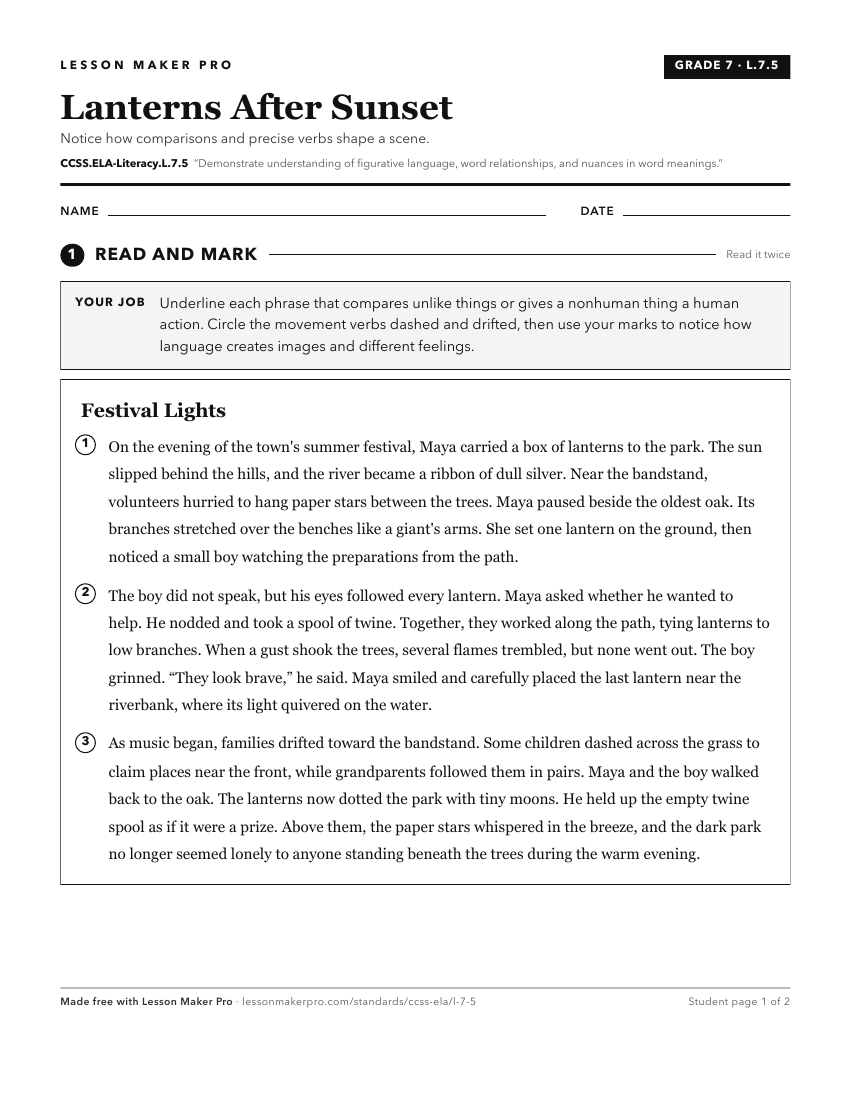
A ready-to-print activity worksheet aligned to CCSS.ELA-Literacy.L.7.5, with an answer key for the teacher on its own page. No account needed.
PDF, US Letter, prints cleanly in black and white.
Download the worksheetBefore This Standard
If students are struggling here, check these first.
What This Unlocks
Mastery here sets students up for these next.
Keep exploring
Related Standards
Turn this exact standard into a lesson
Grade, subject, topic, and the complete standard are prefilled. Create one free, no account needed.
Also for this standard:Make a WorksheetMake a QuizMake a Sub Lesson