CCSS.
The Standard
Demonstrate understanding of figurative language, word relationships, and nuances in word meanings.
Common Core State Standards for English Language Arts · Language Standards
Teacher's field guide
What This Standard Means
What Students Need to Do
- Students interpret figurative expressions in context, including metaphor, hyperbole, and paradox. They explain relationships among words, such as analogy, cause and effect, or part and whole. They compare near-synonyms and explain how connotation changes tone and meaning.
What Mastery Looks Like
- Given a complex passage, students can explain what a figure of speech means and cite context that supports their reading. They can explain an analogy and choose the most precise word from several near-synonyms based on tone.
Common Misconceptions
- Students may read every phrase literally or label a device without explaining its effect. They often treat near-synonyms as interchangeable and miss positive, negative, or formal connotations. They may solve analogies through loose association rather than matching the exact relationship.
How to Assess It
- Exit ticket: Read, “The committee’s praise was a velvet leash,” and explain the metaphor. Then explain hand:glove::foot:sock and use either “persistent” or “stubborn” to show disapproval.
Lesson moves
Ways to Teach It
Have groups sort phrase cards into literal, metaphor, hyperbole, and paradox, then annotate the context clue that supports each choice.
Ask students to compare “confident,” “assertive,” and “arrogant” in one character description and defend which word best fits the author’s tone.
Run an analogy relay where teams match word pairs, state the relationship, and reject one tempting but incorrect match.
Collect three headlines or advertisements with figurative wording, then have students explain the intended meaning and the connotation of one key word.
Free download
Printable L.11-12.5 Worksheet
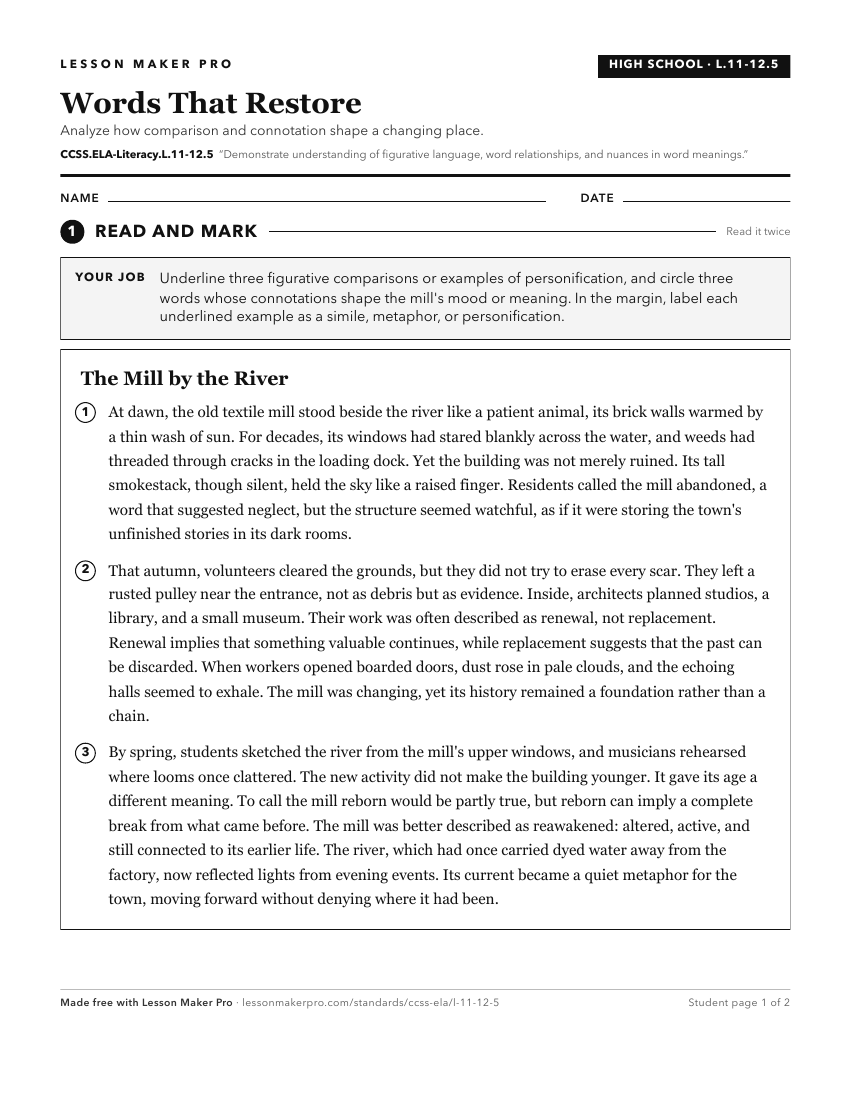
A ready-to-print activity worksheet aligned to CCSS.ELA-Literacy.L.11-12.5, with an answer key for the teacher on its own page. No account needed.
PDF, US Letter, prints cleanly in black and white.
Download the worksheetBefore This Standard
If students are struggling here, check these first.
Keep exploring
Related Standards
Turn this exact standard into a lesson
Grade, subject, topic, and the complete standard are prefilled. Create one free, no account needed.
Also for this standard:Make a WorksheetMake a QuizMake a Sub Lesson