CCSS.
The Standard
Use common, grade-appropriate Greek or Latin affixes and roots as clues to the meaning of a word (e.g., belligerent, bellicose, rebel).
Common Core State Standards for English Language Arts
Teacher's field guide
What This Standard Means
What Students Need to Do
- Students break unfamiliar words into roots, prefixes, and suffixes. They use the meanings of those parts to predict a word's meaning, then check the prediction against context.
What Mastery Looks Like
- Students accurately identify familiar roots and affixes in new words. They explain how each part shapes the word's meaning, then confirm that meaning with context.
Common Misconceptions
- Students may treat any familiar letter group as a root, even when it is not. They may use one word part as the full definition or ignore sentence context. They may also confuse roots, prefixes, and suffixes.
How to Assess It
- Use this exit ticket: “The alarm was barely audible across the crowded gym.” Students underline the word parts, explain them, and infer the meaning of “audible.”
Lesson moves
Ways to Teach It
Give pairs root, prefix, and suffix cards to build words, then have them write a possible meaning for each word.
Ask students to explain in writing how the parts of “transportation” help reveal its meaning.
Play a matching game where teams pair unfamiliar words with root meanings, then earn points by explaining each match.
Have students find five Greek or Latin word parts in a science article and annotate how each part helps define the word.
Free download
Printable L.7.4b Worksheet
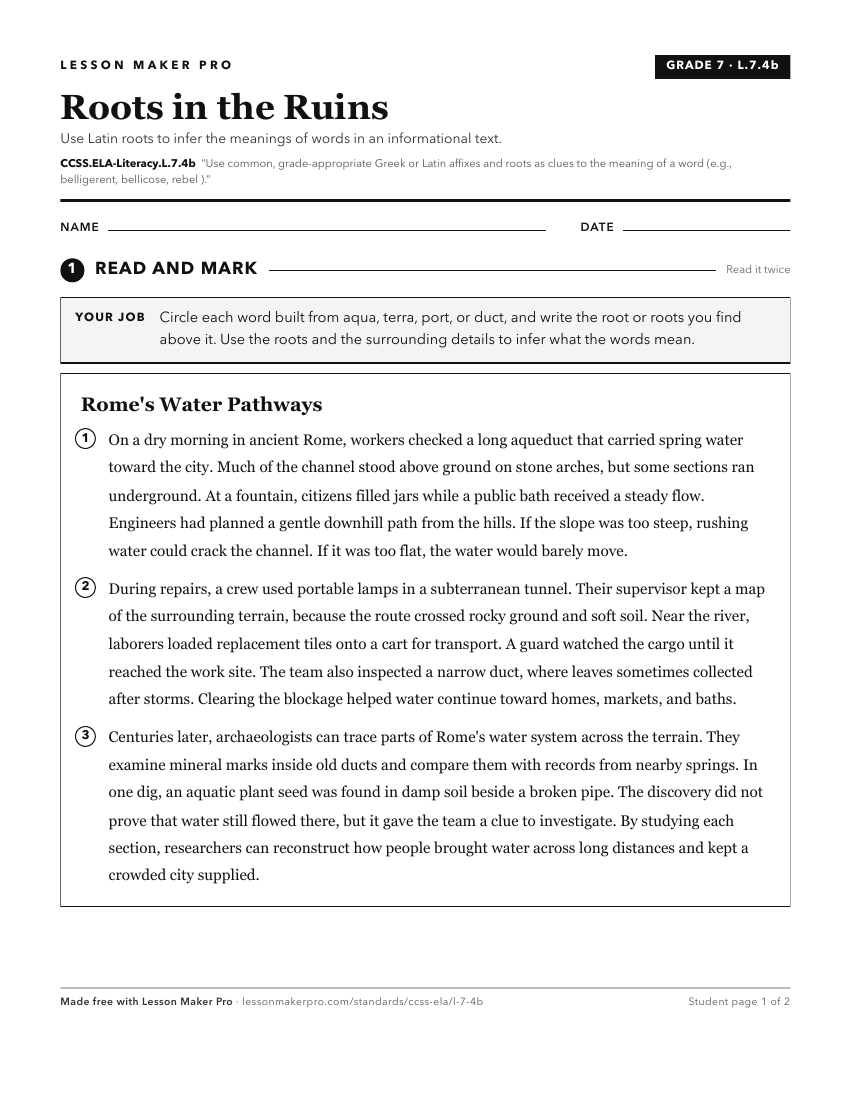
A ready-to-print activity worksheet aligned to CCSS.ELA-Literacy.L.7.4b, with an answer key for the teacher on its own page. No account needed.
PDF, US Letter, prints cleanly in black and white.
Download the worksheetLearning progression
Where This Standard Sits
Before This Standard
If students are struggling here, check these first.
What This Unlocks
Mastery here sets students up for these next.
Keep exploring
Related Standards
- CCSS.ELA-Literacy.L.5.4b
Use common, grade-appropriate Greek and Latin affixes and roots as clues to the meaning of a word (e.g., photograph, photosynthesis).
- CCSS.ELA-Literacy.L.4.4b
Use common, grade-appropriate Greek and Latin affixes and roots as clues to the meaning of a word (e.g., telegraph, photograph, autograph).
Turn this exact standard into a lesson
Grade, subject, topic, and the complete standard are prefilled. Create one free, no account needed.
Also for this standard:Make a WorksheetMake a QuizMake a Sub Lesson