CCSS.
The Standard
Use common, grade-appropriate Greek or Latin affixes and roots as clues to the meaning of a word (e.g., audience, auditory, audible).
Common Core State Standards for English Language Arts
Teacher's field guide
What This Standard Means
What Students Need to Do
- Students break unfamiliar words into roots, prefixes, and suffixes. They use the meanings of those parts to predict what the whole word means.
What Mastery Looks Like
- Students can identify a familiar root or affix in an unfamiliar word. They use that part and the sentence context to give a reasonable meaning and explain their thinking.
Common Misconceptions
- Students may assume a root always keeps one fixed meaning. They may also split words at the wrong point or treat any familiar letter group as a meaningful part.
How to Assess It
- Give this exit ticket: “The announcement was inaudible from the back row.” Use the word parts in inaudible to explain its meaning.
Lesson moves
Ways to Teach It
Give pairs root and affix cards, then have them build words, predict meanings, and verify each word in a dictionary.
Ask students to write how inspect, spectator, and spectacle share a meaning connected to seeing.
Play Root Relay: teams sort word cards under aud, port, scrib, and dict, then justify one placement aloud.
Students collect five root-based words from school signs, menus, or app screens and label each word part and likely meaning.
Free download
Printable L.6.4b Worksheet
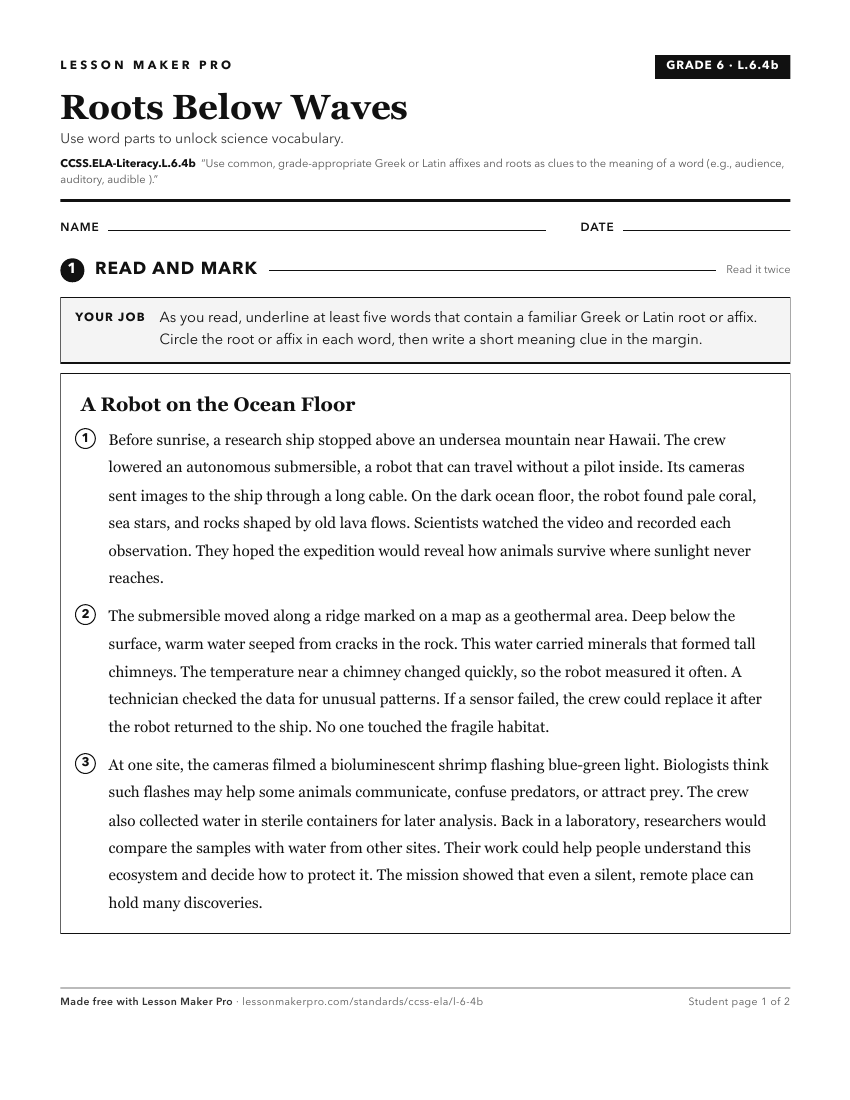
A ready-to-print activity worksheet aligned to CCSS.ELA-Literacy.L.6.4b, with an answer key for the teacher on its own page. No account needed.
PDF, US Letter, prints cleanly in black and white.
Download the worksheetLearning progression
Where This Standard Sits
Before This Standard
If students are struggling here, check these first.
What This Unlocks
Mastery here sets students up for these next.
Keep exploring
Related Standards
- CCSS.ELA-Literacy.L.8.4b
Use common, grade-appropriate Greek or Latin affixes and roots as clues to the meaning of a word (e.g., precede, recede, secede).
- CCSS.ELA-Literacy.L.4.4b
Use common, grade-appropriate Greek and Latin affixes and roots as clues to the meaning of a word (e.g., telegraph, photograph, autograph).
Turn this exact standard into a lesson
Grade, subject, topic, and the complete standard are prefilled. Create one free, no account needed.
Also for this standard:Make a WorksheetMake a QuizMake a Sub Lesson