CCSS.
The Standard
Recognize and explain the meaning of common idioms, adages, and proverbs.
Common Core State Standards for English Language Arts
Teacher's field guide
What This Standard Means
What Students Need to Do
- Students identify when a familiar saying has a meaning beyond its exact words. They explain the message or advice and connect it to a fitting situation.
What Mastery Looks Like
- Students explain the intended message in their own words and use context to support the explanation. They can give a fitting situation or example without relying on the literal wording.
Common Misconceptions
- Students may interpret phrases word for word, such as imagining real spilled beans. They may also confuse an idiom with a proverb or explain an example without stating its broader meaning.
How to Assess It
- Exit ticket: Explain what “Don’t count your chickens before they hatch” means, then give one situation where the advice fits.
Lesson moves
Ways to Teach It
Give pairs expression cards, meaning cards, and situation cards to match, then have them explain each match.
Ask students to write about a time when “actions speak louder than words” applied to a real or fictional person.
Run a team relay where students match familiar sayings to meanings and earn a point by using each correctly.
Have students collect sayings heard at home, in sports, or on television, then explain what each speaker meant.
Free download
Printable L.5.5b Worksheet
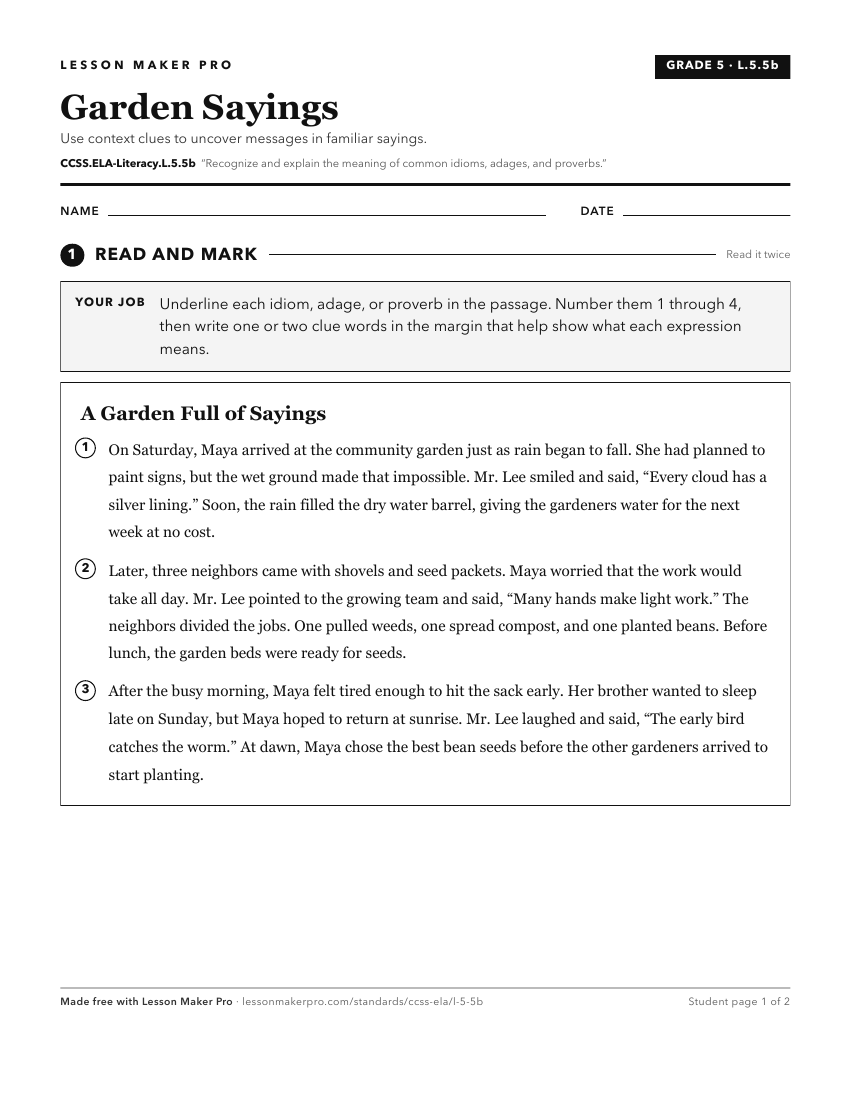
A ready-to-print activity worksheet aligned to CCSS.ELA-Literacy.L.5.5b, with an answer key for the teacher on its own page. No account needed.
PDF, US Letter, prints cleanly in black and white.
Download the worksheetLearning progression
Where This Standard Sits
Before This Standard
If students are struggling here, check these first.
Keep exploring
Related Standards
- CCSS.ELA-Literacy.L.6.5
Demonstrate understanding of figurative language, word relationships, and nuances in word meanings.
- CCSS.ELA-Literacy.CCRA.L.5
Demonstrate understanding of figurative language, word relationships, and nuances in word meanings.
- CCSS.ELA-Literacy.L.11-12.5
Demonstrate understanding of figurative language, word relationships, and nuances in word meanings.
Turn this exact standard into a lesson
Grade, subject, topic, and the complete standard are prefilled. Create one free, no account needed.
Also for this standard:Make a WorksheetMake a QuizMake a Sub Lesson