CCSS.
The Standard
Use a comma to set off the words yes and no (e.g., Yes, thank you), to set off a tag question from the rest of the sentence (e.g., It's true, isn't it?), and to indicate direct address (e.g., Is that you, Steve?).
Common Core State Standards for English Language Arts
Teacher's field guide
What This Standard Means
What Students Need to Do
- Students place commas correctly in replies that begin with yes or no, before tag questions, and around names used in direct address. They identify the comma’s purpose in each sentence.
What Mastery Looks Like
- Students correctly punctuate sentences that include short replies, tag questions, and direct address. They can explain why each comma belongs and distinguish direct address from a name used as the subject.
Common Misconceptions
- Students may omit the comma after an opening yes or no, or add one whenever those words appear anywhere. They may also confuse a person being addressed with the subject of the sentence. Some attach a tag question without a comma.
How to Assess It
- Give this exit ticket: Punctuate “No I did not,” “You brought your book didn’t you?” and “Can you help me Jordan?” Ask students to label each comma’s job.
Lesson moves
Ways to Teach It
Give pairs sentence strips and comma tiles; students place each tile, read the sentence aloud, then explain the pause.
Have students write three lunchroom lines: one beginning with yes or no, one tag question, and one addressing a classmate.
Play Comma Corners: display a sentence, and students move to yes or no, tag question, direct address, or no comma.
Students edit a short email to a coach, adding commas around the coach’s name and after opening yes or no responses.
Free download
Printable L.5.2c Worksheet
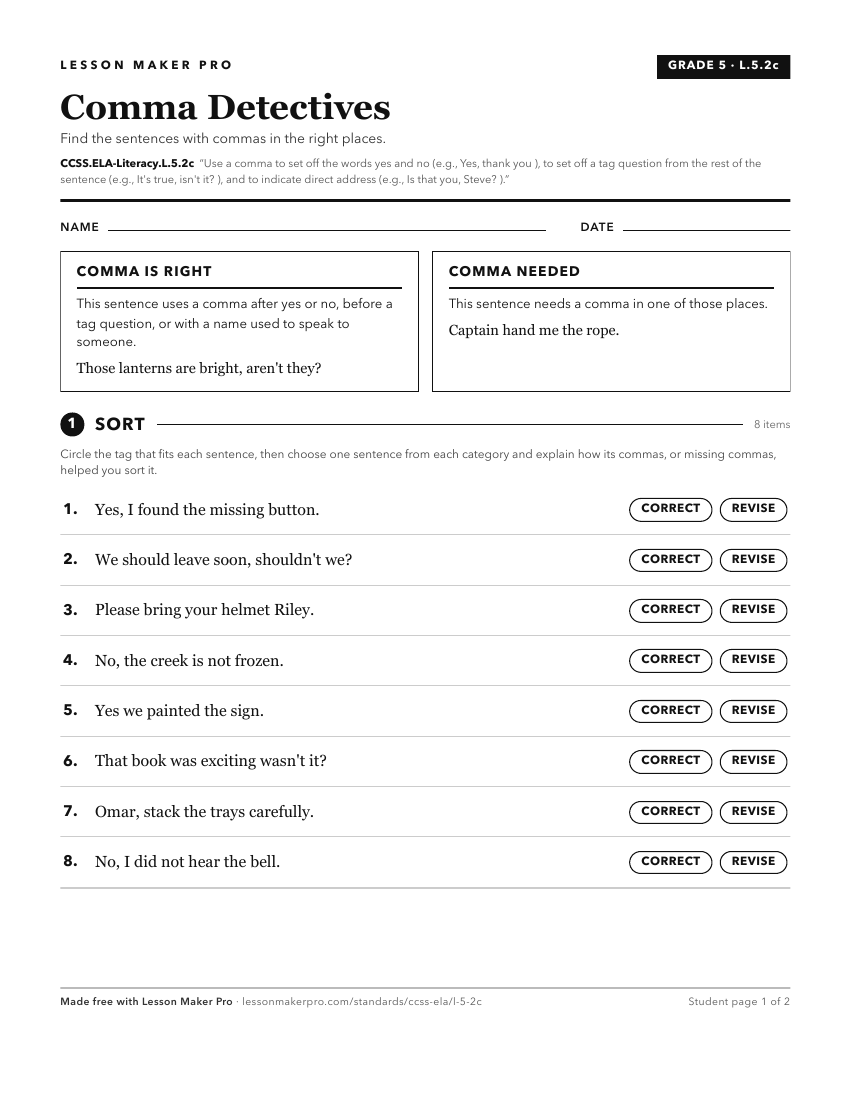
A ready-to-print activity worksheet aligned to CCSS.ELA-Literacy.L.5.2c, with an answer key for the teacher on its own page. No account needed.
PDF, US Letter, prints cleanly in black and white.
Download the worksheetLearning progression
Where This Standard Sits
Before This Standard
If students are struggling here, check these first.
Keep exploring
Related Standards
- CCSS.ELA-Literacy.L.4.2b
Use commas and quotation marks to mark direct speech and quotations from a text.
- CCSS.ELA-Literacy.L.2.2b
Use commas in greetings and closings of letters.
- CCSS.ELA-Literacy.L.6.2a
Use punctuation (commas, parentheses, dashes) to set off nonrestrictive/parenthetical elements.
- CCSS.ELA-Literacy.L.8.2a
Use punctuation (comma, ellipsis, dash) to indicate a pause or break.
Turn this exact standard into a lesson
Grade, subject, topic, and the complete standard are prefilled. Create one free, no account needed.
Also for this standard:Make a WorksheetMake a QuizMake a Sub Lesson