CCSS.
The Standard
Use commas and quotation marks to mark direct speech and quotations from a text.
Common Core State Standards for English Language Arts
Teacher's field guide
What This Standard Means
What Students Need to Do
- Students mark a speaker’s exact words or words copied from a text with quotation marks. They place commas correctly between quoted words and the rest of the sentence.
What Mastery Looks Like
- Students correctly place quotation marks around exact words. They use commas to separate those words from speaker tags and introductory phrases.
Common Misconceptions
- Students may place commas outside the closing quotation mark or omit them before a speaker tag. They may also use quotation marks around indirect speech or include the speaker tag inside the quotation marks.
How to Assess It
- Exit ticket: Correct “Lena said I finished the map,” then write a sentence introducing this quotation from a passage: “The river rose overnight.”
Lesson moves
Ways to Teach It
Give pairs word cards, comma cards, and quotation mark cards to arrange into correctly punctuated dialogue sentences.
Compare “Luis said that he was ready” with “Luis said, ‘I am ready,’” and explain why the punctuation differs.
Run a punctuation relay where teams add commas and quotation marks to unpunctuated dialogue posted around the room.
Have students interview a classmate, then write one exact quotation for a class newsletter.
Free download
Printable L.4.2b Worksheet
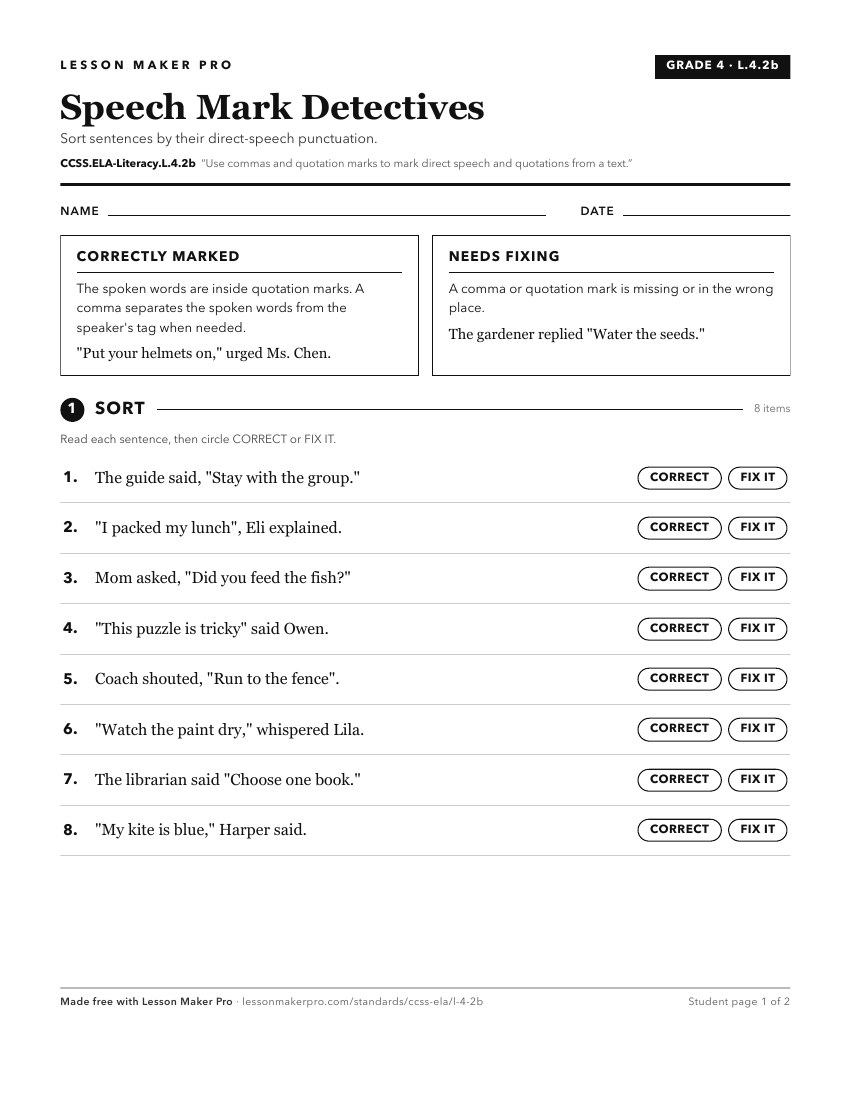
A ready-to-print activity worksheet aligned to CCSS.ELA-Literacy.L.4.2b, with an answer key for the teacher on its own page. No account needed.
PDF, US Letter, prints cleanly in black and white.
Download the worksheetLearning progression
Where This Standard Sits
Before This Standard
If students are struggling here, check these first.
What This Unlocks
Mastery here sets students up for these next.
Keep exploring
Related Standards
- CCSS.ELA-Literacy.L.3.2c
Use commas and quotation marks in dialogue.
- CCSS.ELA-Literacy.L.6.2a
Use punctuation (commas, parentheses, dashes) to set off nonrestrictive/parenthetical elements.
- CCSS.ELA-Literacy.L.1.2c
Use commas in dates and to separate single words in a series.
- CCSS.ELA-Literacy.L.5.2c
Use a comma to set off the words yes and no (e.g., Yes, thank you), to set off a tag question from the rest of the sentence (e.g., It's true, isn't it?), and to...
Turn this exact standard into a lesson
Grade, subject, topic, and the complete standard are prefilled. Create one free, no account needed.
Also for this standard:Make a WorksheetMake a QuizMake a Sub Lesson