CCSS.
The Standard
Use commas and quotation marks in dialogue.
Common Core State Standards for English Language Arts
Teacher's field guide
What This Standard Means
What Students Need to Do
- Students punctuate spoken words so readers know exactly what a character says. They place quotation marks around the speech and add commas correctly beside speaker tags.
What Mastery Looks Like
- Students correctly punctuate dialogue when the speaker tag comes before or after the spoken words. They keep commas inside closing quotation marks and use question marks or exclamation points when needed.
Common Misconceptions
- Students may put quotation marks around the speaker tag or place commas outside the closing quotation mark. They may omit the comma after a beginning speaker tag. They may also replace a question mark or exclamation point with a comma.
How to Assess It
- Give students: Maya said I lost my pencil and Where is it asked Leo. Ask them to rewrite both sentences with correct punctuation.
Lesson moves
Ways to Teach It
Give pairs word cards and punctuation cards to arrange into correctly punctuated dialogue sentences.
Ask students to explain how punctuation changes when a speaker tag moves from the beginning to the end.
Play Dialogue Fix-It by having teams correct one punctuation error in each sentence posted around the room.
Have students interview a classmate, then write two answers as dialogue with one speaker tag before and one after the spoken words.
Free download
Printable L.3.2c Worksheet
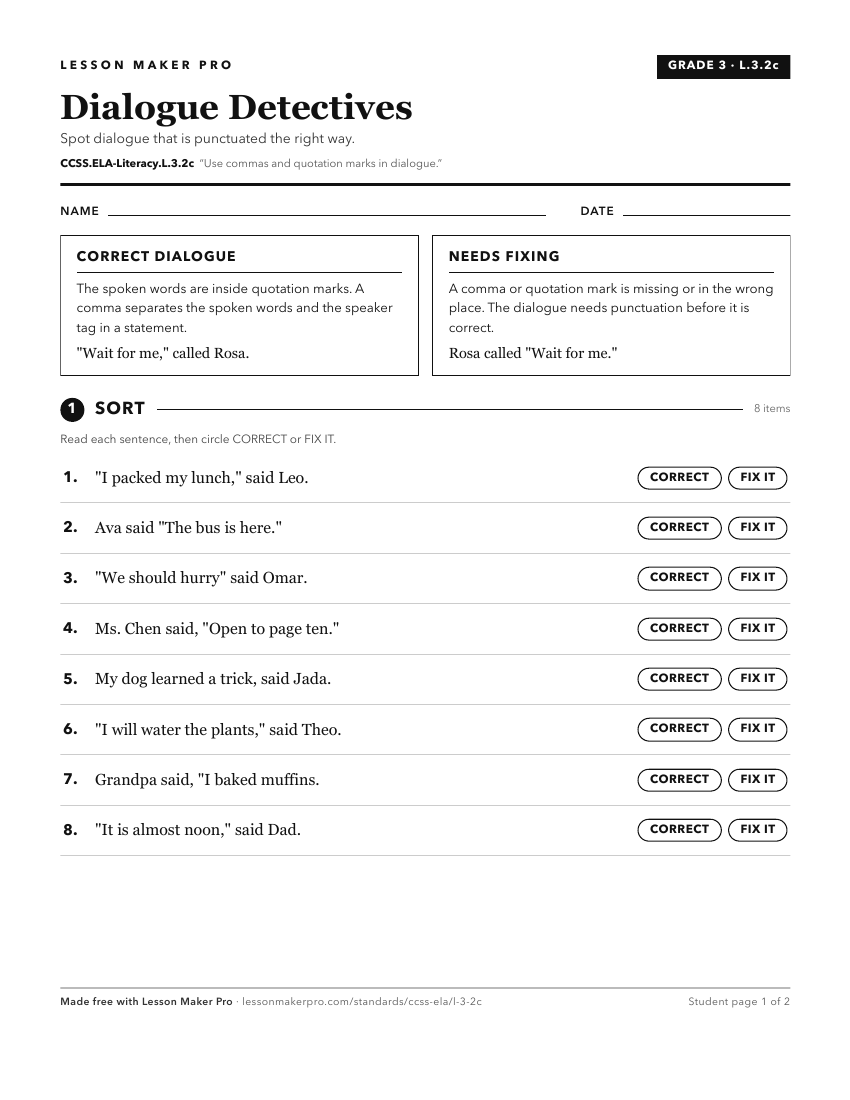
A ready-to-print activity worksheet aligned to CCSS.ELA-Literacy.L.3.2c, with an answer key for the teacher on its own page. No account needed.
PDF, US Letter, prints cleanly in black and white.
Download the worksheetLearning progression
Where This Standard Sits
What This Unlocks
Mastery here sets students up for these next.
Keep exploring
Related Standards
- CCSS.ELA-Literacy.L.4.2b
Use commas and quotation marks to mark direct speech and quotations from a text.
- CCSS.ELA-Literacy.L.2.2b
Use commas in greetings and closings of letters.
- CCSS.ELA-Literacy.L.6.2a
Use punctuation (commas, parentheses, dashes) to set off nonrestrictive/parenthetical elements.
- CCSS.ELA-Literacy.L.3.2b
Use commas in addresses.
Turn this exact standard into a lesson
Grade, subject, topic, and the complete standard are prefilled. Create one free, no account needed.
Also for this standard:Make a WorksheetMake a QuizMake a Sub Lesson