CCSS.
The Standard
Use spelling patterns and generalizations (e.g., word families, position-based spellings, syllable patterns, ending rules, meaningful word parts) in writing words.
Common Core State Standards for English Language Arts
Teacher's field guide
What This Standard Means
What Students Need to Do
- Students use familiar letter patterns, syllable chunks, and meaningful word parts to spell words. They also apply rules when adding endings such as -ed and -ing.
What Mastery Looks Like
- Students correctly spell familiar words and make reasonable attempts at new words by using known patterns. They apply ending rules and use roots, prefixes, suffixes, and syllables as guides.
Common Misconceptions
- Students may spell only by sound, leading to forms such as "hopeing" or "carryed." They may miss useful roots, prefixes, suffixes, and syllable chunks within longer words.
How to Assess It
- Dictate bright, carried, hoping, replay, farmer, and sunshine. Have students circle the helpful pattern or word part in two words.
Lesson moves
Ways to Teach It
Give pairs word cards to sort by pattern, such as silent e, vowel teams, doubled consonants, and changed y endings.
Ask students to explain in writing how the spelling changes from carry to carried and hope to hoping.
Play Spelling Detective, where teams find and correct patterned spelling errors in short sentences.
Have students create a grocery list, then group words by syllables, word families, or meaningful word parts.
Free download
Printable L.3.2f Worksheet
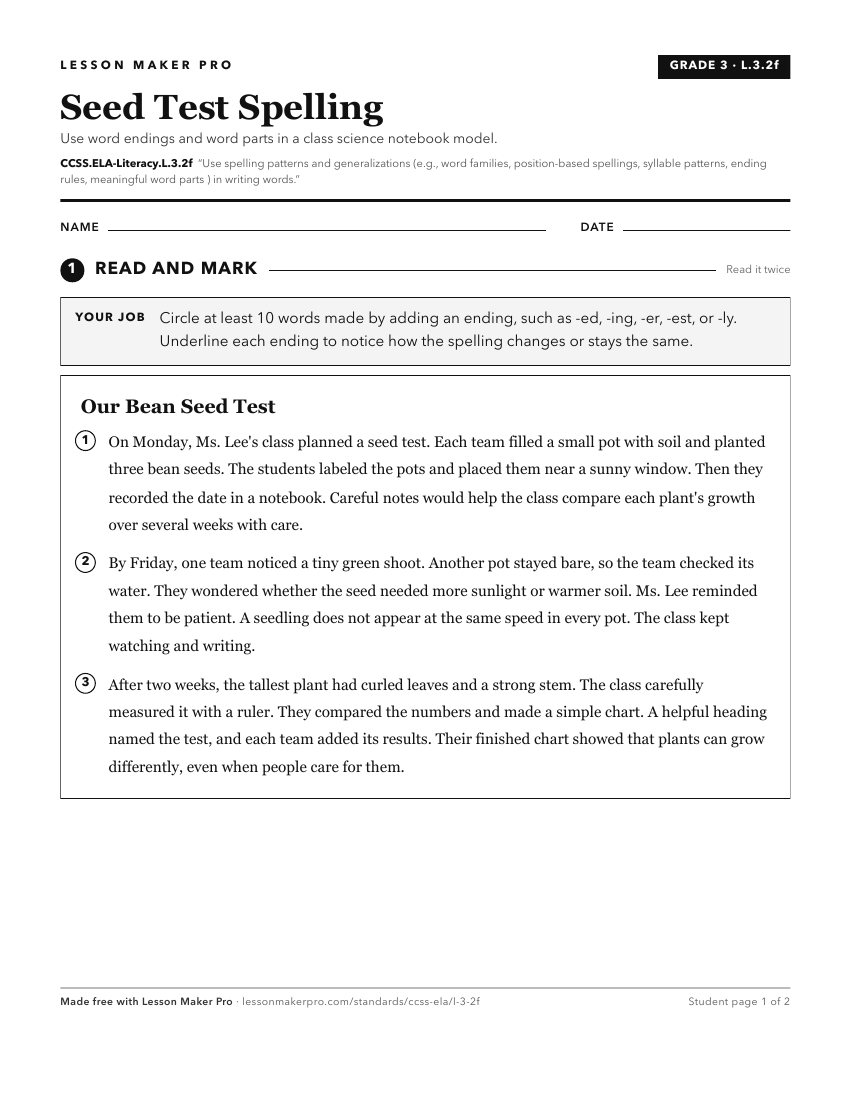
A ready-to-print activity worksheet aligned to CCSS.ELA-Literacy.L.3.2f, with an answer key for the teacher on its own page. No account needed.
PDF, US Letter, prints cleanly in black and white.
Download the worksheetKeep exploring
Related Standards
- CCSS.ELA-Literacy.L.3.2e
Use conventional spelling for high-frequency and other studied words and for adding suffixes to base words (e.g., sitting, smiled, cries, happiness).
- CCSS.ELA-Literacy.L.1.2d
Use conventional spelling for words with common spelling patterns and for frequently occurring irregular words.
- CCSS.ELA-Literacy.L.1.2e
Spell untaught words phonetically, drawing on phonemic awareness and spelling conventions.
- CCSS.ELA-Literacy.L.2.2d
Generalize learned spelling patterns when writing words (e.g., cage → badge; boy → boil).
Turn this exact standard into a lesson
Grade, subject, topic, and the complete standard are prefilled. Create one free, no account needed.
Also for this standard:Make a WorksheetMake a QuizMake a Sub Lesson