CCSS.
The Standard
Use conventional spelling for high-frequency and other studied words and for adding suffixes to base words (e.g., sitting, smiled, cries, happiness).
Common Core State Standards for English Language Arts
Teacher's field guide
What This Standard Means
What Students Need to Do
- Students spell familiar, frequently used words correctly from memory. They add endings such as -ing, -ed, -es, and -ness while making needed changes to the base word.
What Mastery Looks Like
- A student writes familiar words correctly in sentences without relying on phonetic guesses. The student doubles consonants, drops final e, and changes y to i when needed.
Common Misconceptions
- Students may spell common words exactly as they sound, especially words with irregular patterns. They may keep a final e before -ing, forget to double a final consonant, or leave y unchanged before some suffixes.
How to Assess It
- On an exit ticket, ask students to spell people and every, then change run to running, hope to hoped, carry to carries, and kind to kindness.
Lesson moves
Ways to Teach It
Give pairs base-word and suffix cards; students build words, write them, and explain each spelling change to a partner.
Ask students to write four sentences using running, hoped, carries, and kindness, then label each base word and spelling change.
Play Suffix Sort: teams place word cards under double, drop e, change y, or no change, then check with a dictionary.
Have students edit a pretend class announcement, correcting misspelled common words and suffix forms before posting the clean copy.
Free download
Printable L.3.2e Worksheet
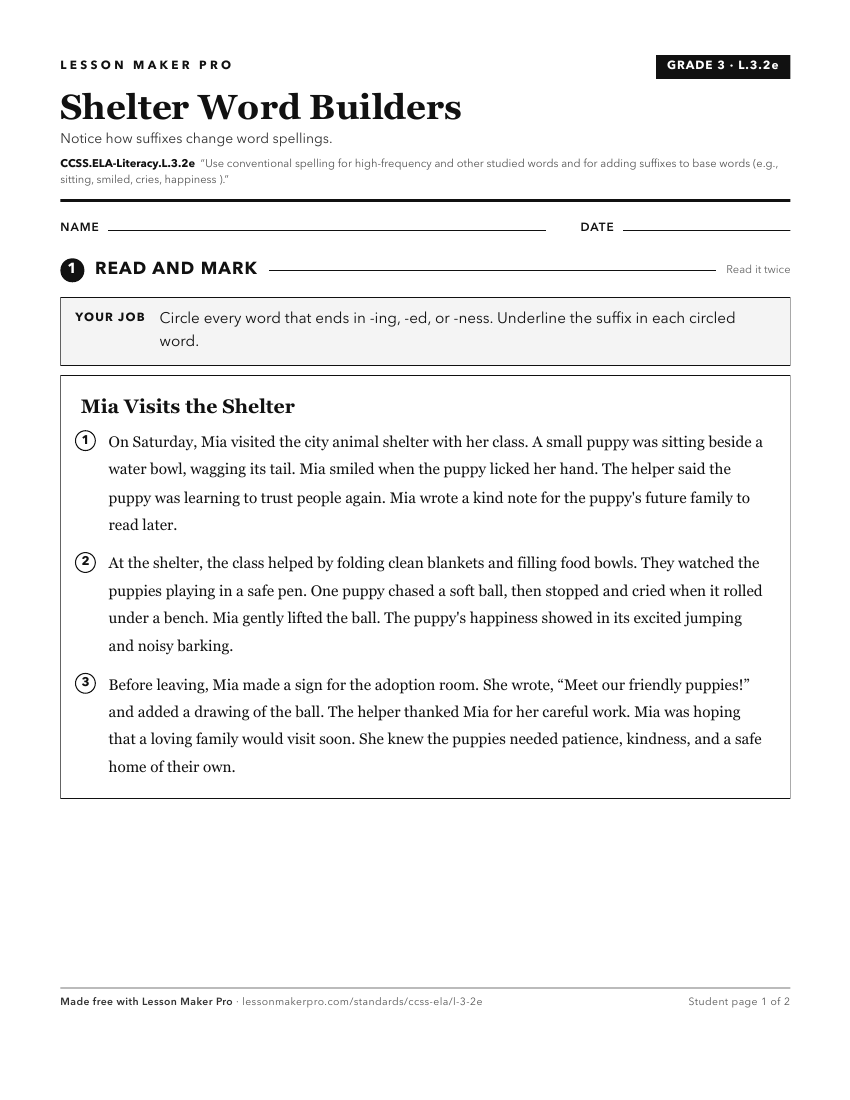
A ready-to-print activity worksheet aligned to CCSS.ELA-Literacy.L.3.2e, with an answer key for the teacher on its own page. No account needed.
PDF, US Letter, prints cleanly in black and white.
Download the worksheetLearning progression
Where This Standard Sits
Before This Standard
If students are struggling here, check these first.
Keep exploring
Related Standards
- CCSS.ELA-Literacy.L.1.2d
Use conventional spelling for words with common spelling patterns and for frequently occurring irregular words.
- CCSS.ELA-Literacy.L.3.2f
Use spelling patterns and generalizations (e.g., word families, position-based spellings, syllable patterns, ending rules, meaningful word parts) in writing wor...
- CCSS.ELA-Literacy.RF.K.3c
Read common high-frequency words by sight (e.g., the, of, to, you, she, my, is, are, do, does).
- CCSS.ELA-Literacy.L.2.2d
Generalize learned spelling patterns when writing words (e.g., cage → badge; boy → boil).
Turn this exact standard into a lesson
Grade, subject, topic, and the complete standard are prefilled. Create one free, no account needed.
Also for this standard:Make a WorksheetMake a QuizMake a Sub Lesson