CCSS.
The Standard
Identify frequently occurring root words (e.g., look) and their inflectional forms (e.g., looks, looked, looking).
Common Core State Standards for English Language Arts
Teacher's field guide
What This Standard Means
What Students Need to Do
- Students find the familiar base word inside words with endings such as s, ed, and ing. They connect each form to the same main meaning.
What Mastery Looks Like
- Students can find the base word in a group such as jump, jumps, jumped, and jumping. They can use each form in a sentence that shows its meaning.
Common Misconceptions
- Students may treat words like play, plays, played, and playing as unrelated words. They may also remove letters incorrectly, such as calling s the base of sing.
How to Assess It
- Give students help, helps, helped, helping, and held. Ask them to circle the four related words and underline the shared base word.
Lesson moves
Ways to Teach It
Give pairs base-word cards and ending tiles labeled s, ed, and ing, then have them build and read each new form.
Ask students to write three sentences showing what someone does every day, did yesterday, and is doing now.
Play a matching game where students pair base-word cards with forms such as walks, walked, and walking.
Use the class schedule to change walk to lunch into sentences about one student, yesterday, and right now.
Free download
Printable L.1.4c Worksheet
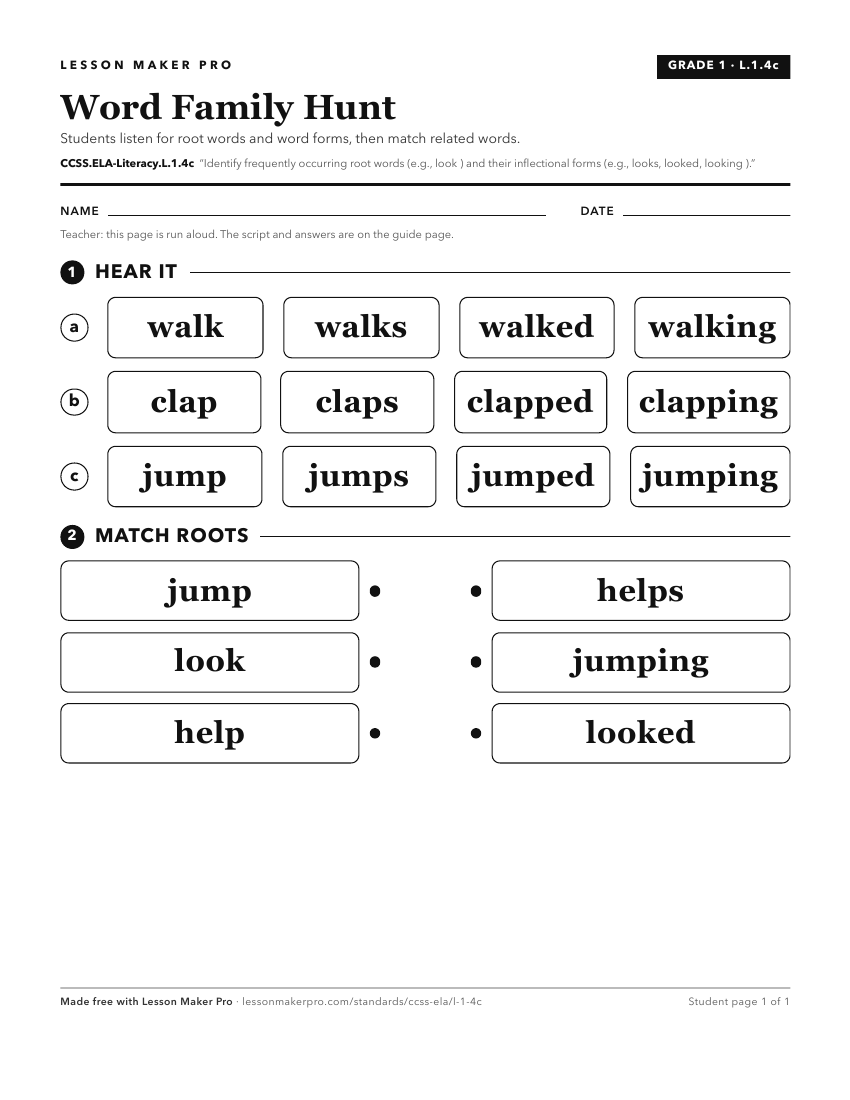
A ready-to-print activity worksheet aligned to CCSS.ELA-Literacy.L.1.4c, with an answer key for the teacher on its own page. No account needed.
PDF, US Letter, prints cleanly in black and white.
Download the worksheetLearning progression
Where This Standard Sits
What This Unlocks
Mastery here sets students up for these next.
Keep exploring
Related Standards
- CCSS.ELA-Literacy.RF.3.3a
Identify and know the meaning of the most common prefixes and derivational suffixes.
- CCSS.ELA-Literacy.L.K.4b
Use the most frequently occurring inflections and affixes (e.g., -ed, -s, re-, un-, pre-, -ful, -less) as a clue to the meaning of an unknown word.
- CCSS.ELA-Literacy.RF.1.3f
Read words with inflectional endings.
- CCSS.ELA-Literacy.L.1.4b
Use frequently occurring affixes as a clue to the meaning of a word.
Turn this exact standard into a lesson
Grade, subject, topic, and the complete standard are prefilled. Create one free, no account needed.
Also for this standard:Make a WorksheetMake a QuizMake a Sub Lesson