CCSS.
The Standard
Use a known root word as a clue to the meaning of an unknown word with the same root (e.g., addition, additional).
Common Core State Standards for English Language Arts
Teacher's field guide
What This Standard Means
What Students Need to Do
- Students find a familiar root inside an unfamiliar word. They use the root’s meaning to make a reasonable guess about the new word.
What Mastery Looks Like
- Students can underline the shared root in two related words. They use the known root to give a sensible meaning for the unfamiliar word and explain the connection.
Common Misconceptions
- Students may match words just because they share a few letters, such as car and care. They may also give the root’s exact meaning without considering the longer word.
How to Assess It
- Exit ticket: “Help means to give support. In ‘Mina is a helpful neighbor,’ what does helpful mean?” Have students circle the root and explain their answer.
Lesson moves
Ways to Teach It
Give pairs of word cards, such as paint and painter, and have students match them, circle the root, and explain each new word.
Ask students to write how knowing the meaning of teach helps them understand teacher.
Play Root Detective by showing one longer word at a time and awarding points for naming its root and predicting its meaning.
Collect related words from classroom signs, book covers, or lunch menus, then use familiar roots to explain the longer words.
Free download
Printable L.2.4c Worksheet
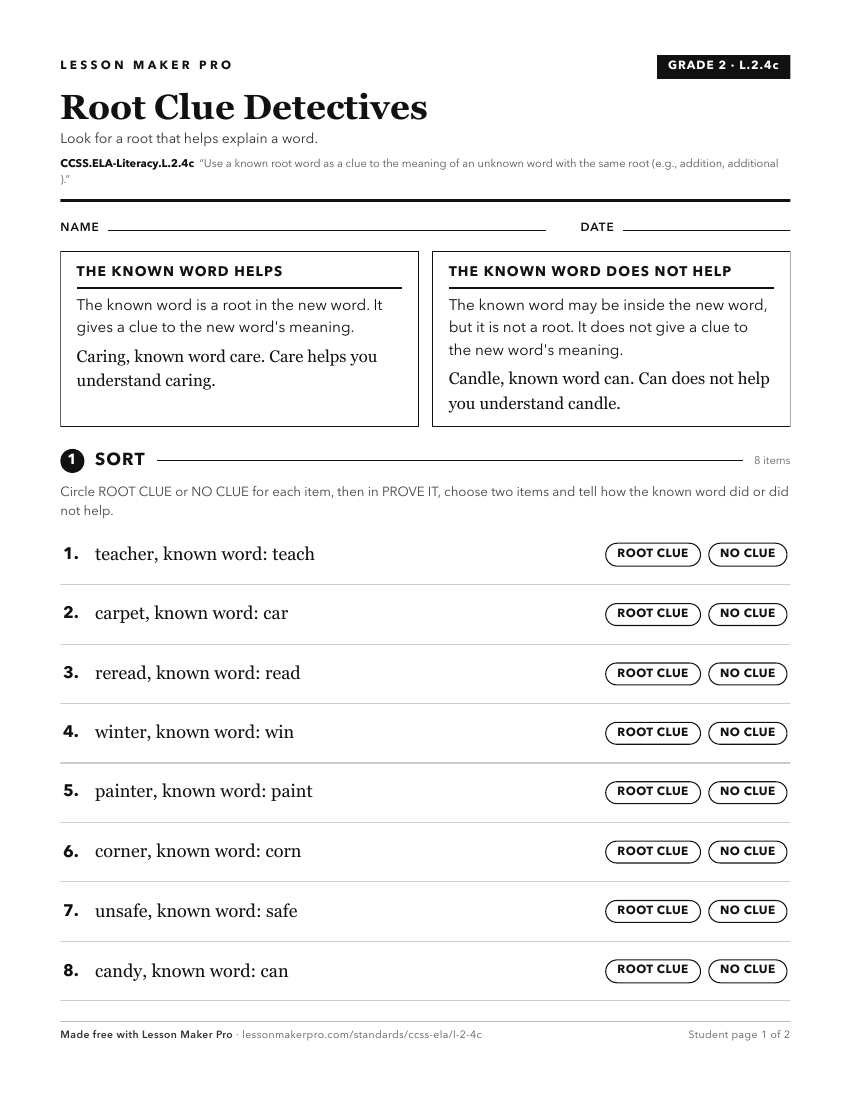
A ready-to-print activity worksheet aligned to CCSS.ELA-Literacy.L.2.4c, with an answer key for the teacher on its own page. No account needed.
PDF, US Letter, prints cleanly in black and white.
Download the worksheetLearning progression
Where This Standard Sits
Before This Standard
If students are struggling here, check these first.
What This Unlocks
Mastery here sets students up for these next.
Keep exploring
Related Standards
- CCSS.ELA-Literacy.L.5.4b
Use common, grade-appropriate Greek and Latin affixes and roots as clues to the meaning of a word (e.g., photograph, photosynthesis).
- CCSS.ELA-Literacy.L.8.4b
Use common, grade-appropriate Greek or Latin affixes and roots as clues to the meaning of a word (e.g., precede, recede, secede).
- CCSS.ELA-Literacy.L.1.4b
Use frequently occurring affixes as a clue to the meaning of a word.
Turn this exact standard into a lesson
Grade, subject, topic, and the complete standard are prefilled. Create one free, no account needed.
Also for this standard:Make a WorksheetMake a QuizMake a Sub Lesson