CCSS.
The Standard
Use frequently occurring affixes as a clue to the meaning of a word.
Common Core State Standards for English Language Arts
Teacher's field guide
What This Standard Means
What Students Need to Do
- Students spot a familiar beginning or ending added to a base word. They use the meaning of that word part to figure out the whole word.
What Mastery Looks Like
- Students identify the base word and the added beginning or ending. They use both parts to give a sensible meaning for words such as unhappy, replay, helpful, and careless.
Common Misconceptions
- Students may treat the added word part as a separate word or ignore the base word. They may also assume an affix has the same effect in every unfamiliar word.
How to Assess It
- Give students the words unhappy and helpful. Ask them to circle the added part and explain each word using the base word.
Lesson moves
Ways to Teach It
Give pairs base-word cards and affix tiles such as un, re, ful, and less, then have them build and illustrate new words.
Ask, “How does adding un to happy change the meaning?” and have students answer with a complete sentence.
Play Affix Match by having students pair words such as replay and careless with meaning cards such as play again and without care.
Collect classroom labels or book words with un, re, ful, or less, then discuss how each added part changes the meaning.
Free download
Printable L.1.4b Worksheet
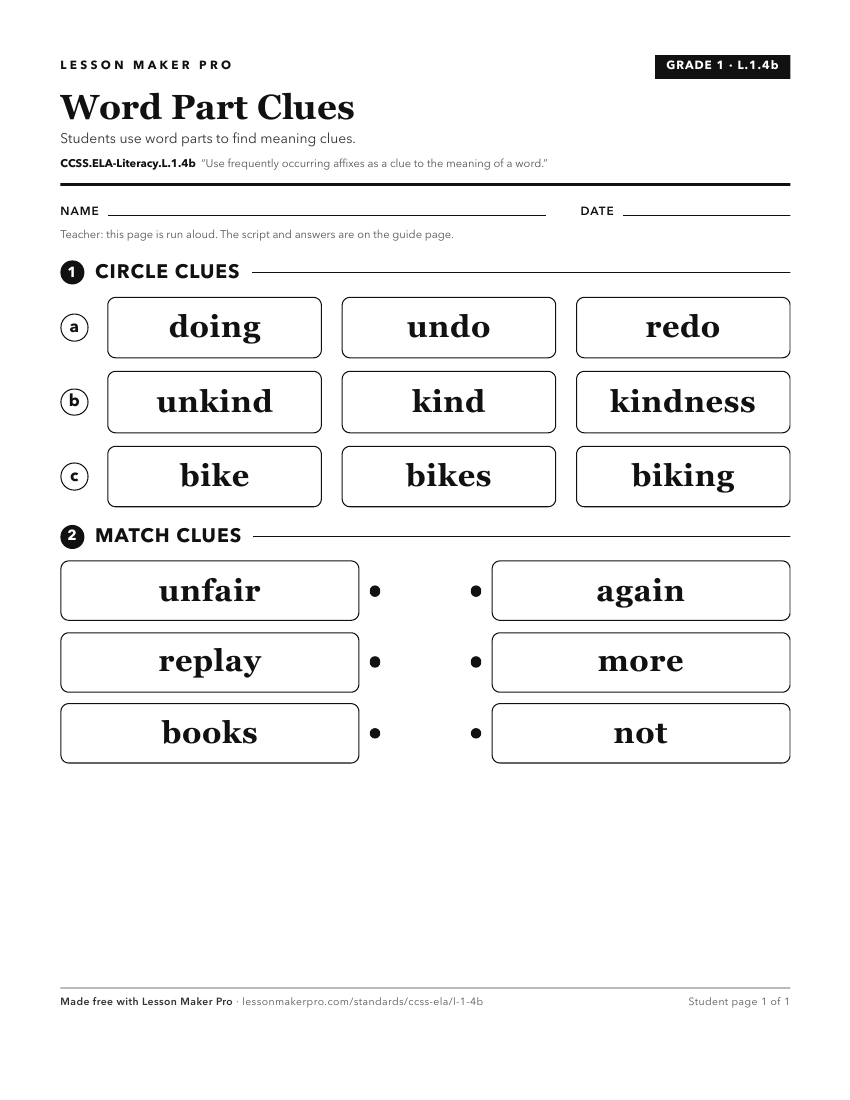
A ready-to-print activity worksheet aligned to CCSS.ELA-Literacy.L.1.4b, with an answer key for the teacher on its own page. No account needed.
PDF, US Letter, prints cleanly in black and white.
Download the worksheetLearning progression
Where This Standard Sits
Before This Standard
If students are struggling here, check these first.
What This Unlocks
Mastery here sets students up for these next.
Keep exploring
Related Standards
- CCSS.ELA-Literacy.L.2.4c
Use a known root word as a clue to the meaning of an unknown word with the same root (e.g., addition, additional).
- CCSS.ELA-Literacy.L.5.4b
Use common, grade-appropriate Greek and Latin affixes and roots as clues to the meaning of a word (e.g., photograph, photosynthesis).
- CCSS.ELA-Literacy.L.8.4b
Use common, grade-appropriate Greek or Latin affixes and roots as clues to the meaning of a word (e.g., precede, recede, secede).
Turn this exact standard into a lesson
Grade, subject, topic, and the complete standard are prefilled. Create one free, no account needed.
Also for this standard:Make a WorksheetMake a QuizMake a Sub Lesson