CCSS.
The Standard
Determine the meaning of the new word formed when a known prefix is added to a known word (e.g., happy/unhappy, tell/retell).
Common Core State Standards for English Language Arts
Teacher's field guide
What This Standard Means
What Students Need to Do
- Students identify a familiar word inside a longer word. They use the added prefix, such as un- or re-, to work out the new meaning.
What Mastery Looks Like
- Students can split words such as unhappy and retell into a prefix and base word. They can define the new word and explain how the prefix changes the meaning.
Common Misconceptions
- Students may treat the prefix and base word as one whole word instead of separating them. They may confuse un- with re-, or think every word beginning with those letters has a prefix.
How to Assess It
- Give students this exit ticket: “If wrap means to cover something, what does unwrap mean? Circle the prefix and explain your answer.”
Lesson moves
Ways to Teach It
Give pairs prefix cards, base-word cards, and sticky notes, then have them build words and write each new meaning.
Ask students to explain in writing how reread differs from read and how unhappy differs from happy.
Play Prefix Match, where students match un- and re- word cards to meaning cards, then read each completed pair aloud.
Show everyday directions such as refill, untie, and rewrite, then have students act out each word and identify the prefix.
Free download
Printable L.2.4b Worksheet
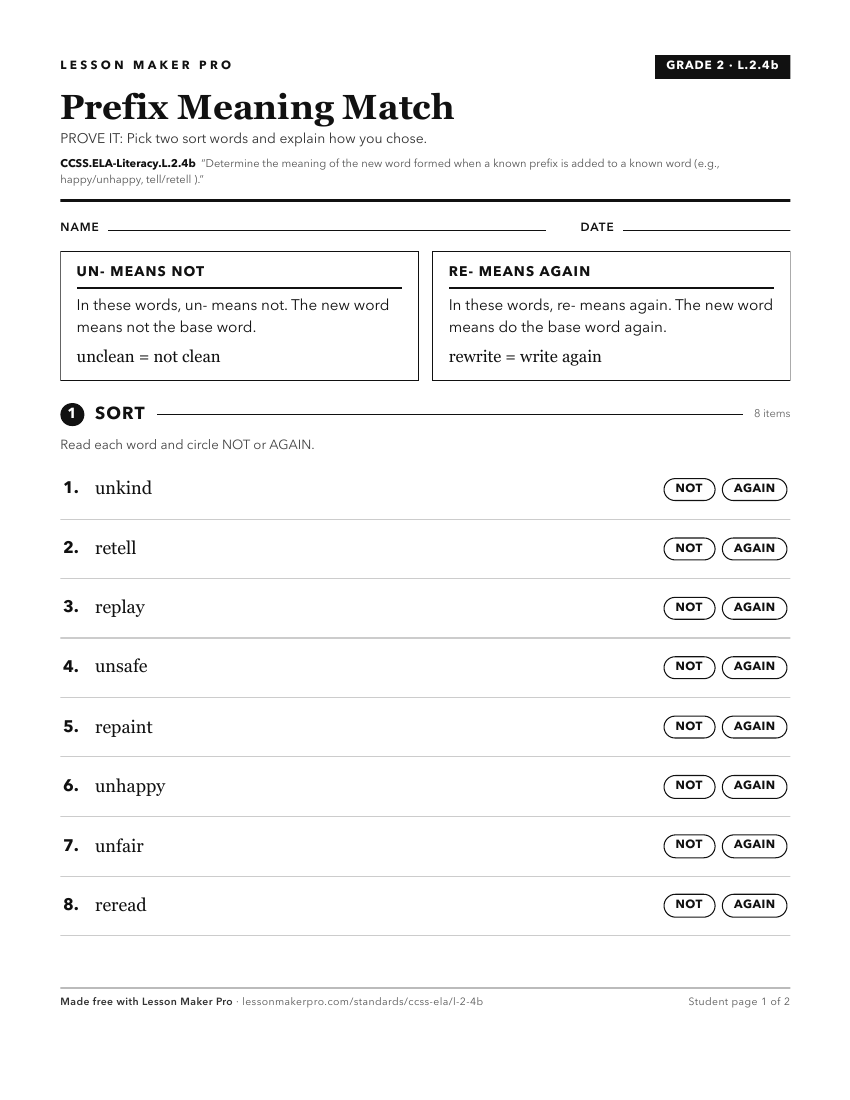
A ready-to-print activity worksheet aligned to CCSS.ELA-Literacy.L.2.4b, with an answer key for the teacher on its own page. No account needed.
PDF, US Letter, prints cleanly in black and white.
Download the worksheetLearning progression
Where This Standard Sits
Before This Standard
If students are struggling here, check these first.
What This Unlocks
Mastery here sets students up for these next.
Keep exploring
Related Standards
- CCSS.ELA-Literacy.RF.3.3a
Identify and know the meaning of the most common prefixes and derivational suffixes.
- CCSS.ELA-Literacy.L.2.4c
Use a known root word as a clue to the meaning of an unknown word with the same root (e.g., addition, additional).
- CCSS.ELA-Literacy.L.K.4b
Use the most frequently occurring inflections and affixes (e.g., -ed, -s, re-, un-, pre-, -ful, -less) as a clue to the meaning of an unknown word.
Turn this exact standard into a lesson
Grade, subject, topic, and the complete standard are prefilled. Create one free, no account needed.
Also for this standard:Make a WorksheetMake a QuizMake a Sub Lesson