CCSS.
The Standard
Identify and know the meaning of the most common prefixes and derivational suffixes.
Common Core State Standards for English Language Arts
Teacher's field guide
What This Standard Means
What Students Need to Do
- Students recognize common prefixes and suffixes in words and explain what those parts mean. They use those meanings to work out new words and notice when a suffix changes a word's role.
What Mastery Looks Like
- Students separate a familiar word into its base and affix, then explain what each part contributes. They use affix meanings to define unfamiliar words and create new words correctly.
Common Misconceptions
- Students may treat every word beginning or ending with familiar letters as having an affix, such as uncle or corner. They may also know how an affix sounds but not how it changes meaning or word class.
How to Assess It
- Use this exit ticket: Add a prefix or suffix to kind, write the new word, and explain how the affix changes its meaning.
Lesson moves
Ways to Teach It
Give pairs word-part cards, such as un, re, help, and ful, then have students build words and explain each meaning.
Ask students to compare careless and careful in writing, including what the suffix changes in each word.
Play Affix Match by having students pair word cards with meaning cards, then use each matched word in a sentence.
Collect signs, labels, or headlines containing affixed words, then have students circle each affix and explain the word's meaning.
Free download
Printable RF.3.3a Worksheet
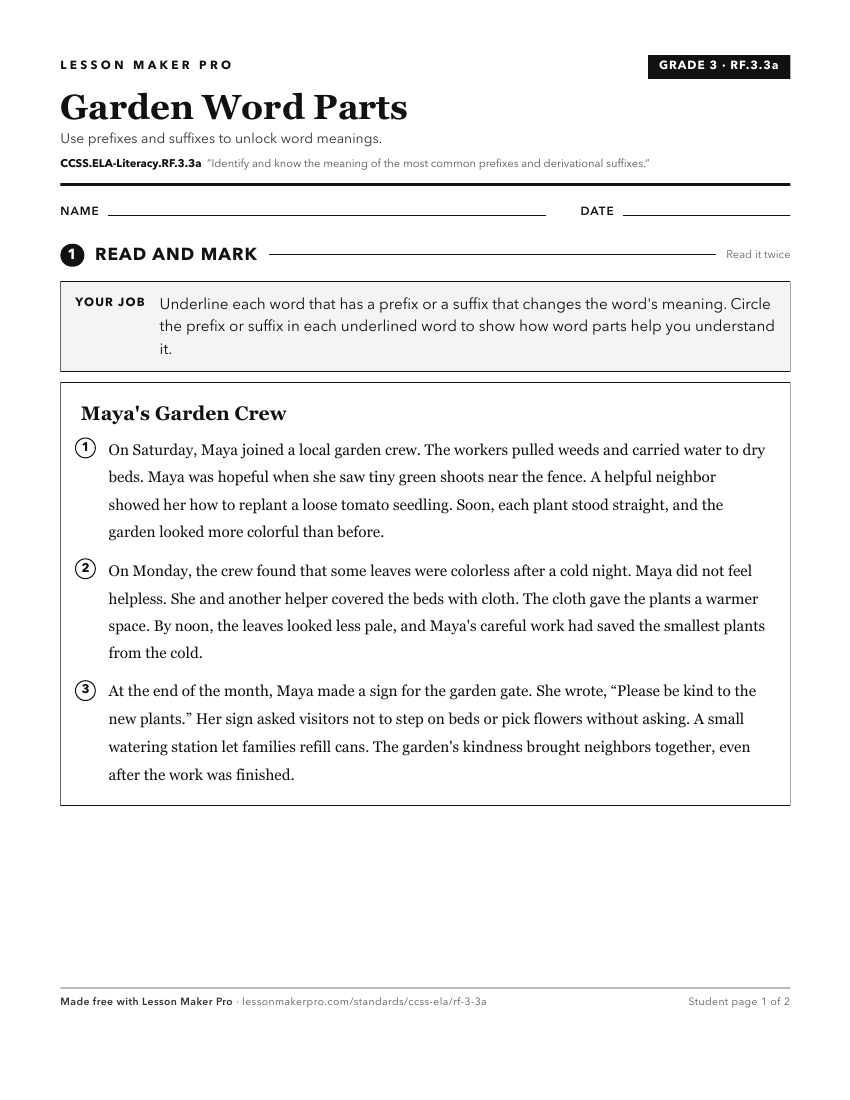
A ready-to-print activity worksheet aligned to CCSS.ELA-Literacy.RF.3.3a, with an answer key for the teacher on its own page. No account needed.
PDF, US Letter, prints cleanly in black and white.
Download the worksheetLearning progression
Where This Standard Sits
What This Unlocks
Mastery here sets students up for these next.
Keep exploring
Related Standards
- CCSS.ELA-Literacy.L.5.4b
Use common, grade-appropriate Greek and Latin affixes and roots as clues to the meaning of a word (e.g., photograph, photosynthesis).
- CCSS.ELA-Literacy.L.K.4b
Use the most frequently occurring inflections and affixes (e.g., -ed, -s, re-, un-, pre-, -ful, -less) as a clue to the meaning of an unknown word.
- CCSS.ELA-Literacy.L.8.4b
Use common, grade-appropriate Greek or Latin affixes and roots as clues to the meaning of a word (e.g., precede, recede, secede).
- CCSS.ELA-Literacy.RF.2.3d
Decode words with common prefixes and suffixes.
Turn this exact standard into a lesson
Grade, subject, topic, and the complete standard are prefilled. Create one free, no account needed.
Also for this standard:Make a WorksheetMake a QuizMake a Sub Lesson