CCSS.
The Standard
Read words with inflectional endings.
Common Core State Standards for English Language Arts
Teacher's field guide
What This Standard Means
What Students Need to Do
- Students find a familiar base word inside a longer word. They blend endings such as -s, -es, -ed, and -ing with the base word.
What Mastery Looks Like
- Students read words such as jumps, wishes, played, helped, and running accurately. They recognize the base word and use the ending to understand the word.
Common Misconceptions
- Students may read jumped as jump or pronounce every -ed ending as /ed/. They may miss the base word when its spelling changes in running or making.
How to Assess It
- Give students the words jumps, wishes, played, helped, and running. Ask them to underline each ending and read every word aloud.
Lesson moves
Ways to Teach It
Use letter tiles to build jump, jumps, jumped, and jumping, then have students read each form aloud.
Write and answer: How does adding -ed or -ing change the action in played and playing?
Play an ending sort with word cards labeled -s, -es, -ed, and -ing, then read each sorted word.
Read a lunch menu or class note, circle words with endings, and read them aloud.
Free download
Printable RF.1.3f Worksheet
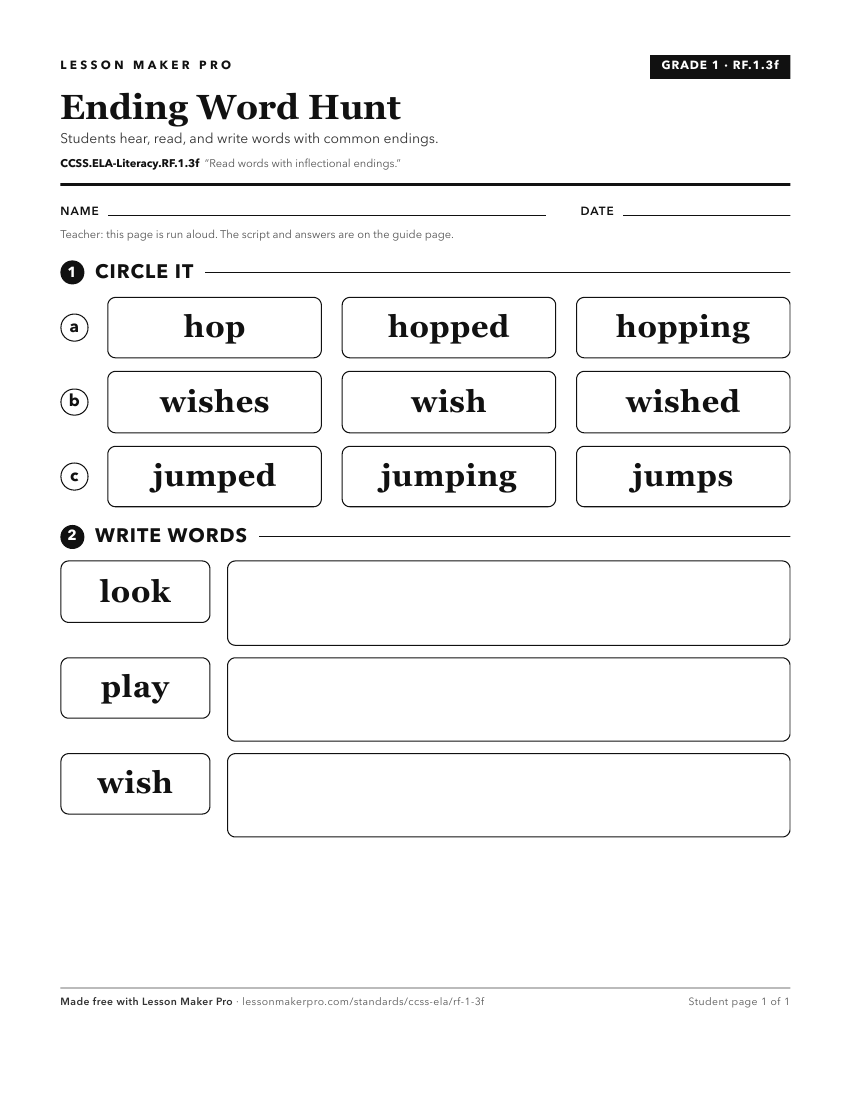
A ready-to-print activity worksheet aligned to CCSS.ELA-Literacy.RF.1.3f, with an answer key for the teacher on its own page. No account needed.
PDF, US Letter, prints cleanly in black and white.
Download the worksheetKeep exploring
Related Standards
- CCSS.ELA-Literacy.RF.3.3b
Decode words with common Latin suffixes.
- CCSS.ELA-Literacy.L.K.4b
Use the most frequently occurring inflections and affixes (e.g., -ed, -s, re-, un-, pre-, -ful, -less) as a clue to the meaning of an unknown word.
- CCSS.ELA-Literacy.RF.3.3d
Read grade-appropriate irregularly spelled words.
- CCSS.ELA-Literacy.L.1.4c
Identify frequently occurring root words (e.g., look) and their inflectional forms (e.g., looks, looked, looking).
Turn this exact standard into a lesson
Grade, subject, topic, and the complete standard are prefilled. Create one free, no account needed.
Also for this standard:Make a WorksheetMake a QuizMake a Sub Lesson