CCSS.
The Standard
Read grade-appropriate irregularly spelled words.
Common Core State Standards for English Language Arts
Teacher's field guide
What This Standard Means
What Students Need to Do
- Students recognize and pronounce common words that do not follow expected spelling patterns. They use familiar word parts, memory, and sentence meaning to read them accurately.
What Mastery Looks Like
- Students read common exception words accurately in lists and sentences. They recognize the words quickly and self-correct when a pronunciation does not fit the sentence.
Common Misconceptions
- Students may force regular phonics rules onto words such as “does” or “enough.” They may also confuse similar words, including “though,” “through,” and “thought.”
How to Assess It
- Ask each student to read these words aloud: answer, enough, though, thought, brought, does, young, and once. Note accuracy and hesitation.
Lesson moves
Ways to Teach It
Give students word cards and counters, then have them cover or mark the letters that do not match expected sounds.
Ask students to choose one tricky word and write which letters help them remember its pronunciation.
Play irregular word bingo by calling words, using each one in a sentence, and having students read matched cards aloud.
Have students find tricky words on classroom signs, lunch menus, or school notices, then read each word in context.
Free download
Printable RF.3.3d Worksheet
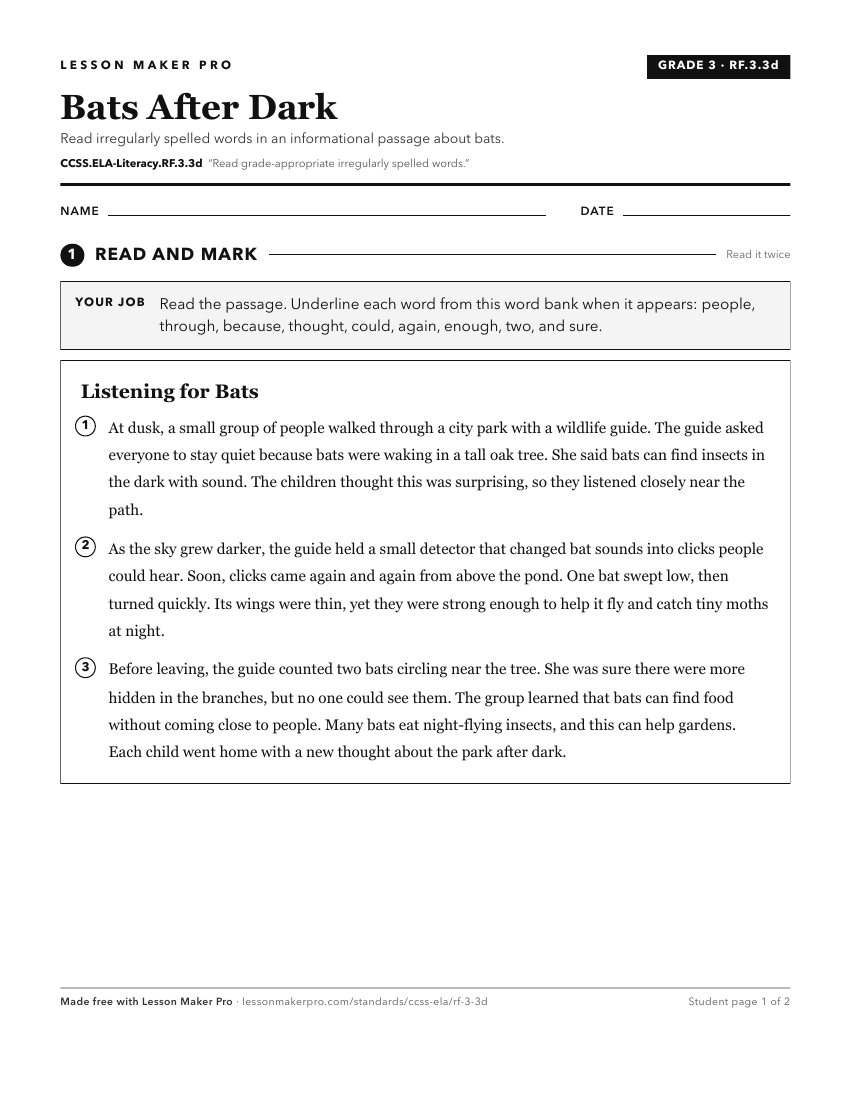
A ready-to-print activity worksheet aligned to CCSS.ELA-Literacy.RF.3.3d, with an answer key for the teacher on its own page. No account needed.
PDF, US Letter, prints cleanly in black and white.
Download the worksheetKeep exploring
Related Standards
- CCSS.ELA-Literacy.RF.1.3g
Recognize and read grade-appropriate irregularly spelled words.
- CCSS.ELA-Literacy.L.5.2e
Spell grade-appropriate words correctly, consulting references as needed.
- CCSS.ELA-Literacy.RF.2.3f
Recognize and read grade-appropriate irregularly spelled words.
- CCSS.ELA-Literacy.L.4.2d
Spell grade-appropriate words correctly, consulting references as needed.
Turn this exact standard into a lesson
Grade, subject, topic, and the complete standard are prefilled. Create one free, no account needed.
Also for this standard:Make a WorksheetMake a QuizMake a Sub Lesson