Alabama Science P.2
Standard Cluster
Construct explanations of dynamics from evidence, using Newton’s laws of motion. a. Evaluate the effects of balanced and unbalanced forces on an object’s motion. b. Use mathematical, graphical, and narrative methods to explain the relationships among net force, mass, and acceleration of a single object. c. Create free and fixed body diagrams to model all the forces acting on a single object. d. Create an explanation of the nature of forces and the interactions among them, including tension, friction, gravitation, and normal forces, using free-body diagrams. e. Analyze data to identify the pair of equal and opposite forces between two interacting bodies and relate their magnitudes and directions using Newton’s third law.
2023 Alabama Course of Study: Science · Motion and Stability: Forces and Interactions
Cluster contents
Standards in This Cluster
P.2 is a cluster heading. These are the individual standards under it.
- P.2.a
Evaluate the effects of balanced and unbalanced forces on an object’s motion.
- P.2.b
Use mathematical, graphical, and narrative methods to explain the relationships among net force, mass, and acceleration of a single object.
- P.2.c
Create free and fixed body diagrams to model all the forces acting on a single object.
- P.2.d
Create an explanation of the nature of forces and the interactions among them, including tension, friction, gravitation, and normal forces, using free-body diag...
- P.2.e
Analyze data to identify the pair of equal and opposite forces between two interacting bodies and relate their magnitudes and directions using Newton’s third la...
Teacher's field guide
What This Cluster Means
What Students Need to Do
- Use force and motion data to explain why an object speeds up, slows down, or keeps a steady velocity. Draw free-body and fixed-body diagrams. Use net force, mass, acceleration, and graphs to support their explanations.
What Mastery Looks Like
- Given cart data, a student labels tension, friction, weight, and normal force on force diagrams. They calculate acceleration from net force and explain what a force versus acceleration graph shows. They identify equal and opposite forces acting on two different objects.
Common Misconceptions
- Students may think a moving object needs a forward net force, even when its velocity is steady. They may put a third-law pair on one object’s diagram or confuse weight with the table’s upward push. Some assume friction always equals the applied force.
How to Assess It
- Exit ticket: A 2 kg cart is pulled right with 10 N, and friction acts left with 4 N. Draw a free-body diagram, calculate its acceleration, and name the force paired with the rope’s pull on the cart.
Lesson moves
Ways to Teach It
Pull an empty cart and a loaded cart with the same spring-scale reading, then time each over a marked distance.
Sketch a book on a table and explain whether its weight and the table’s upward push are a third-law pair.
Give pairs cards labeled Earth pulls book, book pulls Earth, table pushes book, and book pushes table; have them match third-law pairs.
Sketch a standing passenger on a braking bus, then label the floor’s friction force and explain why the passenger lurches forward.
Free download
Printable P.2 Worksheet
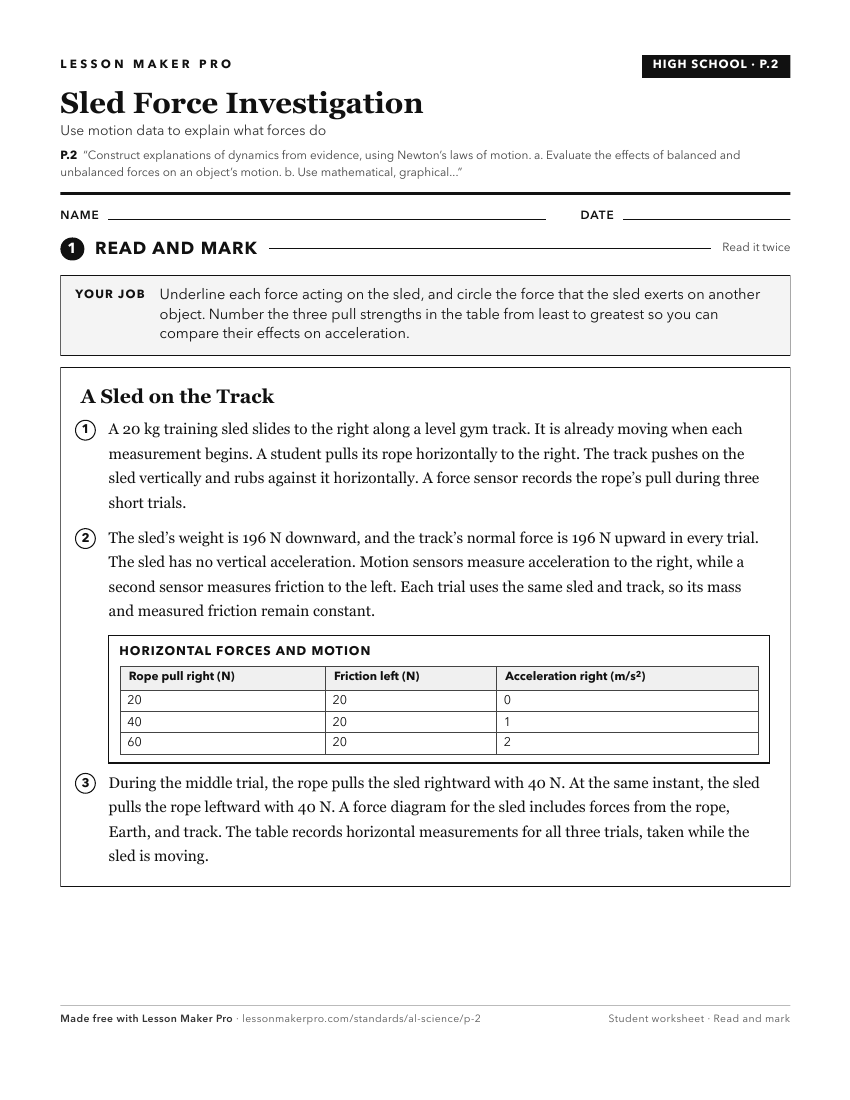
A ready-to-print activity worksheet aligned to P.2, with an answer key for the teacher on its own page. No account needed.
PDF, US Letter, prints cleanly in black and white.
Download the worksheetKeep exploring
Related Standards
- 8.11
Use models to demonstrate each of Newton’s laws of motion and explain the effect of net force on objects.
- ESS.5.c
Construct explanations from evidence of how the flow of energy through Earth's systems has changed over time.
- 8.10
Develop and use models to illustrate how individual external forces affect the motion of objects.
Turn this cluster into a lesson
Grade, subject, topic, and the complete cluster are prefilled. Create one free, no account needed.
Also for this cluster:Make a WorksheetMake a QuizMake a Sub Lesson