Alabama Science K.2
The Standard
Analyze data from investigations to determine whether a design solution provides sufficient force to change the speed or direction of an object.
2023 Alabama Course of Study: Science · Motion and Stability: Forces and Interactions
Teacher's field guide
What This Standard Means
What Students Need to Do
- Students test a design meant to change a moving object's speed or direction. They record what happens in repeated trials and use those results to decide whether the design works.
What Mastery Looks Like
- A student can point to car-path drawings and say, 'The bumper turned the car in all three tests.' If the car keeps going straight, they can explain that the bumper did not work.
Common Misconceptions
- Students may think a bumper worked just because the car touched it, even if the car kept going straight. They may judge a design by one lucky test instead of looking at all the trials.
How to Assess It
- Show two three-trial car-path charts: bumper A turns the car each time, while bumper B lets it go straight. Ask, 'Which bumper can turn the car? Show me the results that prove it.'
Lesson moves
Ways to Teach It
Build an angled cardboard bumper, roll a toy car down the same ramp three times, and draw its path after each hit.
Compare two bumper test charts and ask, 'Which bumper kept the car away from the paper house every time? How do you know?'
Play Bumper Detective by sorting three-trial car-path cards into 'turns every time' and 'needs fixing' piles.
Show a photo of a roadside guardrail, then have students draw arrows showing how it could turn a toy car away from the road's edge.
Free download
Printable K.2 Worksheet
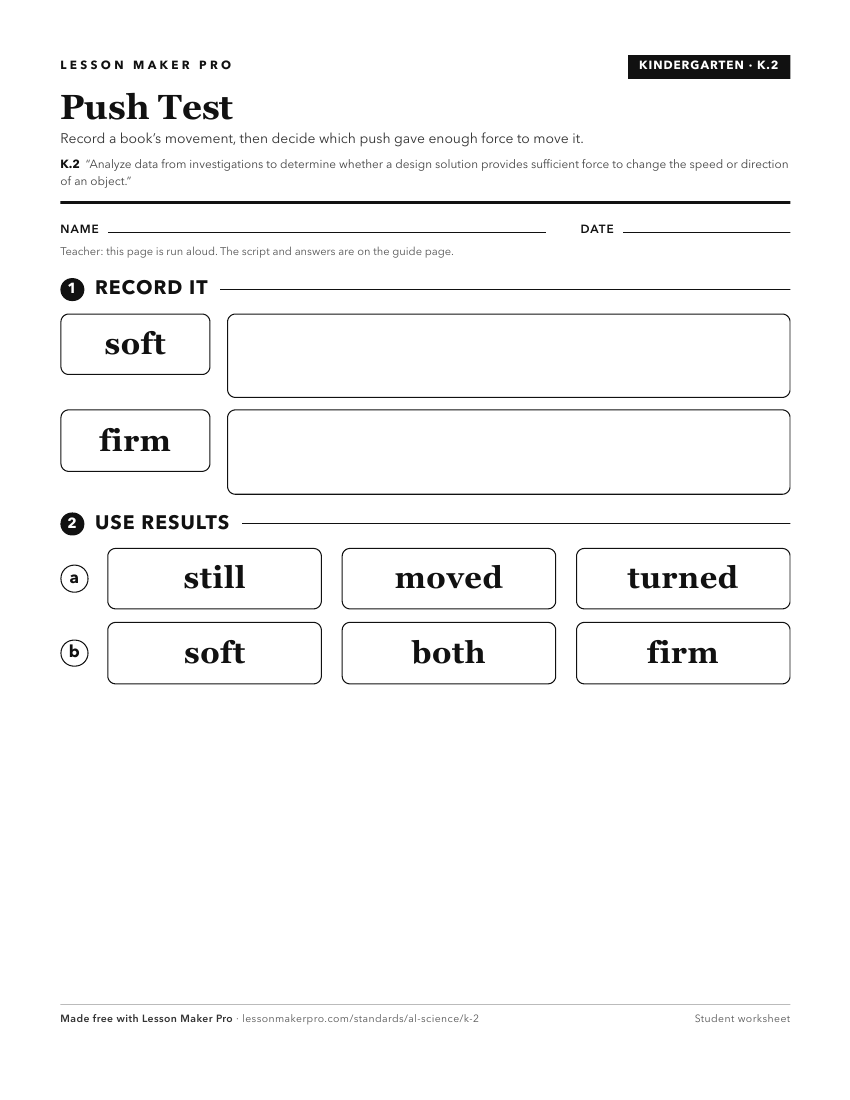
A ready-to-print activity worksheet aligned to K.2, with an answer key for the teacher on its own page. No account needed.
PDF, US Letter, prints cleanly in black and white.
Download the worksheetKeep exploring
Related Standards
- K.1
Plan and carry out investigations to determine the effects of forces of different strengths and directions on the motion of an object, including speed, directio...
- 3.1
Conduct investigations to explain the effects of balanced and unbalanced forces exerted on an object, varying the size, number, and direction of the forces.
- 8.9
Use data from an investigation to identify factors that affect acceleration.
- 4.2
Plan and carry out investigations to answer questions regarding changes in energy when objects collide, and predict reasonable outcomes based on observed patter...
Turn this exact standard into a lesson
Grade, subject, topic, and the complete standard are prefilled. Create one free, no account needed.
Also for this standard:Make a WorksheetMake a QuizMake a Sub Lesson